

conservation hypothesis postulates that electricity conservation policies designed to reduce electricity consumption and waste may not have an adverse impact
on economic growth. The conservation hypothesis is
confirmed if there is unidirectional causality from
economic growth to electricity consumption. Third,
the feedback hypothesis emphasizes the interdependent relationship between electricity consumption and
economic growth and their complementarity. The presence of bidirectional causality between electricity
consumption and economic growth lends support for
the feedback hypothesis. Finally, the neutrality hypothesis considers electricity consumption to be a small
component of an economy’s overall output and thus
may have little or no impact on economic growth.
Similar to the conservation hypothesis, electricity conservation policies may not have an adverse impact on
economic growth under the neutrality hypothesis. The
neutrality hypothesis is supported by the absence of
a causal relationship between electricity consumption
and economic growth (Apergis & Payne 2010). The
hypothesis for this transmission mechanism is given
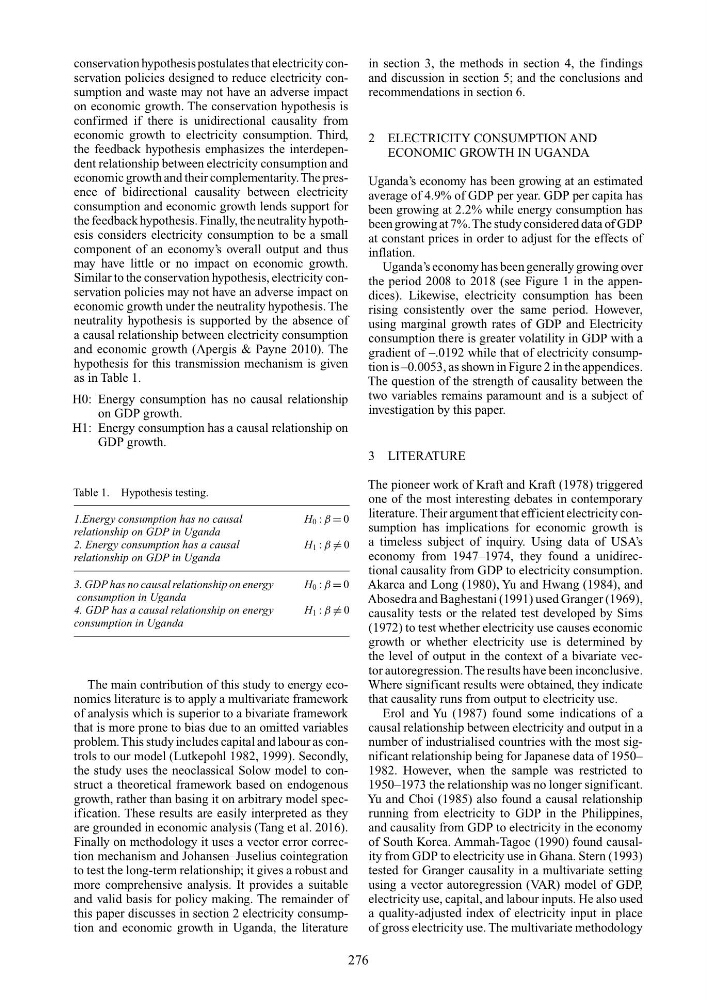
as in Table 1.
H0: Energy consumption has no causal relationship
on GDP growth.
H1: Energy consumption has a causal relationship on
GDP growth.
Table 1. Hypothesis testing.
1.Energy consumption has no causal
relationship on GDP in Uganda
H 0 : β = 0
2. Energy consumption has a causal
relationship on GDP in Uganda
H 1 : β = 0
3. GDP has no causal relationship on energy
consumption in Uganda
H 0 : β = 0
4. GDP has a causal relationship on energy
consumption in Uganda
H 1 : β = 0
The main contribution of this study to energy economics literature is to apply a multivariate framework
of analysis which is superior to a bivariate framework
that is more prone to bias due to an omitted variables
problem. This study includes capital and labour as controls to our model (Lutkepohl 1982, 1999). Secondly,
the study uses the neoclassical Solow model to construct a theoretical framework based on endogenous
growth, rather than basing it on arbitrary model specification. These results are easily interpreted as they
are grounded in economic analysis (Tang et al. 2016).
Finally on methodology it uses a vector error correction mechanism and Johansen–Juselius cointegration
to test the long-term relationship; it gives a robust and
more comprehensive analysis. It provides a suitable
and valid basis for policy making. The remainder of
this paper discusses in section 2 electricity consumption and economic growth in Uganda, the literature
in section 3, the methods in section 4, the findings
and discussion in section 5; and the conclusions and
recommendations in section 6.
2 ELECTRICITY CONSUMPTION AND
ECONOMIC GROWTH IN UGANDA
Uganda’s economy has been growing at an estimated
average of 4.9% of GDP per year. GDP per capita has
been growing at 2.2% while energy consumption has
been growing at 7%.The study considered data of GDP
at constant prices in order to adjust for the effects of
inflation.
Uganda’s economy has been generally growing over
the period 2008 to 2018 (see Figure 1 in the appendices). Likewise, electricity consumption has been
rising consistently over the same period. However,
using marginal growth rates of GDP and Electricity
consumption there is greater volatility in GDP with a
gradient of –.0192 while that of electricity consumption is –0.0053, as shown in Figure 2 in the appendices.
The question of the strength of causality between the
two variables remains paramount and is a subject of
investigation by this paper.
3 LITERATURE
The pioneer work of Kraft and Kraft (1978) triggered
one of the most interesting debates in contemporary
literature. Their argument that efficient electricity consumption has implications for economic growth is
a timeless subject of inquiry. Using data of USA’s
economy from 1947–1974, they found a unidirectional causality from GDP to electricity consumption.
Akarca and Long (1980), Yu and Hwang (1984), and
Abosedra and Baghestani (1991) used Granger (1969),
causality tests or the related test developed by Sims
(1972) to test whether electricity use causes economic
growth or whether electricity use is determined by
the level of output in the context of a bivariate vector autoregression. The results have been inconclusive.
Where significant results were obtained, they indicate
that causality runs from output to electricity use.
Erol and Yu (1987) found some indications of a
causal relationship between electricity and output in a
number of industrialised countries with the most significant relationship being for Japanese data of 1950–
1982. However, when the sample was restricted to
1950–1973 the relationship was no longer significant.
Yu and Choi (1985) also found a causal relationship
running from electricity to GDP in the Philippines,
and causality from GDP to electricity in the economy
of South Korea. Ammah-Tagoe (1990) found causality from GDP to electricity use in Ghana. Stern (1993)
tested for Granger causality in a multivariate setting
using a vector autoregression (VAR) model of GDP,
electricity use, capital, and labour inputs. He also used
a quality-adjusted index of electricity input in place
of gross electricity use. The multivariate methodology
276
on economic growth. The conservation hypothesis is
confirmed if there is unidirectional causality from
economic growth to electricity consumption. Third,
the feedback hypothesis emphasizes the interdependent relationship between electricity consumption and
economic growth and their complementarity. The presence of bidirectional causality between electricity
consumption and economic growth lends support for
the feedback hypothesis. Finally, the neutrality hypothesis considers electricity consumption to be a small
component of an economy’s overall output and thus
may have little or no impact on economic growth.
Similar to the conservation hypothesis, electricity conservation policies may not have an adverse impact on
economic growth under the neutrality hypothesis. The
neutrality hypothesis is supported by the absence of
a causal relationship between electricity consumption
and economic growth (Apergis & Payne 2010). The
hypothesis for this transmission mechanism is given
as in Table 1.
H0: Energy consumption has no causal relationship
on GDP growth.
H1: Energy consumption has a causal relationship on
GDP growth.
Table 1. Hypothesis testing.
1.Energy consumption has no causal
relationship on GDP in Uganda
H 0 : β = 0
2. Energy consumption has a causal
relationship on GDP in Uganda
H 1 : β = 0
3. GDP has no causal relationship on energy
consumption in Uganda
H 0 : β = 0
4. GDP has a causal relationship on energy
consumption in Uganda
H 1 : β = 0
The main contribution of this study to energy economics literature is to apply a multivariate framework
of analysis which is superior to a bivariate framework
that is more prone to bias due to an omitted variables
problem. This study includes capital and labour as controls to our model (Lutkepohl 1982, 1999). Secondly,
the study uses the neoclassical Solow model to construct a theoretical framework based on endogenous
growth, rather than basing it on arbitrary model specification. These results are easily interpreted as they
are grounded in economic analysis (Tang et al. 2016).
Finally on methodology it uses a vector error correction mechanism and Johansen–Juselius cointegration
to test the long-term relationship; it gives a robust and
more comprehensive analysis. It provides a suitable
and valid basis for policy making. The remainder of
this paper discusses in section 2 electricity consumption and economic growth in Uganda, the literature
in section 3, the methods in section 4, the findings
and discussion in section 5; and the conclusions and
recommendations in section 6.
2 ELECTRICITY CONSUMPTION AND
ECONOMIC GROWTH IN UGANDA
Uganda’s economy has been growing at an estimated
average of 4.9% of GDP per year. GDP per capita has
been growing at 2.2% while energy consumption has
been growing at 7%.The study considered data of GDP
at constant prices in order to adjust for the effects of
inflation.
Uganda’s economy has been generally growing over
the period 2008 to 2018 (see Figure 1 in the appendices). Likewise, electricity consumption has been
rising consistently over the same period. However,
using marginal growth rates of GDP and Electricity
consumption there is greater volatility in GDP with a
gradient of –.0192 while that of electricity consumption is –0.0053, as shown in Figure 2 in the appendices.
The question of the strength of causality between the
two variables remains paramount and is a subject of
investigation by this paper.
3 LITERATURE
The pioneer work of Kraft and Kraft (1978) triggered
one of the most interesting debates in contemporary
literature. Their argument that efficient electricity consumption has implications for economic growth is
a timeless subject of inquiry. Using data of USA’s
economy from 1947–1974, they found a unidirectional causality from GDP to electricity consumption.
Akarca and Long (1980), Yu and Hwang (1984), and
Abosedra and Baghestani (1991) used Granger (1969),
causality tests or the related test developed by Sims
(1972) to test whether electricity use causes economic
growth or whether electricity use is determined by
the level of output in the context of a bivariate vector autoregression. The results have been inconclusive.
Where significant results were obtained, they indicate
that causality runs from output to electricity use.
Erol and Yu (1987) found some indications of a
causal relationship between electricity and output in a
number of industrialised countries with the most significant relationship being for Japanese data of 1950–
1982. However, when the sample was restricted to
1950–1973 the relationship was no longer significant.
Yu and Choi (1985) also found a causal relationship
running from electricity to GDP in the Philippines,
and causality from GDP to electricity in the economy
of South Korea. Ammah-Tagoe (1990) found causality from GDP to electricity use in Ghana. Stern (1993)
tested for Granger causality in a multivariate setting
using a vector autoregression (VAR) model of GDP,
electricity use, capital, and labour inputs. He also used
a quality-adjusted index of electricity input in place
of gross electricity use. The multivariate methodology
276