

exhibited high uptake capacity (Loh et.al., 2009).
El-sharkawy et al. (2009) observed that Maxsorb
III/methanol pair has superiority among other carbonaceous adsorbent/methanol pair for both air conditioning and ice making with adsorption capacity 1.76 times
than that of activated charcoal/methanol. Allouhi et al.
(2015) had similar observation for activated carbon
fibre/methanol pair in which the optimal uptake was
0.3406 kg/kg whereas the maximum specific COP was
about 0.384 for silica gel/water.
5.2.1 Coated adsorbers
The utilization of coated adsorbers is particularly
suited for applications where high COP is not as important as high SCP. This technology improves the wall
heat transfer coefficient by effectively decreasing the
contact thermal resistance between the heat exchange
surface and the adsorbent. Its main disadvantage is
a very high ratio between the inert mass and the
adsorbent mass, which spoils the COP. In order to overcome this drawback, very effective heat management
is required.
5.2.2 Consolidated and composite adsorbents
Consolidated adsorbents with high thermal conductivity can be considered as the most promising alternative
to enhance the heat transfer within the adsorber. Wang
et al. (2004) developed a consolidated compound made
Table 2. Comparison between adsorption working pairs.
T evp
T d
SCP
Ref
Working pair
COP
(
◦ )
(
◦ )
(w/Kg)
Physical adsorbents
Activated Carbon/Ammonia
0.61
−5
100
2000
Activated Carbon/Methanol
0.78
15
90
16
Activated Carbon/Ethanol
0.8
3
80
N.A
Silica gel/Water
0.61
12
82
208
Chemical adsorbents
Metal chloride/Ammonia
0.6
−10
52
NA
Metalhydride/Hydrogen
0.83
−50
85
300
Metal Oxides/Water
N.A
100
200
78
Composite adsorbents
Silica gel and chlorides/water
1.65
7
70
N.A
Silica gel and chlorides/methanol
0.33
−10
47
N.A
Chlorides and porous media/ammonia
0.35
−15
117.5
493.5
Zeolite and foam aluminum/water
0.55
10
250
500
Table 3. Typical research on solar adsorption systems.
Ref.
Yr.
Application
Working pair 7
COP
T evp (
◦ C)
Type
Sumathy
2001
Icemaker
Ethanol/Silica gel
0.12
−5
Experiment
Li et al.
2004
Icemaker
Methanol/Activated Carbon
0.2–0.3
0
Experiment
Khattab N.
2004
Icemaker
Methanol/Activated Carbon
0.18
−0.5
Experiment
Wang S.
2005
Icemaker
NH3/Activated Carbon +CaCl2
0.41
–
Experiment
Watheq
2008
Chiller
Methanol/Activated carbon
0.1
10
Experiment
Hassan et al.
2011
Chiller
Methanol/Charcoal
0.21
16.3
Theoretical
Faeza H. et al.
2011
Chiller
NH3/Activated carbon
0.30
7
Experiment
Naef Q. Maged A.
2013
Icemaker
Methanol/Activated carbon
0.24
Theoretical
Berdja et al.
2014
Chiller
Methanol/Olive Waste
0.49
4
Experiment
Fadhil A.
2014
Chiller
Methanol/Activated carbon
0.34
9
Experiment
Khalifa et al.
2015
Hybrid
Water/Silicagel
–
–
Theoretical
Hadj A. et al.
2015
Icemaker
Methanol/Activated carbon
0.21
−1
Theoretical
Source: Author.
from a mixture of CaCl 2 and activated carbon. Their
experiments showed that utilization of this compound
could lead to a cooling density 35% higher than that
obtained by use of pure powder of CaCl 2 . In general, consolidated adsorbents have lower mass transfer
properties than granular adsorbents, which could lead
to very low adsorption rates especially for refrigerants
evaporating under atmospheric pressure such as water
or methanol.
Thus, besides experiments to identify the thermal
conductivity and the wall heat transfer coefficient
of these compounds, experiments to identify their
permeability must also be performed when a new
consolidated adsorbent is formulated. By controlling
the compression pressure and mass ratio between an
adsorbent and the inert material, it is possible to control
the density of the final compound and its properties of
heat and mass transfer.
6 RESULTS AND DISCUSSION
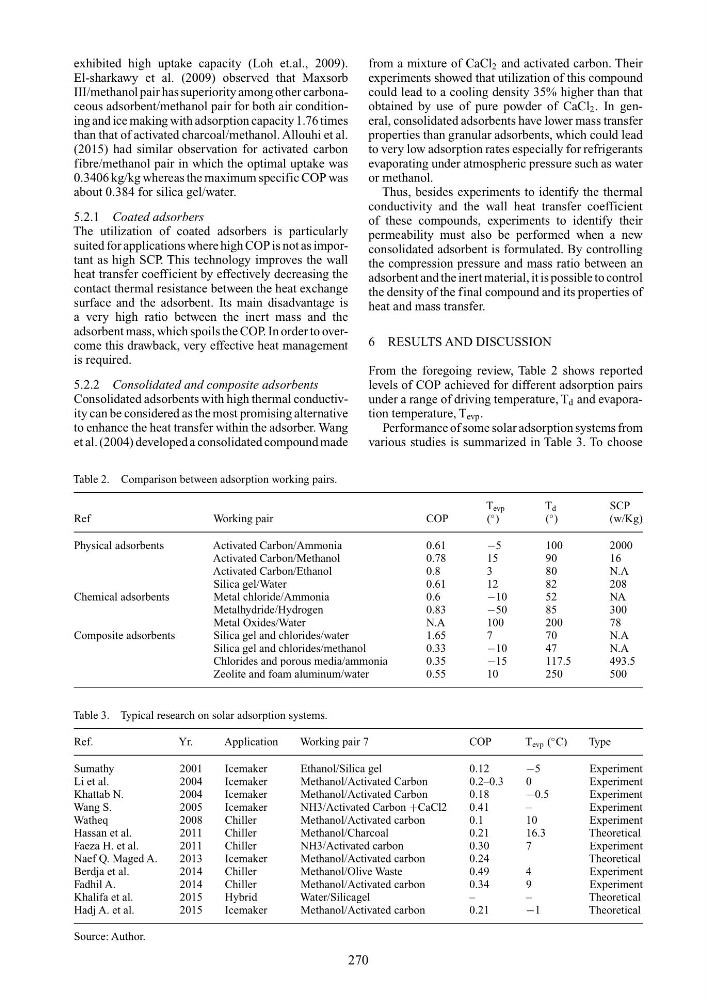
From the foregoing review, Table 2 shows reported
levels of COP achieved for different adsorption pairs
under a range of driving temperature, T d and evaporation temperature, T evp .
Performance of some solar adsorption systems from
various studies is summarized in Table 3. To choose
270
El-sharkawy et al. (2009) observed that Maxsorb
III/methanol pair has superiority among other carbonaceous adsorbent/methanol pair for both air conditioning and ice making with adsorption capacity 1.76 times
than that of activated charcoal/methanol. Allouhi et al.
(2015) had similar observation for activated carbon
fibre/methanol pair in which the optimal uptake was
0.3406 kg/kg whereas the maximum specific COP was
about 0.384 for silica gel/water.
5.2.1 Coated adsorbers
The utilization of coated adsorbers is particularly
suited for applications where high COP is not as important as high SCP. This technology improves the wall
heat transfer coefficient by effectively decreasing the
contact thermal resistance between the heat exchange
surface and the adsorbent. Its main disadvantage is
a very high ratio between the inert mass and the
adsorbent mass, which spoils the COP. In order to overcome this drawback, very effective heat management
is required.
5.2.2 Consolidated and composite adsorbents
Consolidated adsorbents with high thermal conductivity can be considered as the most promising alternative
to enhance the heat transfer within the adsorber. Wang
et al. (2004) developed a consolidated compound made
Table 2. Comparison between adsorption working pairs.
T evp
T d
SCP
Ref
Working pair
COP
(
◦ )
(
◦ )
(w/Kg)
Physical adsorbents
Activated Carbon/Ammonia
0.61
−5
100
2000
Activated Carbon/Methanol
0.78
15
90
16
Activated Carbon/Ethanol
0.8
3
80
N.A
Silica gel/Water
0.61
12
82
208
Chemical adsorbents
Metal chloride/Ammonia
0.6
−10
52
NA
Metalhydride/Hydrogen
0.83
−50
85
300
Metal Oxides/Water
N.A
100
200
78
Composite adsorbents
Silica gel and chlorides/water
1.65
7
70
N.A
Silica gel and chlorides/methanol
0.33
−10
47
N.A
Chlorides and porous media/ammonia
0.35
−15
117.5
493.5
Zeolite and foam aluminum/water
0.55
10
250
500
Table 3. Typical research on solar adsorption systems.
Ref.
Yr.
Application
Working pair 7
COP
T evp (
◦ C)
Type
Sumathy
2001
Icemaker
Ethanol/Silica gel
0.12
−5
Experiment
Li et al.
2004
Icemaker
Methanol/Activated Carbon
0.2–0.3
0
Experiment
Khattab N.
2004
Icemaker
Methanol/Activated Carbon
0.18
−0.5
Experiment
Wang S.
2005
Icemaker
NH3/Activated Carbon +CaCl2
0.41
–
Experiment
Watheq
2008
Chiller
Methanol/Activated carbon
0.1
10
Experiment
Hassan et al.
2011
Chiller
Methanol/Charcoal
0.21
16.3
Theoretical
Faeza H. et al.
2011
Chiller
NH3/Activated carbon
0.30
7
Experiment
Naef Q. Maged A.
2013
Icemaker
Methanol/Activated carbon
0.24
Theoretical
Berdja et al.
2014
Chiller
Methanol/Olive Waste
0.49
4
Experiment
Fadhil A.
2014
Chiller
Methanol/Activated carbon
0.34
9
Experiment
Khalifa et al.
2015
Hybrid
Water/Silicagel
–
–
Theoretical
Hadj A. et al.
2015
Icemaker
Methanol/Activated carbon
0.21
−1
Theoretical
Source: Author.
from a mixture of CaCl 2 and activated carbon. Their
experiments showed that utilization of this compound
could lead to a cooling density 35% higher than that
obtained by use of pure powder of CaCl 2 . In general, consolidated adsorbents have lower mass transfer
properties than granular adsorbents, which could lead
to very low adsorption rates especially for refrigerants
evaporating under atmospheric pressure such as water
or methanol.
Thus, besides experiments to identify the thermal
conductivity and the wall heat transfer coefficient
of these compounds, experiments to identify their
permeability must also be performed when a new
consolidated adsorbent is formulated. By controlling
the compression pressure and mass ratio between an
adsorbent and the inert material, it is possible to control
the density of the final compound and its properties of
heat and mass transfer.
6 RESULTS AND DISCUSSION
From the foregoing review, Table 2 shows reported
levels of COP achieved for different adsorption pairs
under a range of driving temperature, T d and evaporation temperature, T evp .
Performance of some solar adsorption systems from
various studies is summarized in Table 3. To choose
270