

MGs can either be off or on-grid networks. In the
event of a power outage, frequency drop, voltage sag
or maintenance of the main grid, the latter networks
can operate autonomously as they are coupled with a
groundbreaking islanding feature (Romankiewicz et
al., 2014). MGs are regarded as the better approach
of delivering a fast and more economic approach of
power generation to rural communities. They also
serve as bridging technologies before grid arrival
essentially through the smaller electrical distribution
networks to compliment the utility network (Bahaj &
James, 2019). New technologies with regard to payment schemes, load limits, load monitoring as well as
remote control are further progressing MG assumption
(UOMA, 2019).
MG sizes differ depending on the context of
application as they are dependent on the organizational setup, financial model, local demand, customer
base, resource potential, technology and their quality
(Shrestha, Shrestha, Shrestha, Papadakis, & Maskey,
2020). The context of analysis discussed in this paper
entails MGs that provide power to several customers
and not only a single facility like a hospital, school or
industry irrespective of the few kW or MW generated.
4.2 Mini-grid as an option for driving Uganda’s
rural electrification efforts
As of 2018, the country incurred 3.9 and 16.6%
electricity losses due to transmission and distribution
inefficiencies respectively (ERA, 2018). This definitely comes at an extra cost to power consumers. MG
proximity to the loads reduces transmission and distribution losses, of which the latter poses as the major
challenge of the Electricity Supply Industry (ESI) in
the country (ERA, 2019). Correspondingly, MG are
proposed with increased power efficiencies, resilience
and economic operation with reduced end user cost
(Parhizi et al., 2015). This thus makes them an outstanding option for the Ugandan rural communities. To
the utilities, the cost of upgrading the grid to the rural
areas with lower population densities is uneconomic
and becomes extremely difficult (ERA, 2019). While
the use of MG technologies provides an economically
attractive and competitive option to fossil based power
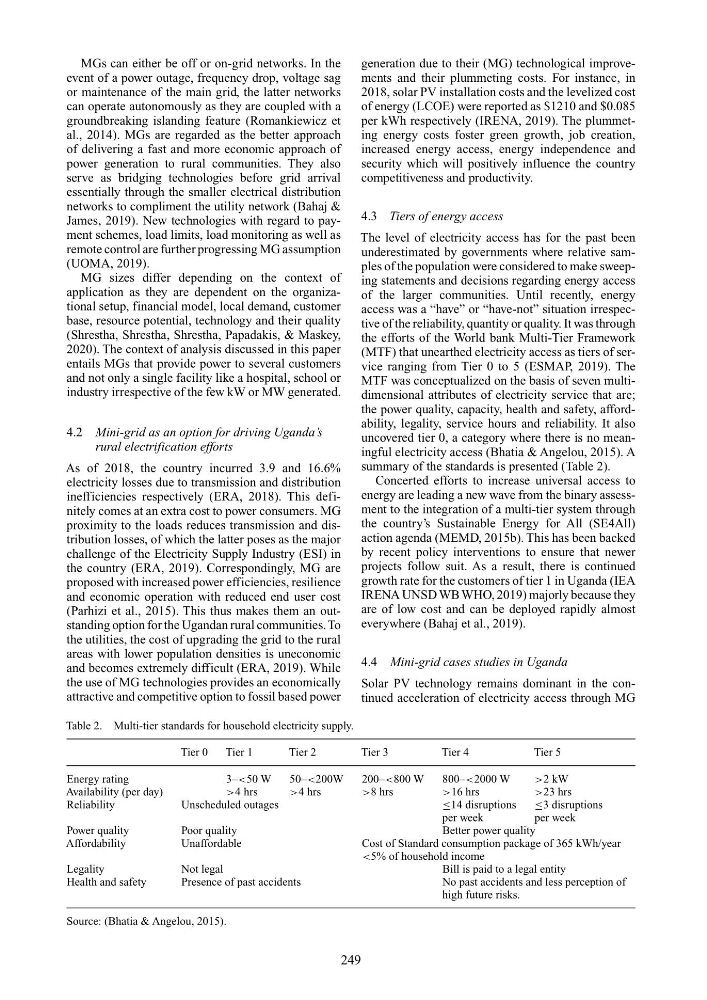
Table 2. Multi-tier standards for household electricity supply.
Tier 0
Tier 1
Tier 2
Tier 3
Tier 4
Tier 5
Energy rating
3–<50 W
50–<200W
200–<800 W
800–<2000 W
>2 kW
Availability (per day)
>4 hrs
>4 hrs
>8 hrs
>16 hrs
>23 hrs
Reliability
Unscheduled outages
≤14 disruptions
≤3 disruptions
per week
per week
Power quality
Poor quality
Better power quality
Affordability
Unaffordable
Cost of Standard consumption package of 365 kWh/year
<5% of household income
Legality
Not legal
Bill is paid to a legal entity
Health and safety
Presence of past accidents
No past accidents and less perception of
high future risks.
Source: (Bhatia & Angelou, 2015).
generation due to their (MG) technological improvements and their plummeting costs. For instance, in
2018, solar PV installation costs and the levelized cost
of energy (LCOE) were reported as $1210 and $0.085
per kWh respectively (IRENA, 2019). The plummeting energy costs foster green growth, job creation,
increased energy access, energy independence and
security which will positively influence the country
competitiveness and productivity.
4.3 Tiers of energy access
The level of electricity access has for the past been
underestimated by governments where relative samples of the population were considered to make sweeping statements and decisions regarding energy access
of the larger communities. Until recently, energy
access was a “have” or “have-not” situation irrespective of the reliability, quantity or quality. It was through
the efforts of the World bank Multi-Tier Framework
(MTF) that unearthed electricity access as tiers of service ranging from Tier 0 to 5 (ESMAP, 2019). The
MTF was conceptualized on the basis of seven multidimensional attributes of electricity service that are;
the power quality, capacity, health and safety, affordability, legality, service hours and reliability. It also
uncovered tier 0, a category where there is no meaningful electricity access (Bhatia & Angelou, 2015). A
summary of the standards is presented (Table 2).
Concerted efforts to increase universal access to
energy are leading a new wave from the binary assessment to the integration of a multi-tier system through
the country’s Sustainable Energy for All (SE4All)
action agenda (MEMD, 2015b). This has been backed
by recent policy interventions to ensure that newer
projects follow suit. As a result, there is continued
growth rate for the customers of tier 1 in Uganda (IEA
IRENA UNSD WB WHO, 2019) majorly because they
are of low cost and can be deployed rapidly almost
everywhere (Bahaj et al., 2019).
4.4 Mini-grid cases studies in Uganda
Solar PV technology remains dominant in the continued acceleration of electricity access through MG
249
event of a power outage, frequency drop, voltage sag
or maintenance of the main grid, the latter networks
can operate autonomously as they are coupled with a
groundbreaking islanding feature (Romankiewicz et
al., 2014). MGs are regarded as the better approach
of delivering a fast and more economic approach of
power generation to rural communities. They also
serve as bridging technologies before grid arrival
essentially through the smaller electrical distribution
networks to compliment the utility network (Bahaj &
James, 2019). New technologies with regard to payment schemes, load limits, load monitoring as well as
remote control are further progressing MG assumption
(UOMA, 2019).
MG sizes differ depending on the context of
application as they are dependent on the organizational setup, financial model, local demand, customer
base, resource potential, technology and their quality
(Shrestha, Shrestha, Shrestha, Papadakis, & Maskey,
2020). The context of analysis discussed in this paper
entails MGs that provide power to several customers
and not only a single facility like a hospital, school or
industry irrespective of the few kW or MW generated.
4.2 Mini-grid as an option for driving Uganda’s
rural electrification efforts
As of 2018, the country incurred 3.9 and 16.6%
electricity losses due to transmission and distribution
inefficiencies respectively (ERA, 2018). This definitely comes at an extra cost to power consumers. MG
proximity to the loads reduces transmission and distribution losses, of which the latter poses as the major
challenge of the Electricity Supply Industry (ESI) in
the country (ERA, 2019). Correspondingly, MG are
proposed with increased power efficiencies, resilience
and economic operation with reduced end user cost
(Parhizi et al., 2015). This thus makes them an outstanding option for the Ugandan rural communities. To
the utilities, the cost of upgrading the grid to the rural
areas with lower population densities is uneconomic
and becomes extremely difficult (ERA, 2019). While
the use of MG technologies provides an economically
attractive and competitive option to fossil based power
Table 2. Multi-tier standards for household electricity supply.
Tier 0
Tier 1
Tier 2
Tier 3
Tier 4
Tier 5
Energy rating
3–<50 W
50–<200W
200–<800 W
800–<2000 W
>2 kW
Availability (per day)
>4 hrs
>4 hrs
>8 hrs
>16 hrs
>23 hrs
Reliability
Unscheduled outages
≤14 disruptions
≤3 disruptions
per week
per week
Power quality
Poor quality
Better power quality
Affordability
Unaffordable
Cost of Standard consumption package of 365 kWh/year
<5% of household income
Legality
Not legal
Bill is paid to a legal entity
Health and safety
Presence of past accidents
No past accidents and less perception of
high future risks.
Source: (Bhatia & Angelou, 2015).
generation due to their (MG) technological improvements and their plummeting costs. For instance, in
2018, solar PV installation costs and the levelized cost
of energy (LCOE) were reported as $1210 and $0.085
per kWh respectively (IRENA, 2019). The plummeting energy costs foster green growth, job creation,
increased energy access, energy independence and
security which will positively influence the country
competitiveness and productivity.
4.3 Tiers of energy access
The level of electricity access has for the past been
underestimated by governments where relative samples of the population were considered to make sweeping statements and decisions regarding energy access
of the larger communities. Until recently, energy
access was a “have” or “have-not” situation irrespective of the reliability, quantity or quality. It was through
the efforts of the World bank Multi-Tier Framework
(MTF) that unearthed electricity access as tiers of service ranging from Tier 0 to 5 (ESMAP, 2019). The
MTF was conceptualized on the basis of seven multidimensional attributes of electricity service that are;
the power quality, capacity, health and safety, affordability, legality, service hours and reliability. It also
uncovered tier 0, a category where there is no meaningful electricity access (Bhatia & Angelou, 2015). A
summary of the standards is presented (Table 2).
Concerted efforts to increase universal access to
energy are leading a new wave from the binary assessment to the integration of a multi-tier system through
the country’s Sustainable Energy for All (SE4All)
action agenda (MEMD, 2015b). This has been backed
by recent policy interventions to ensure that newer
projects follow suit. As a result, there is continued
growth rate for the customers of tier 1 in Uganda (IEA
IRENA UNSD WB WHO, 2019) majorly because they
are of low cost and can be deployed rapidly almost
everywhere (Bahaj et al., 2019).
4.4 Mini-grid cases studies in Uganda
Solar PV technology remains dominant in the continued acceleration of electricity access through MG
249