

development in section two. Secondly, the metrics on
which the impacts of rural electrification could be
based discussed in section three. Thirdly, a description
of MGs with particular emphasis on the case studies
in view are highlighted in section four while section
five contains the challenges to the deployment of MGs
in the country. Finally, the discussions, conclusions as
well as recommendations from the review are covered
in sections six, seven and eight respectively.
2 RURAL ELECTRIFICATION AND
DEVELOPMENT
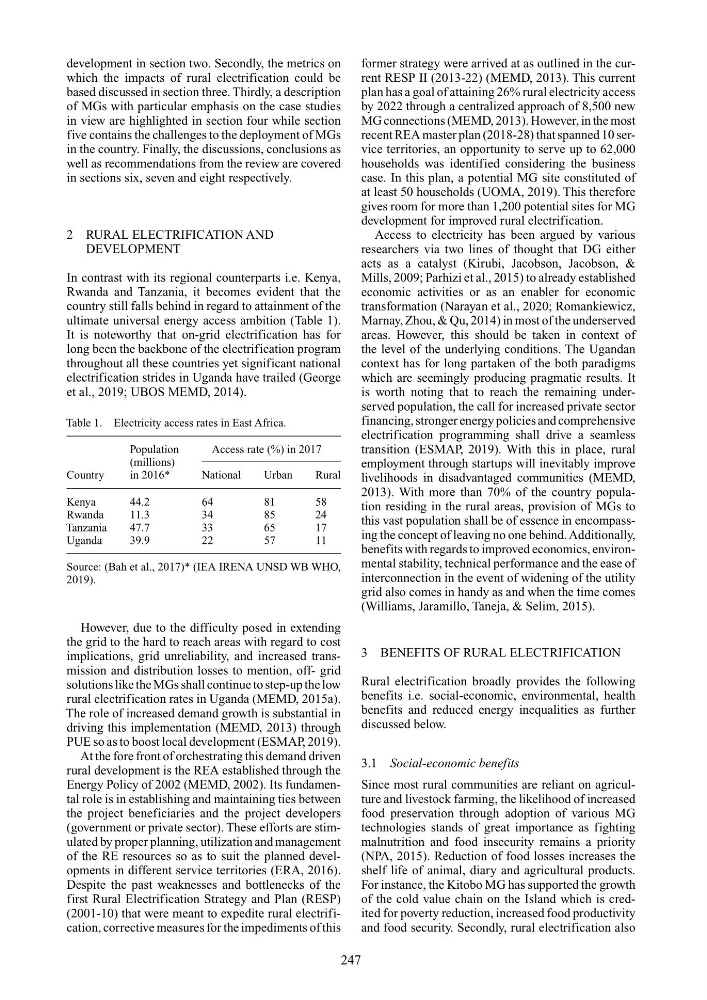
In contrast with its regional counterparts i.e. Kenya,
Rwanda and Tanzania, it becomes evident that the
country still falls behind in regard to attainment of the
ultimate universal energy access ambition (Table 1).
It is noteworthy that on-grid electrification has for
long been the backbone of the electrification program
throughout all these countries yet significant national
electrification strides in Uganda have trailed (George
et al., 2019; UBOS MEMD, 2014).
Table 1. Electricity access rates in East Africa.
Access rate (%) in 2017
Population
(millions)
Country
in 2016*
National
Urban
Rural
Kenya
44.2
64
81
58
Rwanda
11.3
34
85
24
Tanzania
47.7
33
65
17
Uganda
39.9
22
57
11
Source: (Bah et al., 2017)* (IEA IRENA UNSD WB WHO,
2019).
However, due to the difficulty posed in extending
the grid to the hard to reach areas with regard to cost
implications, grid unreliability, and increased transmission and distribution losses to mention, off- grid
solutions like the MGs shall continue to step-up the low
rural electrification rates in Uganda (MEMD, 2015a).
The role of increased demand growth is substantial in
driving this implementation (MEMD, 2013) through
PUE so as to boost local development (ESMAP, 2019).
At the fore front of orchestrating this demand driven
rural development is the REA established through the
Energy Policy of 2002 (MEMD, 2002). Its fundamental role is in establishing and maintaining ties between
the project beneficiaries and the project developers
(government or private sector). These efforts are stimulated by proper planning, utilization and management
of the RE resources so as to suit the planned developments in different service territories (ERA, 2016).
Despite the past weaknesses and bottlenecks of the
first Rural Electrification Strategy and Plan (RESP)
(2001-10) that were meant to expedite rural electrification, corrective measures for the impediments of this
former strategy were arrived at as outlined in the current RESP II (2013-22) (MEMD, 2013). This current
plan has a goal of attaining 26% rural electricity access
by 2022 through a centralized approach of 8,500 new
MG connections (MEMD, 2013). However, in the most
recent REA master plan (2018-28) that spanned 10 service territories, an opportunity to serve up to 62,000
households was identified considering the business
case. In this plan, a potential MG site constituted of
at least 50 households (UOMA, 2019). This therefore
gives room for more than 1,200 potential sites for MG
development for improved rural electrification.
Access to electricity has been argued by various
researchers via two lines of thought that DG either
acts as a catalyst (Kirubi, Jacobson, Jacobson, &
Mills, 2009; Parhizi et al., 2015) to already established
economic activities or as an enabler for economic
transformation (Narayan et al., 2020; Romankiewicz,
Marnay, Zhou, & Qu, 2014) in most of the underserved
areas. However, this should be taken in context of
the level of the underlying conditions. The Ugandan
context has for long partaken of the both paradigms
which are seemingly producing pragmatic results. It
is worth noting that to reach the remaining underserved population, the call for increased private sector
financing, stronger energy policies and comprehensive
electrification programming shall drive a seamless
transition (ESMAP, 2019). With this in place, rural
employment through startups will inevitably improve
livelihoods in disadvantaged communities (MEMD,
2013). With more than 70% of the country population residing in the rural areas, provision of MGs to
this vast population shall be of essence in encompassing the concept of leaving no one behind. Additionally,
benefits with regards to improved economics, environmental stability, technical performance and the ease of
interconnection in the event of widening of the utility
grid also comes in handy as and when the time comes
(Williams, Jaramillo, Taneja, & Selim, 2015).
3 BENEFITS OF RURAL ELECTRIFICATION
Rural electrification broadly provides the following
benefits i.e. social-economic, environmental, health
benefits and reduced energy inequalities as further
discussed below.
3.1 Social-economic benefits
Since most rural communities are reliant on agriculture and livestock farming, the likelihood of increased
food preservation through adoption of various MG
technologies stands of great importance as fighting
malnutrition and food insecurity remains a priority
(NPA, 2015). Reduction of food losses increases the
shelf life of animal, diary and agricultural products.
For instance, the Kitobo MG has supported the growth
of the cold value chain on the Island which is credited for poverty reduction, increased food productivity
and food security. Secondly, rural electrification also
247
which the impacts of rural electrification could be
based discussed in section three. Thirdly, a description
of MGs with particular emphasis on the case studies
in view are highlighted in section four while section
five contains the challenges to the deployment of MGs
in the country. Finally, the discussions, conclusions as
well as recommendations from the review are covered
in sections six, seven and eight respectively.
2 RURAL ELECTRIFICATION AND
DEVELOPMENT
In contrast with its regional counterparts i.e. Kenya,
Rwanda and Tanzania, it becomes evident that the
country still falls behind in regard to attainment of the
ultimate universal energy access ambition (Table 1).
It is noteworthy that on-grid electrification has for
long been the backbone of the electrification program
throughout all these countries yet significant national
electrification strides in Uganda have trailed (George
et al., 2019; UBOS MEMD, 2014).
Table 1. Electricity access rates in East Africa.
Access rate (%) in 2017
Population
(millions)
Country
in 2016*
National
Urban
Rural
Kenya
44.2
64
81
58
Rwanda
11.3
34
85
24
Tanzania
47.7
33
65
17
Uganda
39.9
22
57
11
Source: (Bah et al., 2017)* (IEA IRENA UNSD WB WHO,
2019).
However, due to the difficulty posed in extending
the grid to the hard to reach areas with regard to cost
implications, grid unreliability, and increased transmission and distribution losses to mention, off- grid
solutions like the MGs shall continue to step-up the low
rural electrification rates in Uganda (MEMD, 2015a).
The role of increased demand growth is substantial in
driving this implementation (MEMD, 2013) through
PUE so as to boost local development (ESMAP, 2019).
At the fore front of orchestrating this demand driven
rural development is the REA established through the
Energy Policy of 2002 (MEMD, 2002). Its fundamental role is in establishing and maintaining ties between
the project beneficiaries and the project developers
(government or private sector). These efforts are stimulated by proper planning, utilization and management
of the RE resources so as to suit the planned developments in different service territories (ERA, 2016).
Despite the past weaknesses and bottlenecks of the
first Rural Electrification Strategy and Plan (RESP)
(2001-10) that were meant to expedite rural electrification, corrective measures for the impediments of this
former strategy were arrived at as outlined in the current RESP II (2013-22) (MEMD, 2013). This current
plan has a goal of attaining 26% rural electricity access
by 2022 through a centralized approach of 8,500 new
MG connections (MEMD, 2013). However, in the most
recent REA master plan (2018-28) that spanned 10 service territories, an opportunity to serve up to 62,000
households was identified considering the business
case. In this plan, a potential MG site constituted of
at least 50 households (UOMA, 2019). This therefore
gives room for more than 1,200 potential sites for MG
development for improved rural electrification.
Access to electricity has been argued by various
researchers via two lines of thought that DG either
acts as a catalyst (Kirubi, Jacobson, Jacobson, &
Mills, 2009; Parhizi et al., 2015) to already established
economic activities or as an enabler for economic
transformation (Narayan et al., 2020; Romankiewicz,
Marnay, Zhou, & Qu, 2014) in most of the underserved
areas. However, this should be taken in context of
the level of the underlying conditions. The Ugandan
context has for long partaken of the both paradigms
which are seemingly producing pragmatic results. It
is worth noting that to reach the remaining underserved population, the call for increased private sector
financing, stronger energy policies and comprehensive
electrification programming shall drive a seamless
transition (ESMAP, 2019). With this in place, rural
employment through startups will inevitably improve
livelihoods in disadvantaged communities (MEMD,
2013). With more than 70% of the country population residing in the rural areas, provision of MGs to
this vast population shall be of essence in encompassing the concept of leaving no one behind. Additionally,
benefits with regards to improved economics, environmental stability, technical performance and the ease of
interconnection in the event of widening of the utility
grid also comes in handy as and when the time comes
(Williams, Jaramillo, Taneja, & Selim, 2015).
3 BENEFITS OF RURAL ELECTRIFICATION
Rural electrification broadly provides the following
benefits i.e. social-economic, environmental, health
benefits and reduced energy inequalities as further
discussed below.
3.1 Social-economic benefits
Since most rural communities are reliant on agriculture and livestock farming, the likelihood of increased
food preservation through adoption of various MG
technologies stands of great importance as fighting
malnutrition and food insecurity remains a priority
(NPA, 2015). Reduction of food losses increases the
shelf life of animal, diary and agricultural products.
For instance, the Kitobo MG has supported the growth
of the cold value chain on the Island which is credited for poverty reduction, increased food productivity
and food security. Secondly, rural electrification also
247