

through the improvement of the legal and institutional
responsiveness to renewable energy investments. It
also catered for the establishment of an appropriate
financing and fiscal policy framework for investments in renewable energy technologies, promotion of
research, international cooperation, technology transfer, and the realization of efficient and sustainable consumption of biomass energy. Whereas some success
was registered in areas such as the hydro power subsector, research on efficient technologies for biomass
energy use, wind turbine studies and tests, solar power
generation, and geothermal studies and tests, these
however have not been realized without challenges.
1.2 Overview of energy resources and energy mix
in Uganda
Uganda is endowed with renewable and non-renewable
energy resources. The renewable energy resources
include biomass (firewood, charcoal and cogeneration), hydrological (water), solar energy, geothermal
energy, and wind energy resources. Non-renewable
energy resources, on the other hand, include crude oil,
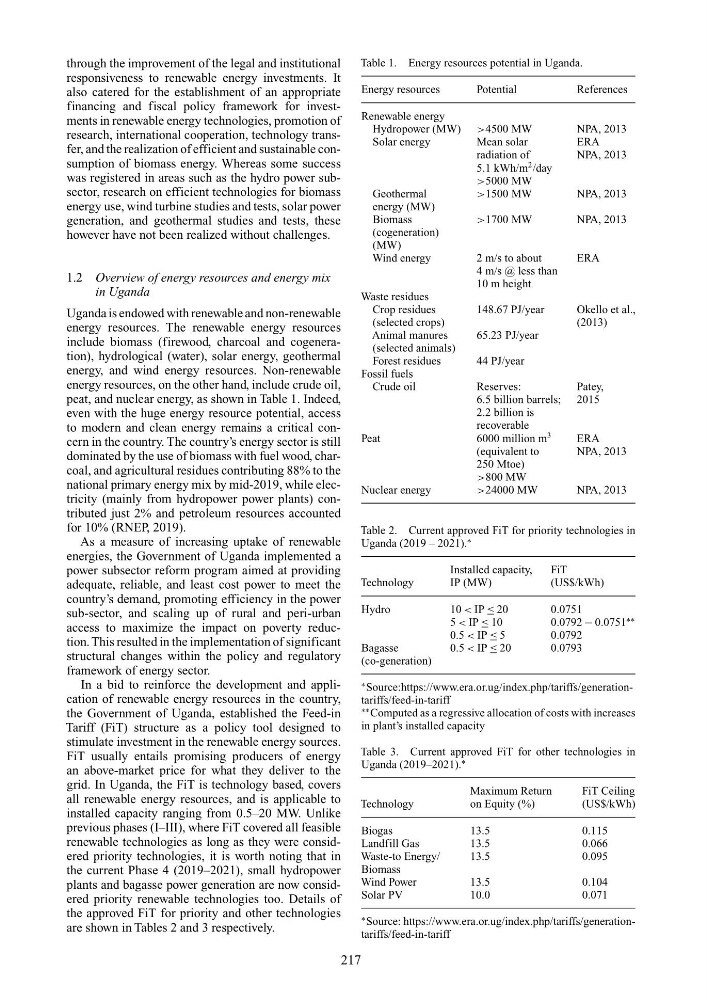
peat, and nuclear energy, as shown in Table 1. Indeed,
even with the huge energy resource potential, access
to modern and clean energy remains a critical concern in the country. The country’s energy sector is still
dominated by the use of biomass with fuel wood, charcoal, and agricultural residues contributing 88% to the
national primary energy mix by mid-2019, while electricity (mainly from hydropower power plants) contributed just 2% and petroleum resources accounted
for 10% (RNEP, 2019).
As a measure of increasing uptake of renewable
energies, the Government of Uganda implemented a
power subsector reform program aimed at providing
adequate, reliable, and least cost power to meet the
country’s demand, promoting efficiency in the power
sub-sector, and scaling up of rural and peri-urban
access to maximize the impact on poverty reduction. This resulted in the implementation of significant
structural changes within the policy and regulatory
framework of energy sector.
In a bid to reinforce the development and application of renewable energy resources in the country,
the Government of Uganda, established the Feed-in
Tariff (FiT) structure as a policy tool designed to
stimulate investment in the renewable energy sources.
FiT usually entails promising producers of energy
an above-market price for what they deliver to the
grid. In Uganda, the FiT is technology based, covers
all renewable energy resources, and is applicable to
installed capacity ranging from 0.5–20 MW. Unlike
previous phases (I–III), where FiT covered all feasible
renewable technologies as long as they were considered priority technologies, it is worth noting that in
the current Phase 4 (2019–2021), small hydropower
plants and bagasse power generation are now considered priority renewable technologies too. Details of
the approved FiT for priority and other technologies
are shown in Tables 2 and 3 respectively.
Table 1. Energy resources potential in Uganda.
Energy resources
Potential
References
Renewable energy
Hydropower (MW) >4500 MW
NPA, 2013
Solar energy
Mean solar
ERA
radiation of
NPA, 2013
5.1 kWh/m
2 /day
>5000 MW
Geothermal
>1500 MW
NPA, 2013
energy (MW)
Biomass
>1700 MW
NPA, 2013
(cogeneration)
(MW)
Wind energy
2 m/s to about
ERA
4 m/s @ less than
10 m height
Waste residues
Crop residues
148.67 PJ/year
Okello et al.,
(selected crops)
(2013)
Animal manures
65.23 PJ/year
(selected animals)
Forest residues
44 PJ/year
Fossil fuels
Crude oil
Reserves:
Patey,
6.5 billion barrels; 2015
2.2 billion is
recoverable
Peat
6000 million m
3
ERA
(equivalent to
NPA, 2013
250 Mtoe)
>800 MW
Nuclear energy
>24000 MW
NPA, 2013
Table 2. Current approved FiT for priority technologies in
Uganda (2019 – 2021).
∗
Installed capacity,
FiT
Technology
IP (MW)
(US$/kWh)
Hydro
10 < IP ≤ 20
0.0751
5 < IP ≤ 10
0.0792 − 0.0751
∗∗
0.5 < IP ≤ 5
0.0792
Bagasse
0.5 < IP ≤ 20
0.0793
(co-generation)
∗ Source:https://www.era.or.ug/index.php/tariffs/generationtariffs/feed-in-tariff
∗∗ Computed as a regressive allocation of costs with increases
in plant’s installed capacity
Table 3. Current approved FiT for other technologies in
Uganda (2019–2021).
∗
Maximum Return
FiT Ceiling
Technology
on Equity (%)
(US$/kWh)
Biogas
13.5
0.115
Landfill Gas
13.5
0.066
Waste-to Energy/
13.5
0.095
Biomass
Wind Power
13.5
0.104
Solar PV
10.0
0.071
∗ Source: https://www.era.or.ug/index.php/tariffs/generationtariffs/feed-in-tariff
217
responsiveness to renewable energy investments. It
also catered for the establishment of an appropriate
financing and fiscal policy framework for investments in renewable energy technologies, promotion of
research, international cooperation, technology transfer, and the realization of efficient and sustainable consumption of biomass energy. Whereas some success
was registered in areas such as the hydro power subsector, research on efficient technologies for biomass
energy use, wind turbine studies and tests, solar power
generation, and geothermal studies and tests, these
however have not been realized without challenges.
1.2 Overview of energy resources and energy mix
in Uganda
Uganda is endowed with renewable and non-renewable
energy resources. The renewable energy resources
include biomass (firewood, charcoal and cogeneration), hydrological (water), solar energy, geothermal
energy, and wind energy resources. Non-renewable
energy resources, on the other hand, include crude oil,
peat, and nuclear energy, as shown in Table 1. Indeed,
even with the huge energy resource potential, access
to modern and clean energy remains a critical concern in the country. The country’s energy sector is still
dominated by the use of biomass with fuel wood, charcoal, and agricultural residues contributing 88% to the
national primary energy mix by mid-2019, while electricity (mainly from hydropower power plants) contributed just 2% and petroleum resources accounted
for 10% (RNEP, 2019).
As a measure of increasing uptake of renewable
energies, the Government of Uganda implemented a
power subsector reform program aimed at providing
adequate, reliable, and least cost power to meet the
country’s demand, promoting efficiency in the power
sub-sector, and scaling up of rural and peri-urban
access to maximize the impact on poverty reduction. This resulted in the implementation of significant
structural changes within the policy and regulatory
framework of energy sector.
In a bid to reinforce the development and application of renewable energy resources in the country,
the Government of Uganda, established the Feed-in
Tariff (FiT) structure as a policy tool designed to
stimulate investment in the renewable energy sources.
FiT usually entails promising producers of energy
an above-market price for what they deliver to the
grid. In Uganda, the FiT is technology based, covers
all renewable energy resources, and is applicable to
installed capacity ranging from 0.5–20 MW. Unlike
previous phases (I–III), where FiT covered all feasible
renewable technologies as long as they were considered priority technologies, it is worth noting that in
the current Phase 4 (2019–2021), small hydropower
plants and bagasse power generation are now considered priority renewable technologies too. Details of
the approved FiT for priority and other technologies
are shown in Tables 2 and 3 respectively.
Table 1. Energy resources potential in Uganda.
Energy resources
Potential
References
Renewable energy
Hydropower (MW) >4500 MW
NPA, 2013
Solar energy
Mean solar
ERA
radiation of
NPA, 2013
5.1 kWh/m
2 /day
>5000 MW
Geothermal
>1500 MW
NPA, 2013
energy (MW)
Biomass
>1700 MW
NPA, 2013
(cogeneration)
(MW)
Wind energy
2 m/s to about
ERA
4 m/s @ less than
10 m height
Waste residues
Crop residues
148.67 PJ/year
Okello et al.,
(selected crops)
(2013)
Animal manures
65.23 PJ/year
(selected animals)
Forest residues
44 PJ/year
Fossil fuels
Crude oil
Reserves:
Patey,
6.5 billion barrels; 2015
2.2 billion is
recoverable
Peat
6000 million m
3
ERA
(equivalent to
NPA, 2013
250 Mtoe)
>800 MW
Nuclear energy
>24000 MW
NPA, 2013
Table 2. Current approved FiT for priority technologies in
Uganda (2019 – 2021).
∗
Installed capacity,
FiT
Technology
IP (MW)
(US$/kWh)
Hydro
10 < IP ≤ 20
0.0751
5 < IP ≤ 10
0.0792 − 0.0751
∗∗
0.5 < IP ≤ 5
0.0792
Bagasse
0.5 < IP ≤ 20
0.0793
(co-generation)
∗ Source:https://www.era.or.ug/index.php/tariffs/generationtariffs/feed-in-tariff
∗∗ Computed as a regressive allocation of costs with increases
in plant’s installed capacity
Table 3. Current approved FiT for other technologies in
Uganda (2019–2021).
∗
Maximum Return
FiT Ceiling
Technology
on Equity (%)
(US$/kWh)
Biogas
13.5
0.115
Landfill Gas
13.5
0.066
Waste-to Energy/
13.5
0.095
Biomass
Wind Power
13.5
0.104
Solar PV
10.0
0.071
∗ Source: https://www.era.or.ug/index.php/tariffs/generationtariffs/feed-in-tariff
217