

Advances in Phytochemistry, Textile and Renewable Energy Research for
Industrial Growth – Nzila et al. (Eds)
© 2022 Copyright the Author(s), ISBN: 978-1-032-11871-0
Open Access: www.taylorfrancis.com, CC BY-NC-ND 4.0 license
Optimization of liquid fuel from microwave pyrolysis of used tyres
R.K. Bett
School of Engineering, Department of Mechanical, Production and Energy Engineering, Moi University, Eldoret,
Kenya
The Africa Centre of Excellence II in Phytochemicals, Textiles and Renewable Energy (ACE II PTRE), Moi University,
Eldoret, Kenya
A. Kumar
School of Engineering, Department of Chemical & Process Engineering, Moi University, Eldoret, Kenya
Z. Siagi
School of Engineering, Department of Mechanical, Production and Energy Engineering, Moi University, Eldoret,
Kenya
ABSTRACT: Used tyres pose a threat to the environment, especially in developing countries, since they are
non-biodegradable. Liquid from used tyres can used as a source of fuel to replace petroleum diesel. Research
has been done to prove that a pyrolysis technique can extract liquid fuel from used tyres. Microwave pyrolysis
is an alternative valorization process which is efficient and environmentally friendly, and hence is effective in
producing Tyre Pyrolysis Oil. Optimization was done and Central Composite Design was used to optimize the
variables. The variables were microwave power, residence time, and particle size. The yield was correlated as a
quadratic function of the reaction variables. Response surface and contour plots for the correlation were plotted
to indicate the effects of operating variables and finally to identify the points of optimal yield. The highest yield
of 38.4 (wt.%) corresponded to a microwave power of 50%, residence time of 17.5 minutes, and a particle size
of 25 mm
2 .
1 INTRODUCTION
The major source of tyres in Kenya is tyre imports.
According to Dilewski (Gernod Dilewski, 2012) about
62% of all tyres in Kenya are imported. Twenty percent of the tyres in Kenya are those that are imported
with cars while those produced in Kenya and the grey
market account for 18%. The quantities of used tyres
are expected to increase exponentially. This is due to
the fact that the number of people and companies that
buy new cars is increasing (Gernod Dilewski, 2012). In
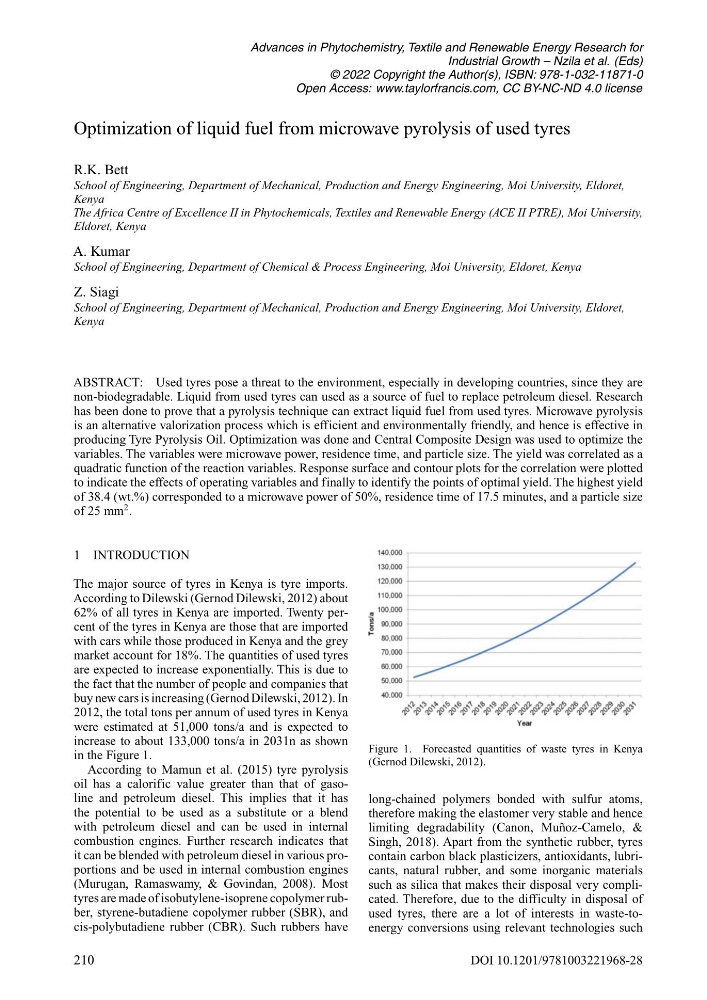
2012, the total tons per annum of used tyres in Kenya
were estimated at 51,000 tons/a and is expected to
increase to about 133,000 tons/a in 2031n as shown
in the Figure 1.
According to Mamun et al. (2015) tyre pyrolysis
oil has a calorific value greater than that of gasoline and petroleum diesel. This implies that it has
the potential to be used as a substitute or a blend
with petroleum diesel and can be used in internal
combustion engines. Further research indicates that
it can be blended with petroleum diesel in various proportions and be used in internal combustion engines
(Murugan, Ramaswamy, & Govindan, 2008). Most
tyres are made of isobutylene-isoprene copolymer rubber, styrene-butadiene copolymer rubber (SBR), and
cis-polybutadiene rubber (CBR). Such rubbers have
Figure 1. Forecasted quantities of waste tyres in Kenya
(Gernod Dilewski, 2012).
long-chained polymers bonded with sulfur atoms,
therefore making the elastomer very stable and hence
limiting degradability (Canon, Muñoz-Camelo, &
Singh, 2018). Apart from the synthetic rubber, tyres
contain carbon black plasticizers, antioxidants, lubricants, natural rubber, and some inorganic materials
such as silica that makes their disposal very complicated. Therefore, due to the difficulty in disposal of
used tyres, there are a lot of interests in waste-toenergy conversions using relevant technologies such
210
DOI 10.1201/9781003221968-28
Industrial Growth – Nzila et al. (Eds)
© 2022 Copyright the Author(s), ISBN: 978-1-032-11871-0
Open Access: www.taylorfrancis.com, CC BY-NC-ND 4.0 license
Optimization of liquid fuel from microwave pyrolysis of used tyres
R.K. Bett
School of Engineering, Department of Mechanical, Production and Energy Engineering, Moi University, Eldoret,
Kenya
The Africa Centre of Excellence II in Phytochemicals, Textiles and Renewable Energy (ACE II PTRE), Moi University,
Eldoret, Kenya
A. Kumar
School of Engineering, Department of Chemical & Process Engineering, Moi University, Eldoret, Kenya
Z. Siagi
School of Engineering, Department of Mechanical, Production and Energy Engineering, Moi University, Eldoret,
Kenya
ABSTRACT: Used tyres pose a threat to the environment, especially in developing countries, since they are
non-biodegradable. Liquid from used tyres can used as a source of fuel to replace petroleum diesel. Research
has been done to prove that a pyrolysis technique can extract liquid fuel from used tyres. Microwave pyrolysis
is an alternative valorization process which is efficient and environmentally friendly, and hence is effective in
producing Tyre Pyrolysis Oil. Optimization was done and Central Composite Design was used to optimize the
variables. The variables were microwave power, residence time, and particle size. The yield was correlated as a
quadratic function of the reaction variables. Response surface and contour plots for the correlation were plotted
to indicate the effects of operating variables and finally to identify the points of optimal yield. The highest yield
of 38.4 (wt.%) corresponded to a microwave power of 50%, residence time of 17.5 minutes, and a particle size
of 25 mm
2 .
1 INTRODUCTION
The major source of tyres in Kenya is tyre imports.
According to Dilewski (Gernod Dilewski, 2012) about
62% of all tyres in Kenya are imported. Twenty percent of the tyres in Kenya are those that are imported
with cars while those produced in Kenya and the grey
market account for 18%. The quantities of used tyres
are expected to increase exponentially. This is due to
the fact that the number of people and companies that
buy new cars is increasing (Gernod Dilewski, 2012). In
2012, the total tons per annum of used tyres in Kenya
were estimated at 51,000 tons/a and is expected to
increase to about 133,000 tons/a in 2031n as shown
in the Figure 1.
According to Mamun et al. (2015) tyre pyrolysis
oil has a calorific value greater than that of gasoline and petroleum diesel. This implies that it has
the potential to be used as a substitute or a blend
with petroleum diesel and can be used in internal
combustion engines. Further research indicates that
it can be blended with petroleum diesel in various proportions and be used in internal combustion engines
(Murugan, Ramaswamy, & Govindan, 2008). Most
tyres are made of isobutylene-isoprene copolymer rubber, styrene-butadiene copolymer rubber (SBR), and
cis-polybutadiene rubber (CBR). Such rubbers have
Figure 1. Forecasted quantities of waste tyres in Kenya
(Gernod Dilewski, 2012).
long-chained polymers bonded with sulfur atoms,
therefore making the elastomer very stable and hence
limiting degradability (Canon, Muñoz-Camelo, &
Singh, 2018). Apart from the synthetic rubber, tyres
contain carbon black plasticizers, antioxidants, lubricants, natural rubber, and some inorganic materials
such as silica that makes their disposal very complicated. Therefore, due to the difficulty in disposal of
used tyres, there are a lot of interests in waste-toenergy conversions using relevant technologies such
210
DOI 10.1201/9781003221968-28