

higher education community through: expertise & trends analysis, publications & portals, advisory services, peerto-peer learning, events, global advocacy. It is an NGO with over 600 universities and university organizations
as members all around the globe.
HESD is one of IAU strategic priorities and the overall objectives are to encourage peer to peer learning, monitor, trends, sharing expertise, fostering whole institutions approach and providing leadership training, capacity
building and networking services (https://www.iau-aiu.net/HESD). One important role is to engage in policy discussions, conferences and in policy documents. For example, IAU is key partner in the UNESCO Global Action
Program on Education for Sustainability (GAP on HESD) and with its member institutions and organizations
active in the High-Level Political Forum 2019 and 2020.
With the aim to foster further support for universities in their role in societal transformation for a global
sustainable development IAU in 2018 started a university network for HESD. For each of the SDG, one university,
actively working with that specific goal and interconnected goals, was invited as leader institutions and asked
to build a network around that goal. Today the network comprises over 80 universities around the world.
The leader institution for SDG12 is the University of Regina and Luther college and they have formed a
network with six universities around the world, the host for this meeting, Moi university, and from Malaysia, Sri
Lanka, Germany, Colombia and Peru. I am sure that this meeting will bring important knowledge to be shared
within the IAU Cluster. Through the network there will be a global voice of the universities actions and needs to
fulfill their role in reaching agenda 2030 and the SDGs. For IAU to act in promoting and advocating for HESD
the global networking is crucial. Each leading institution and their satellite institutions has a role to interact
with other institutions in research and education to extend the sharing and the strength of the voice of higher
education to policy makers, governments, public and private funding agencies.
Covid 19 has increased the awareness of the inequalities in resources and capacities to perform
research and higher education. Recent surveys including that performed by IAU (https://www.iau-aiu.net/
IMG/pdf/iau_covid19_and_he_survey_report_final_may_2020.pdf) on the consequences of Covid 19 on HE
pays attention to the risk of increasing inequality. This highlights the need of cohesion and cooperation between
universities and between universities and the society built on global engagement and local relevance.
Knowledge creation and development through basic and applied research and innovation needs cooperation
on common interests but must be built on respect and trust for each stakeholder’s role, goals and legislations.
For universities the fundamental principles for Higher Education needs to be respected, academic freedom in
research and education, institutional autonomy, education built on science and/or proven experience. These are
values that foster skills as critical thinking, analytical competence and creativity. Skills that together with disciplinary knowledge will be bring through students to society and empowering for taking action for a sustainable
development.
IAU will continue to actively engage in promoting and advocate for the key role of universities in society for
realizing the Agenda 2030. SDG12 “Ensure sustainable consumption and production patterns” safeguards and
accommodates all SDGs and the outcome of this conference is of value for them all. I wish you a successful
conference.
Dr. Pam Fredman, IAU President
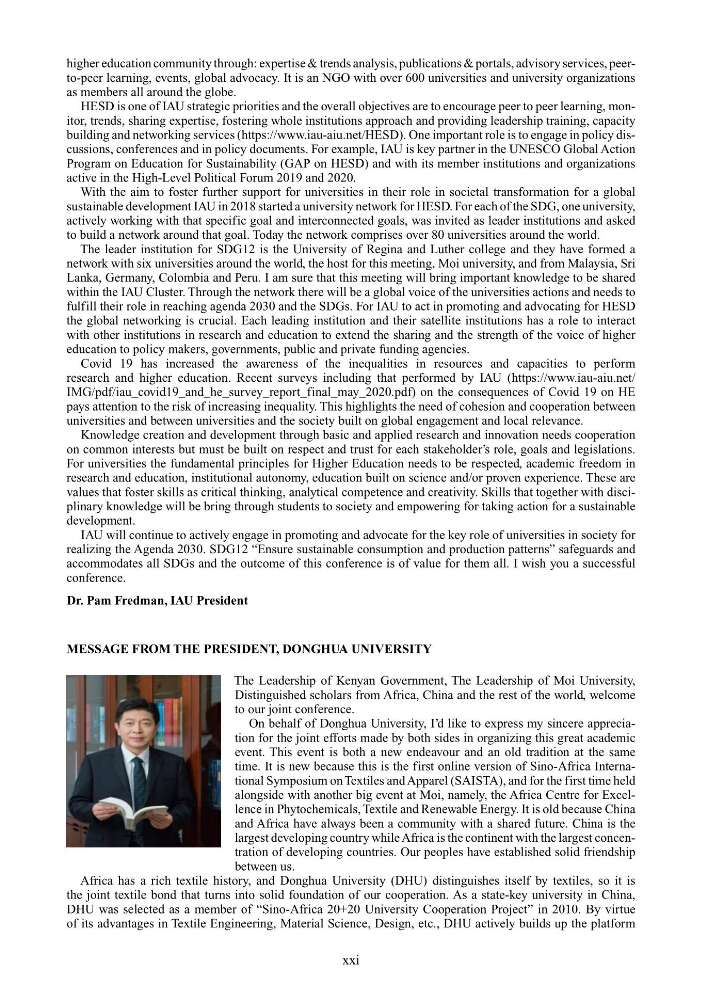
MESSAGE FROM THE PRESIDENT, DONGHUA UNIVERSITY
The Leadership of Kenyan Government, The Leadership of Moi University,
Distinguished scholars from Africa, China and the rest of the world, welcome
to our joint conference.
On behalf of Donghua University, I’d like to express my sincere appreciation for the joint efforts made by both sides in organizing this great academic
event. This event is both a new endeavour and an old tradition at the same
time. It is new because this is the first online version of Sino-Africa International Symposium on Textiles and Apparel (SAISTA), and for the first time held
alongside with another big event at Moi, namely, the Africa Centre for Excellence in Phytochemicals, Textile and Renewable Energy. It is old because China
and Africa have always been a community with a shared future. China is the
largest developing country while Africa is the continent with the largest concentration of developing countries. Our peoples have established solid friendship
between us.
Africa has a rich textile history, and Donghua University (DHU) distinguishes itself by textiles, so it is
the joint textile bond that turns into solid foundation of our cooperation. As a state-key university in China,
DHU was selected as a member of “Sino-Africa 20+20 University Cooperation Project” in 2010. By virtue
of its advantages in Textile Engineering, Material Science, Design, etc., DHU actively builds up the platform
xxi
as members all around the globe.
HESD is one of IAU strategic priorities and the overall objectives are to encourage peer to peer learning, monitor, trends, sharing expertise, fostering whole institutions approach and providing leadership training, capacity
building and networking services (https://www.iau-aiu.net/HESD). One important role is to engage in policy discussions, conferences and in policy documents. For example, IAU is key partner in the UNESCO Global Action
Program on Education for Sustainability (GAP on HESD) and with its member institutions and organizations
active in the High-Level Political Forum 2019 and 2020.
With the aim to foster further support for universities in their role in societal transformation for a global
sustainable development IAU in 2018 started a university network for HESD. For each of the SDG, one university,
actively working with that specific goal and interconnected goals, was invited as leader institutions and asked
to build a network around that goal. Today the network comprises over 80 universities around the world.
The leader institution for SDG12 is the University of Regina and Luther college and they have formed a
network with six universities around the world, the host for this meeting, Moi university, and from Malaysia, Sri
Lanka, Germany, Colombia and Peru. I am sure that this meeting will bring important knowledge to be shared
within the IAU Cluster. Through the network there will be a global voice of the universities actions and needs to
fulfill their role in reaching agenda 2030 and the SDGs. For IAU to act in promoting and advocating for HESD
the global networking is crucial. Each leading institution and their satellite institutions has a role to interact
with other institutions in research and education to extend the sharing and the strength of the voice of higher
education to policy makers, governments, public and private funding agencies.
Covid 19 has increased the awareness of the inequalities in resources and capacities to perform
research and higher education. Recent surveys including that performed by IAU (https://www.iau-aiu.net/
IMG/pdf/iau_covid19_and_he_survey_report_final_may_2020.pdf) on the consequences of Covid 19 on HE
pays attention to the risk of increasing inequality. This highlights the need of cohesion and cooperation between
universities and between universities and the society built on global engagement and local relevance.
Knowledge creation and development through basic and applied research and innovation needs cooperation
on common interests but must be built on respect and trust for each stakeholder’s role, goals and legislations.
For universities the fundamental principles for Higher Education needs to be respected, academic freedom in
research and education, institutional autonomy, education built on science and/or proven experience. These are
values that foster skills as critical thinking, analytical competence and creativity. Skills that together with disciplinary knowledge will be bring through students to society and empowering for taking action for a sustainable
development.
IAU will continue to actively engage in promoting and advocate for the key role of universities in society for
realizing the Agenda 2030. SDG12 “Ensure sustainable consumption and production patterns” safeguards and
accommodates all SDGs and the outcome of this conference is of value for them all. I wish you a successful
conference.
Dr. Pam Fredman, IAU President
MESSAGE FROM THE PRESIDENT, DONGHUA UNIVERSITY
The Leadership of Kenyan Government, The Leadership of Moi University,
Distinguished scholars from Africa, China and the rest of the world, welcome
to our joint conference.
On behalf of Donghua University, I’d like to express my sincere appreciation for the joint efforts made by both sides in organizing this great academic
event. This event is both a new endeavour and an old tradition at the same
time. It is new because this is the first online version of Sino-Africa International Symposium on Textiles and Apparel (SAISTA), and for the first time held
alongside with another big event at Moi, namely, the Africa Centre for Excellence in Phytochemicals, Textile and Renewable Energy. It is old because China
and Africa have always been a community with a shared future. China is the
largest developing country while Africa is the continent with the largest concentration of developing countries. Our peoples have established solid friendship
between us.
Africa has a rich textile history, and Donghua University (DHU) distinguishes itself by textiles, so it is
the joint textile bond that turns into solid foundation of our cooperation. As a state-key university in China,
DHU was selected as a member of “Sino-Africa 20+20 University Cooperation Project” in 2010. By virtue
of its advantages in Textile Engineering, Material Science, Design, etc., DHU actively builds up the platform
xxi