

and the Republic of Kenya in particular through the Ministry of Education, and for facilitating Moi University to
be a beneficiary of the same. The local community has also greatly benefitted from the ACE II Project through
outreach services in short course training on self-sustainability through making detergents and soap, making of
natural dyes, and training on biogas production for surrounding high schools, just to mention a few.
Coping and Containment Mechanisms of Covid-19
Moi University is well aware of the impact of the Covid-19 pandemic and swung into action to be part of
the solution through inter-disciplinary research in combating the scourge. We are also involved in Covid-19
containment measures such as mass production of masks for public use and also medical suits through our
Rivatex Textile Factory at subsidized costs. Additionally, plans are underway for the production of subsidized
hand sanitizers through ACE II PTRE Project hosted in the School of Sciences and Aerospace Studies for local
consumption and commercial purposes eventually.
Conclusion
I would like to conclude by once more thanking the World Bank for their continued support as our Sponsor,
Donghua University – China for jointly hosting this Conference, and the Inter-University Council of East Africa,
Regional Universities Forum for Capacity Building in Agriculture, International Association of Universities,
and all our other partners for their effort in being in the forefront of ensuring that Moi University achieves its
vision and mandate. I end by thanking the participants, presenters, moderators, rapporteurs, and the Organizing
Committee led by the Centre Leader, for the great effort they have made to ensure the virtual Conference is
a success. ’Asanteni Sana’. I wish all the participants the very best during this Conference. Thank you and
welcome to the Conference.
Prof. Isaac Sanga Kosgey,
Vice-Chancellor
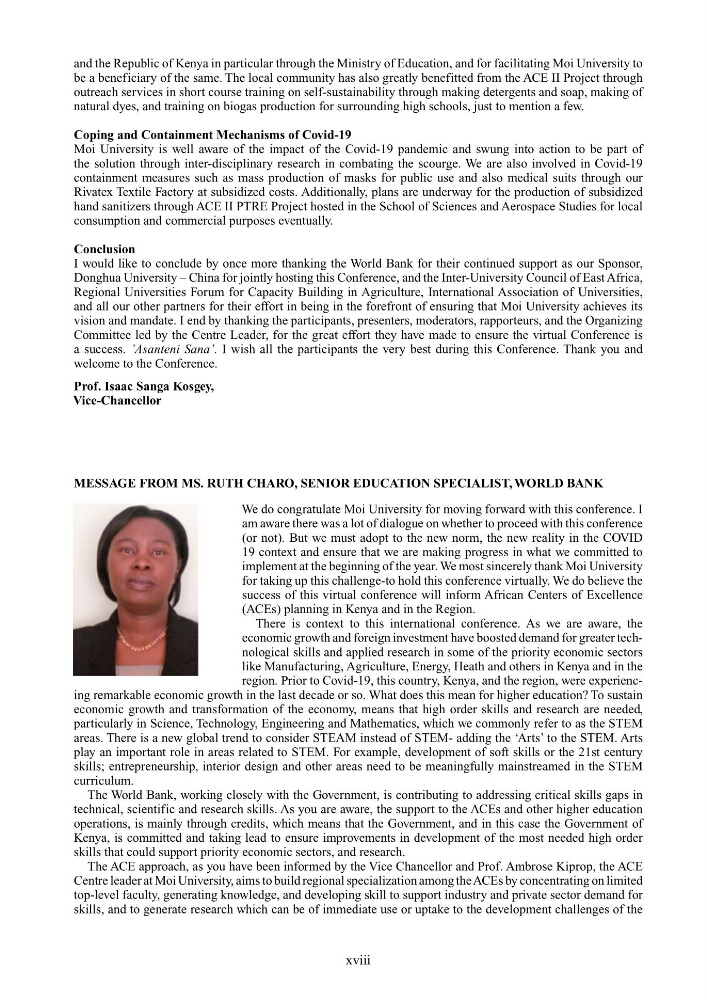
MESSAGE FROM MS. RUTH CHARO, SENIOR EDUCATION SPECIALIST, WORLD BANK
We do congratulate Moi University for moving forward with this conference. I
am aware there was a lot of dialogue on whether to proceed with this conference
(or not). But we must adopt to the new norm, the new reality in the COVID
19 context and ensure that we are making progress in what we committed to
implement at the beginning of the year. We most sincerely thank Moi University
for taking up this challenge-to hold this conference virtually. We do believe the
success of this virtual conference will inform African Centers of Excellence
(ACEs) planning in Kenya and in the Region.
There is context to this international conference. As we are aware, the
economic growth and foreign investment have boosted demand for greater technological skills and applied research in some of the priority economic sectors
like Manufacturing, Agriculture, Energy, Heath and others in Kenya and in the
region. Prior to Covid-19, this country, Kenya, and the region, were experiencing remarkable economic growth in the last decade or so. What does this mean for higher education? To sustain
economic growth and transformation of the economy, means that high order skills and research are needed,
particularly in Science, Technology, Engineering and Mathematics, which we commonly refer to as the STEM
areas. There is a new global trend to consider STEAM instead of STEM- adding the ‘Arts’ to the STEM. Arts
play an important role in areas related to STEM. For example, development of soft skills or the 21st century
skills; entrepreneurship, interior design and other areas need to be meaningfully mainstreamed in the STEM
curriculum.
The World Bank, working closely with the Government, is contributing to addressing critical skills gaps in
technical, scientific and research skills. As you are aware, the support to the ACEs and other higher education
operations, is mainly through credits, which means that the Government, and in this case the Government of
Kenya, is committed and taking lead to ensure improvements in development of the most needed high order
skills that could support priority economic sectors, and research.
The ACE approach, as you have been informed by the Vice Chancellor and Prof. Ambrose Kiprop, the ACE
Centre leader at Moi University, aims to build regional specialization among theACEs by concentrating on limited
top-level faculty, generating knowledge, and developing skill to support industry and private sector demand for
skills, and to generate research which can be of immediate use or uptake to the development challenges of the
xviii
be a beneficiary of the same. The local community has also greatly benefitted from the ACE II Project through
outreach services in short course training on self-sustainability through making detergents and soap, making of
natural dyes, and training on biogas production for surrounding high schools, just to mention a few.
Coping and Containment Mechanisms of Covid-19
Moi University is well aware of the impact of the Covid-19 pandemic and swung into action to be part of
the solution through inter-disciplinary research in combating the scourge. We are also involved in Covid-19
containment measures such as mass production of masks for public use and also medical suits through our
Rivatex Textile Factory at subsidized costs. Additionally, plans are underway for the production of subsidized
hand sanitizers through ACE II PTRE Project hosted in the School of Sciences and Aerospace Studies for local
consumption and commercial purposes eventually.
Conclusion
I would like to conclude by once more thanking the World Bank for their continued support as our Sponsor,
Donghua University – China for jointly hosting this Conference, and the Inter-University Council of East Africa,
Regional Universities Forum for Capacity Building in Agriculture, International Association of Universities,
and all our other partners for their effort in being in the forefront of ensuring that Moi University achieves its
vision and mandate. I end by thanking the participants, presenters, moderators, rapporteurs, and the Organizing
Committee led by the Centre Leader, for the great effort they have made to ensure the virtual Conference is
a success. ’Asanteni Sana’. I wish all the participants the very best during this Conference. Thank you and
welcome to the Conference.
Prof. Isaac Sanga Kosgey,
Vice-Chancellor
MESSAGE FROM MS. RUTH CHARO, SENIOR EDUCATION SPECIALIST, WORLD BANK
We do congratulate Moi University for moving forward with this conference. I
am aware there was a lot of dialogue on whether to proceed with this conference
(or not). But we must adopt to the new norm, the new reality in the COVID
19 context and ensure that we are making progress in what we committed to
implement at the beginning of the year. We most sincerely thank Moi University
for taking up this challenge-to hold this conference virtually. We do believe the
success of this virtual conference will inform African Centers of Excellence
(ACEs) planning in Kenya and in the Region.
There is context to this international conference. As we are aware, the
economic growth and foreign investment have boosted demand for greater technological skills and applied research in some of the priority economic sectors
like Manufacturing, Agriculture, Energy, Heath and others in Kenya and in the
region. Prior to Covid-19, this country, Kenya, and the region, were experiencing remarkable economic growth in the last decade or so. What does this mean for higher education? To sustain
economic growth and transformation of the economy, means that high order skills and research are needed,
particularly in Science, Technology, Engineering and Mathematics, which we commonly refer to as the STEM
areas. There is a new global trend to consider STEAM instead of STEM- adding the ‘Arts’ to the STEM. Arts
play an important role in areas related to STEM. For example, development of soft skills or the 21st century
skills; entrepreneurship, interior design and other areas need to be meaningfully mainstreamed in the STEM
curriculum.
The World Bank, working closely with the Government, is contributing to addressing critical skills gaps in
technical, scientific and research skills. As you are aware, the support to the ACEs and other higher education
operations, is mainly through credits, which means that the Government, and in this case the Government of
Kenya, is committed and taking lead to ensure improvements in development of the most needed high order
skills that could support priority economic sectors, and research.
The ACE approach, as you have been informed by the Vice Chancellor and Prof. Ambrose Kiprop, the ACE
Centre leader at Moi University, aims to build regional specialization among theACEs by concentrating on limited
top-level faculty, generating knowledge, and developing skill to support industry and private sector demand for
skills, and to generate research which can be of immediate use or uptake to the development challenges of the
xviii