

32
Pesticides, Organic Contaminants, and Pathogens in Air
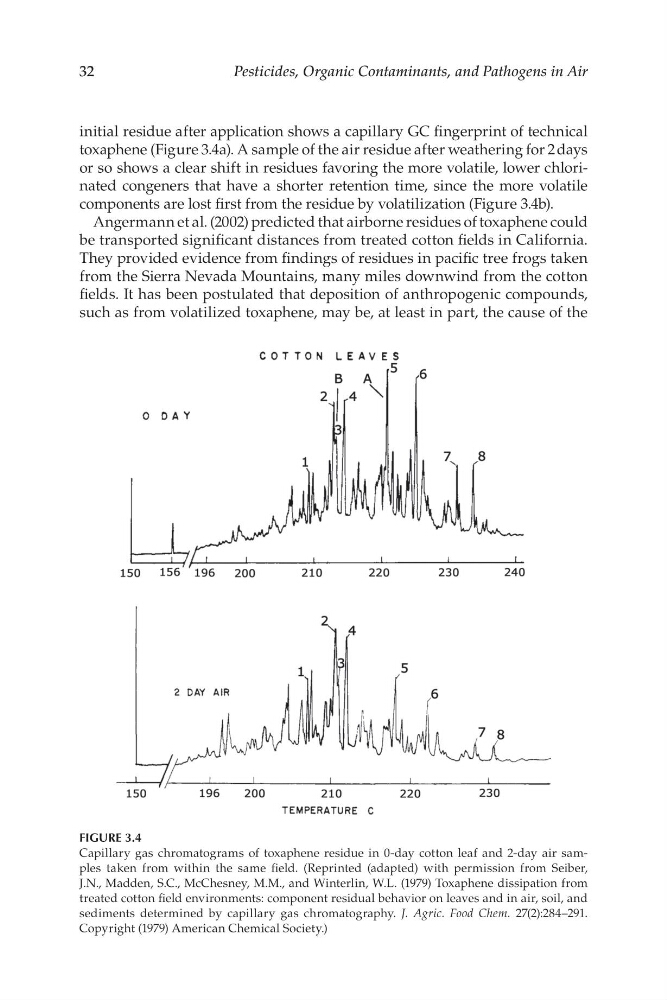
initial residue after application shows a capillary GC fngerprint of technical
toxaphene (Figure 3.4a). A sample of the air residue after weathering for 2 days
or so shows a clear shift in residues favoring the more volatile, lower chlorinated congeners that have a shorter retention time, since the more volatile
components are lost frst from the residue by volatilization (Figure 3.4b).
Angermann et al. (2002) predicted that airborne residues of toxaphene could
be transported signifcant distances from treated cotton felds in California.
They provided evidence from fndings of residues in pacifc tree frogs taken
from the Sierra Nevada Mountains, many miles downwind from the cotton
felds. It has been postulated that deposition of anthropogenic compounds,
such as from volatilized toxaphene, may be, at least in part, the cause of the
FIGURE 3.4
Capillary gas chromatograms of toxaphene residue in 0-day cotton leaf and 2-day air samples taken from within the same feld. (Reprinted (adapted) with permission from Seiber,
J.N., Madden, S.C., McChesney, M.M., and Winterlin, W.L. (1979) Toxaphene dissipation from
treated cotton feld environments: component residual behavior on leaves and in air, soil, and
sediments determined by capillary gas chromatography. J. Agric. Food Chem. 27(2):284–291.
Copyright (1979) American Chemical Society.)
Pesticides, Organic Contaminants, and Pathogens in Air
initial residue after application shows a capillary GC fngerprint of technical
toxaphene (Figure 3.4a). A sample of the air residue after weathering for 2 days
or so shows a clear shift in residues favoring the more volatile, lower chlorinated congeners that have a shorter retention time, since the more volatile
components are lost frst from the residue by volatilization (Figure 3.4b).
Angermann et al. (2002) predicted that airborne residues of toxaphene could
be transported signifcant distances from treated cotton felds in California.
They provided evidence from fndings of residues in pacifc tree frogs taken
from the Sierra Nevada Mountains, many miles downwind from the cotton
felds. It has been postulated that deposition of anthropogenic compounds,
such as from volatilized toxaphene, may be, at least in part, the cause of the
FIGURE 3.4
Capillary gas chromatograms of toxaphene residue in 0-day cotton leaf and 2-day air samples taken from within the same feld. (Reprinted (adapted) with permission from Seiber,
J.N., Madden, S.C., McChesney, M.M., and Winterlin, W.L. (1979) Toxaphene dissipation from
treated cotton feld environments: component residual behavior on leaves and in air, soil, and
sediments determined by capillary gas chromatography. J. Agric. Food Chem. 27(2):284–291.
Copyright (1979) American Chemical Society.)