

30
Pesticides, Organic Contaminants, and Pathogens in Air
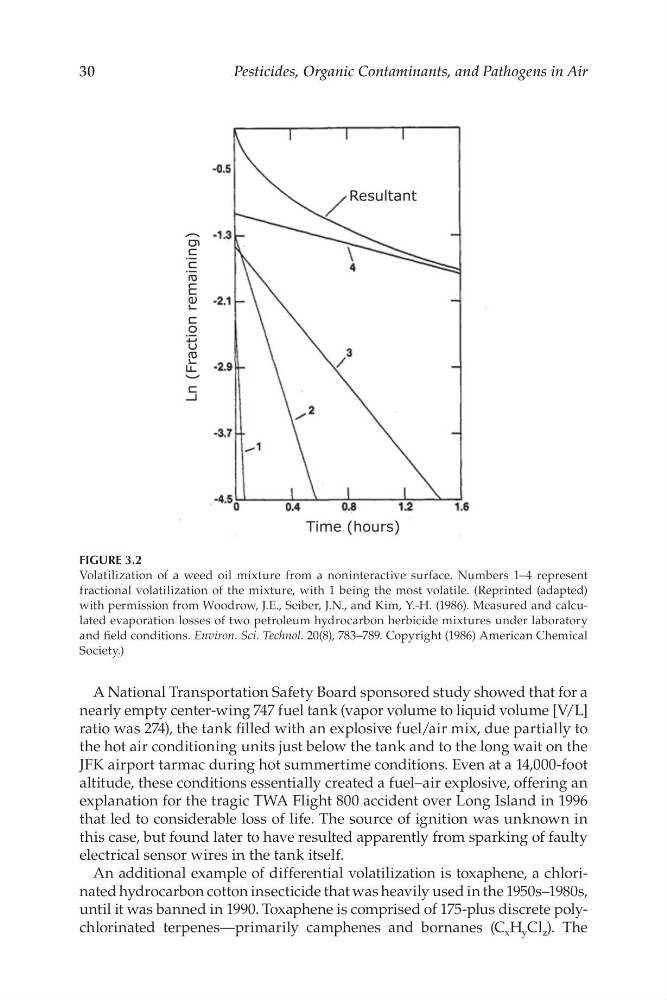
FIGURE 3.2
Volatilization of a weed oil mixture from a noninteractive surface. Numbers 1–4 represent
fractional volatilization of the mixture, with 1 being the most volatile. (Reprinted (adapted)
with permission from Woodrow, J.E., Seiber, J.N., and Kim, Y.-H. (1986). Measured and calculated evaporation losses of two petroleum hydrocarbon herbicide mixtures under laboratory
and feld conditions. Environ. Sci. Technol. 20(8), 783–789. Copyright (1986) American Chemical
Society.)
A National Transportation Safety Board sponsored study showed that for a
nearly empty center-wing 747 fuel tank (vapor volume to liquid volume [V/L]
ratio was 274), the tank flled with an explosive fuel/air mix, due partially to
the hot air conditioning units just below the tank and to the long wait on the
JFK airport tarmac during hot summertime conditions. Even at a 14,000-foot
altitude, these conditions essentially created a fuel–air explosive, offering an
explanation for the tragic TWA Flight 800 accident over Long Island in 1996
that led to considerable loss of life. The source of ignition was unknown in
this case, but found later to have resulted apparently from sparking of faulty
electrical sensor wires in the tank itself.
An additional example of differential volatilization is toxaphene, a chlorinated hydrocarbon cotton insecticide that was heavily used in the 1950s–1980s,
until it was banned in 1990. Toxaphene is comprised of 175-plus discrete polychlorinated terpenes—primarily camphenes and bornanes (C x H y Cl z ). The
Pesticides, Organic Contaminants, and Pathogens in Air
FIGURE 3.2
Volatilization of a weed oil mixture from a noninteractive surface. Numbers 1–4 represent
fractional volatilization of the mixture, with 1 being the most volatile. (Reprinted (adapted)
with permission from Woodrow, J.E., Seiber, J.N., and Kim, Y.-H. (1986). Measured and calculated evaporation losses of two petroleum hydrocarbon herbicide mixtures under laboratory
and feld conditions. Environ. Sci. Technol. 20(8), 783–789. Copyright (1986) American Chemical
Society.)
A National Transportation Safety Board sponsored study showed that for a
nearly empty center-wing 747 fuel tank (vapor volume to liquid volume [V/L]
ratio was 274), the tank flled with an explosive fuel/air mix, due partially to
the hot air conditioning units just below the tank and to the long wait on the
JFK airport tarmac during hot summertime conditions. Even at a 14,000-foot
altitude, these conditions essentially created a fuel–air explosive, offering an
explanation for the tragic TWA Flight 800 accident over Long Island in 1996
that led to considerable loss of life. The source of ignition was unknown in
this case, but found later to have resulted apparently from sparking of faulty
electrical sensor wires in the tank itself.
An additional example of differential volatilization is toxaphene, a chlorinated hydrocarbon cotton insecticide that was heavily used in the 1950s–1980s,
until it was banned in 1990. Toxaphene is comprised of 175-plus discrete polychlorinated terpenes—primarily camphenes and bornanes (C x H y Cl z ). The