

15
Historical and Current Uses of Pesticides
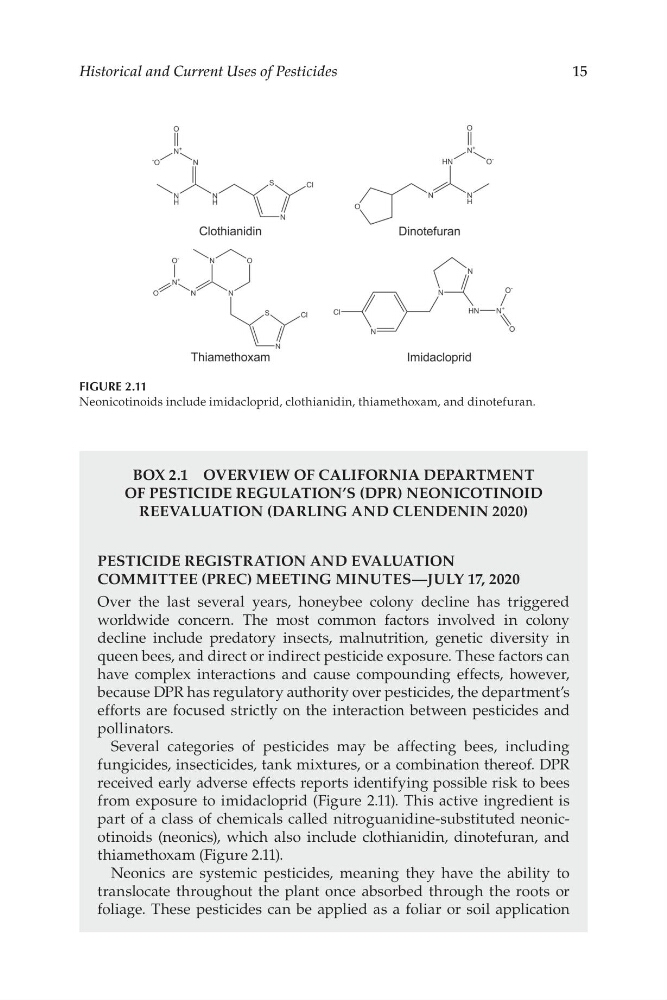
FIGURE 2.11
Neonicotinoids include imidacloprid, clothianidin, thiamethoxam, and dinotefuran.
BOX 2.1 OVERVIEW OF CALIFORNIA DEPARTMENT
OF PESTICIDE REGULATION’S (DPR) NEONICOTINOID
REEVALUATION (DARLING AND CLENDENIN 2020)
PESTICIDE REGISTRATION AND EVALUATION
COMMITTEE (PREC) MEETING MINUTES—JULY 17, 2020
Over the last several years, honeybee colony decline has triggered
worldwide concern. The most common factors involved in colony
decline include predatory insects, malnutrition, genetic diversity in
queen bees, and direct or indirect pesticide exposure. These factors can
have complex interactions and cause compounding effects, however,
because DPR has regulatory authority over pesticides, the department’s
efforts are focused strictly on the interaction between pesticides and
pollinators.
Several categories of pesticides may be affecting bees, including
fungicides, insecticides, tank mixtures, or a combination thereof. DPR
received early adverse effects reports identifying possible risk to bees
from exposure to imidacloprid (Figure 2.11). This active ingredient is
part of a class of chemicals called nitroguanidine-substituted neonicotinoids (neonics), which also include clothianidin, dinotefuran, and
thiamethoxam (Figure 2.11).
Neonics are systemic pesticides, meaning they have the ability to
translocate throughout the plant once absorbed through the roots or
foliage. These pesticides can be applied as a foliar or soil application
Historical and Current Uses of Pesticides
FIGURE 2.11
Neonicotinoids include imidacloprid, clothianidin, thiamethoxam, and dinotefuran.
BOX 2.1 OVERVIEW OF CALIFORNIA DEPARTMENT
OF PESTICIDE REGULATION’S (DPR) NEONICOTINOID
REEVALUATION (DARLING AND CLENDENIN 2020)
PESTICIDE REGISTRATION AND EVALUATION
COMMITTEE (PREC) MEETING MINUTES—JULY 17, 2020
Over the last several years, honeybee colony decline has triggered
worldwide concern. The most common factors involved in colony
decline include predatory insects, malnutrition, genetic diversity in
queen bees, and direct or indirect pesticide exposure. These factors can
have complex interactions and cause compounding effects, however,
because DPR has regulatory authority over pesticides, the department’s
efforts are focused strictly on the interaction between pesticides and
pollinators.
Several categories of pesticides may be affecting bees, including
fungicides, insecticides, tank mixtures, or a combination thereof. DPR
received early adverse effects reports identifying possible risk to bees
from exposure to imidacloprid (Figure 2.11). This active ingredient is
part of a class of chemicals called nitroguanidine-substituted neonicotinoids (neonics), which also include clothianidin, dinotefuran, and
thiamethoxam (Figure 2.11).
Neonics are systemic pesticides, meaning they have the ability to
translocate throughout the plant once absorbed through the roots or
foliage. These pesticides can be applied as a foliar or soil application