

11
Historical and Current Uses of Pesticides
In addition to acting as AChE inhibitors, some OPs can cause a delayed
effect that may not be reversible. Several non-insecticidal OPs, including
the widely used plasticizer and gasoline additive tri-o-cresyl phosphate
(TOCP), cause a longer lasting and more insidious poisoning effect termed
OP-induced delayed neuropathy. This delayed axonal neuropathy results
in sensory effects, slow degeneration of leg muscle control, and eventually paralysis. During prohibition, thousands of people experienced partial
paralysis after unintentionally consuming TOCP that was mistaken for an
alcoholic beverage—termed “ginger jake” paralysis. Additional poisoning
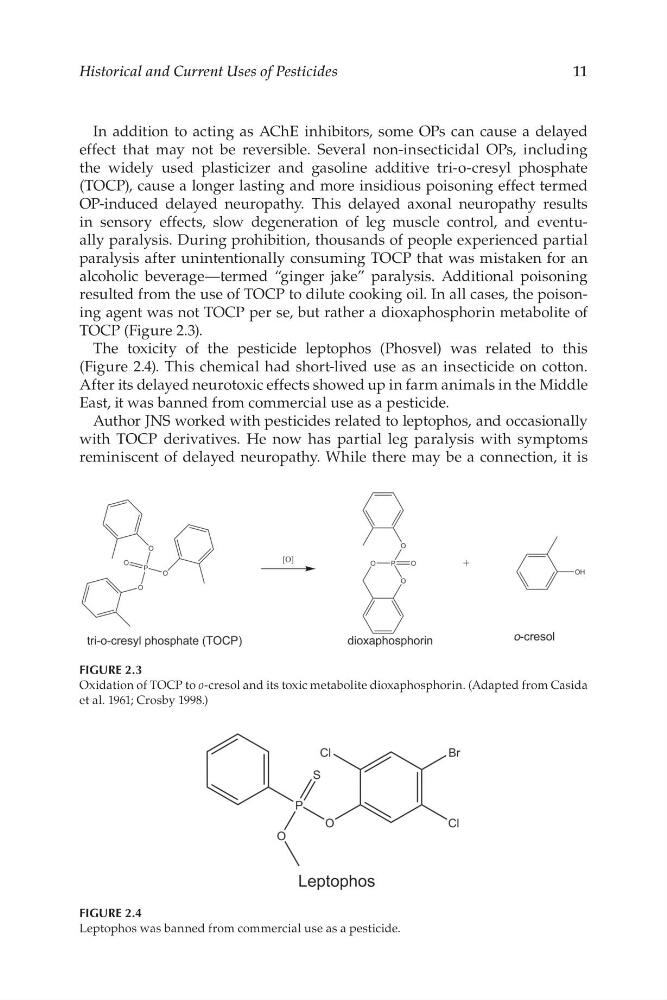
resulted from the use of TOCP to dilute cooking oil. In all cases, the poisoning agent was not TOCP per se, but rather a dioxaphosphorin metabolite of
TOCP (Figure 2.3).
The toxicity of the pesticide leptophos (Phosvel) was related to this
(Figure 2.4). This chemical had short-lived use as an insecticide on cotton.
After its delayed neurotoxic effects showed up in farm animals in the Middle
East, it was banned from commercial use as a pesticide.
Author JNS worked with pesticides related to leptophos, and occasionally
with TOCP derivatives. He now has partial leg paralysis with symptoms
reminiscent of delayed neuropathy. While there may be a connection, it is
FIGURE 2.3
Oxidation of TOCP to o-cresol and its toxic metabolite dioxaphosphorin. (Adapted from Casida
et al. 1961; Crosby 1998.)
FIGURE 2.4
Leptophos was banned from commercial use as a pesticide.
Historical and Current Uses of Pesticides
In addition to acting as AChE inhibitors, some OPs can cause a delayed
effect that may not be reversible. Several non-insecticidal OPs, including
the widely used plasticizer and gasoline additive tri-o-cresyl phosphate
(TOCP), cause a longer lasting and more insidious poisoning effect termed
OP-induced delayed neuropathy. This delayed axonal neuropathy results
in sensory effects, slow degeneration of leg muscle control, and eventually paralysis. During prohibition, thousands of people experienced partial
paralysis after unintentionally consuming TOCP that was mistaken for an
alcoholic beverage—termed “ginger jake” paralysis. Additional poisoning
resulted from the use of TOCP to dilute cooking oil. In all cases, the poisoning agent was not TOCP per se, but rather a dioxaphosphorin metabolite of
TOCP (Figure 2.3).
The toxicity of the pesticide leptophos (Phosvel) was related to this
(Figure 2.4). This chemical had short-lived use as an insecticide on cotton.
After its delayed neurotoxic effects showed up in farm animals in the Middle
East, it was banned from commercial use as a pesticide.
Author JNS worked with pesticides related to leptophos, and occasionally
with TOCP derivatives. He now has partial leg paralysis with symptoms
reminiscent of delayed neuropathy. While there may be a connection, it is
FIGURE 2.3
Oxidation of TOCP to o-cresol and its toxic metabolite dioxaphosphorin. (Adapted from Casida
et al. 1961; Crosby 1998.)
FIGURE 2.4
Leptophos was banned from commercial use as a pesticide.