

9
Historical and Current Uses of Pesticides
After its introduction, use of DDT expanded rapidly. DDT was cheap to
make and was a good control for malaria-bearing mosquitoes. The lethal
dose-50 (LD 50 ) for DDT to rats is 113 mg/kg—thus it was considered generally
safe for applicators. Other OCs introduced in the 1940s and 1950s included
benzene hexachloride, chlordane, toxaphene, aldrin, dieldrin, endrin, endosulfan, isobenzan, and methoxychlor. Methoxychlor was even less toxic than
DDT and broke down more readily in the environment. Despite this, DDT
use dominated.
These OCs were used to control a wide range of insects, including
malaria-bearing mosquitoes, pests in food and fber crops, and pests of livestock. Overuse led to resistant pests and toxicity to nontarget organisms:
the “pesticide treadmill.” Their low polarity and persistence in soil, aquatic
sediments, air, and biota caused a tendency to bioconcentrate in the tissues
of invertebrates and vertebrates. The OCs could move up trophic chains and
affect top predators (e.g., eagles and salmon). Industry started withdrawing
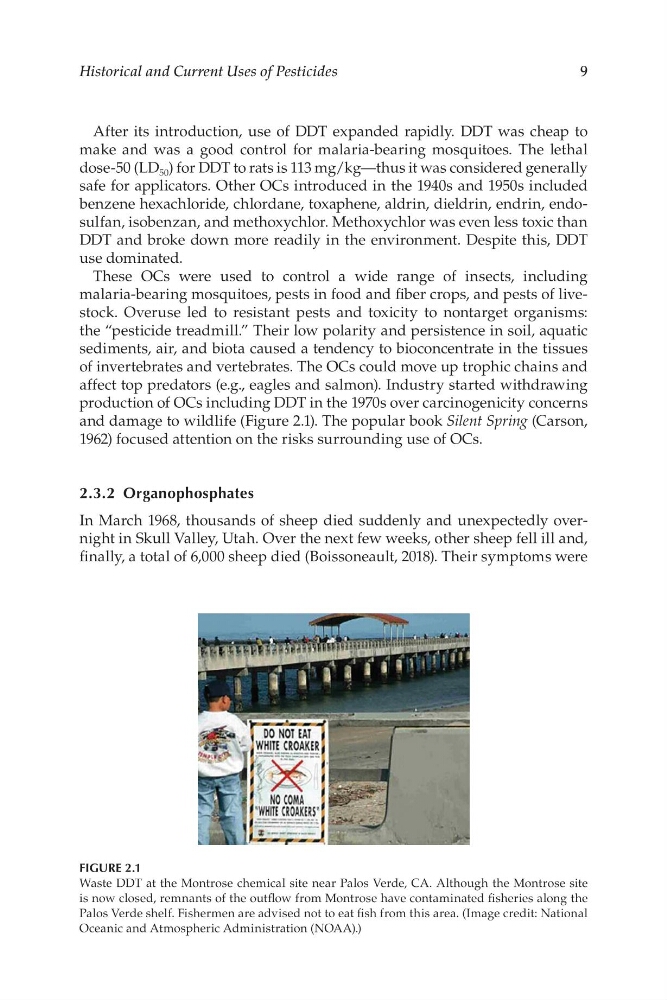
production of OCs including DDT in the 1970s over carcinogenicity concerns
and damage to wildlife (Figure 2.1). The popular book Silent Spring (Carson,
1962) focused attention on the risks surrounding use of OCs.
2.3.2 Organophosphates
In March 1968, thousands of sheep died suddenly and unexpectedly overnight in Skull Valley, Utah. Over the next few weeks, other sheep fell ill and,
fnally, a total of 6,000 sheep died (Boissoneault, 2018). Their symptoms were
FIGURE 2.1
Waste DDT at the Montrose chemical site near Palos Verde, CA. Although the Montrose site
is now closed, remnants of the outfow from Montrose have contaminated fsheries along the
Palos Verde shelf. Fishermen are advised not to eat fsh from this area. (Image credit: National
Oceanic and Atmospheric Administration (NOAA).)
Historical and Current Uses of Pesticides
After its introduction, use of DDT expanded rapidly. DDT was cheap to
make and was a good control for malaria-bearing mosquitoes. The lethal
dose-50 (LD 50 ) for DDT to rats is 113 mg/kg—thus it was considered generally
safe for applicators. Other OCs introduced in the 1940s and 1950s included
benzene hexachloride, chlordane, toxaphene, aldrin, dieldrin, endrin, endosulfan, isobenzan, and methoxychlor. Methoxychlor was even less toxic than
DDT and broke down more readily in the environment. Despite this, DDT
use dominated.
These OCs were used to control a wide range of insects, including
malaria-bearing mosquitoes, pests in food and fber crops, and pests of livestock. Overuse led to resistant pests and toxicity to nontarget organisms:
the “pesticide treadmill.” Their low polarity and persistence in soil, aquatic
sediments, air, and biota caused a tendency to bioconcentrate in the tissues
of invertebrates and vertebrates. The OCs could move up trophic chains and
affect top predators (e.g., eagles and salmon). Industry started withdrawing
production of OCs including DDT in the 1970s over carcinogenicity concerns
and damage to wildlife (Figure 2.1). The popular book Silent Spring (Carson,
1962) focused attention on the risks surrounding use of OCs.
2.3.2 Organophosphates
In March 1968, thousands of sheep died suddenly and unexpectedly overnight in Skull Valley, Utah. Over the next few weeks, other sheep fell ill and,
fnally, a total of 6,000 sheep died (Boissoneault, 2018). Their symptoms were
FIGURE 2.1
Waste DDT at the Montrose chemical site near Palos Verde, CA. Although the Montrose site
is now closed, remnants of the outfow from Montrose have contaminated fsheries along the
Palos Verde shelf. Fishermen are advised not to eat fsh from this area. (Image credit: National
Oceanic and Atmospheric Administration (NOAA).)