

Conclusions
217
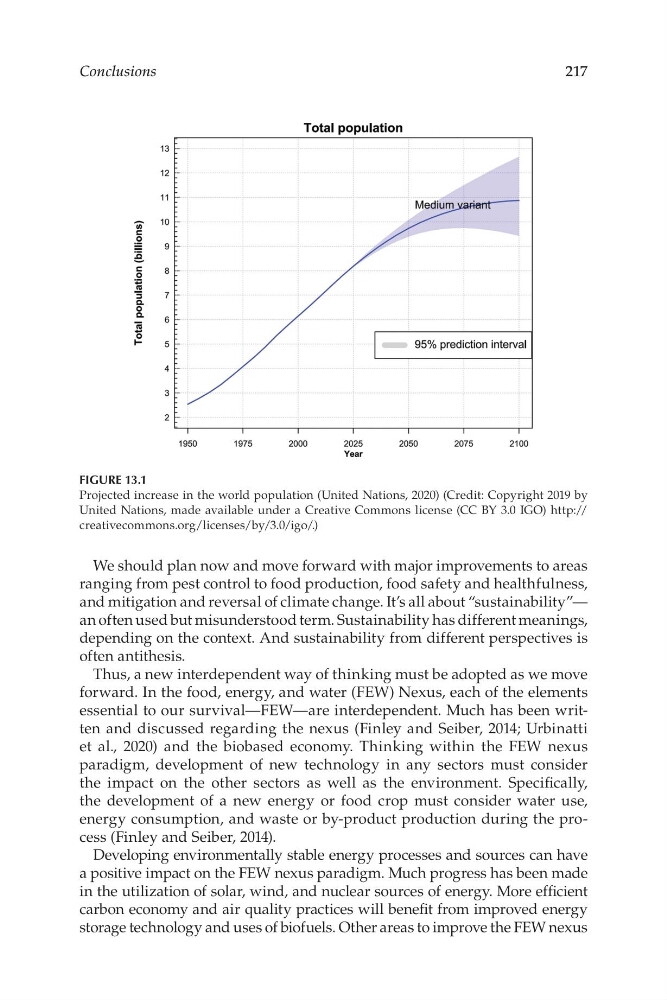
FIGURE 13.1
Projected increase in the world population (United Nations, 2020) (Credit: Copyright 2019 by
United Nations, made available under a Creative Commons license (CC BY 3.0 IGO) http://
creativecommons.org/licenses/by/3.0/igo/.)
We should plan now and move forward with major improvements to areas
ranging from pest control to food production, food safety and healthfulness,
and mitigation and reversal of climate change. It’s all about “sustainability”—
an often used but misunderstood term. Sustainability has different meanings,
depending on the context. And sustainability from different perspectives is
often antithesis.
Thus, a new interdependent way of thinking must be adopted as we move
forward. In the food, energy, and water (FEW) Nexus, each of the elements
essential to our survival—FEW—are interdependent. Much has been written and discussed regarding the nexus (Finley and Seiber, 2014; Urbinatti
et al., 2020) and the biobased economy. Thinking within the FEW nexus
paradigm, development of new technology in any sectors must consider
the impact on the other sectors as well as the environment. Specifcally,
the development of a new energy or food crop must consider water use,
energy consumption, and waste or by-product production during the process (Finley and Seiber, 2014).
Developing environmentally stable energy processes and sources can have
a positive impact on the FEW nexus paradigm. Much progress has been made
in the utilization of solar, wind, and nuclear sources of energy. More effcient
carbon economy and air quality practices will beneft from improved energy
storage technology and uses of biofuels. Other areas to improve the FEW nexus
217
FIGURE 13.1
Projected increase in the world population (United Nations, 2020) (Credit: Copyright 2019 by
United Nations, made available under a Creative Commons license (CC BY 3.0 IGO) http://
creativecommons.org/licenses/by/3.0/igo/.)
We should plan now and move forward with major improvements to areas
ranging from pest control to food production, food safety and healthfulness,
and mitigation and reversal of climate change. It’s all about “sustainability”—
an often used but misunderstood term. Sustainability has different meanings,
depending on the context. And sustainability from different perspectives is
often antithesis.
Thus, a new interdependent way of thinking must be adopted as we move
forward. In the food, energy, and water (FEW) Nexus, each of the elements
essential to our survival—FEW—are interdependent. Much has been written and discussed regarding the nexus (Finley and Seiber, 2014; Urbinatti
et al., 2020) and the biobased economy. Thinking within the FEW nexus
paradigm, development of new technology in any sectors must consider
the impact on the other sectors as well as the environment. Specifcally,
the development of a new energy or food crop must consider water use,
energy consumption, and waste or by-product production during the process (Finley and Seiber, 2014).
Developing environmentally stable energy processes and sources can have
a positive impact on the FEW nexus paradigm. Much progress has been made
in the utilization of solar, wind, and nuclear sources of energy. More effcient
carbon economy and air quality practices will beneft from improved energy
storage technology and uses of biofuels. Other areas to improve the FEW nexus