

184
Pesticides, Organic Contaminants, and Pathogens in Air
substantial economic damage, for example, the need to replant orchards
and vineyards. Training of farmers and PCOs backed by regulatory guidance on the product label and by the agricultural commissioner, cooperative extension, and other experienced personnel can help minimize drift
damage.
An associated problem occurs with drift of inadvertent residues via fogwater (see Chapter 7) to a crop on which the chemical is not registered for
use. This can entail an illegal residue fnding, resulting in destruction of the
crop or preventing its entry into trade channels. If it is due to long range drift
such that it is not clear where the residue originated, and it is determined
that the residues are not a threat to humans or wildlife, regulatory relief can
sometimes be obtained by adding the unintended crop that received the drift
residue to the product label so that it becomes then a legal residue at harvest,
with appropriate tolerance.
An unexpected source of volatilization with drift occurred following application of systemic carbamate insecticides to paddy rice at the International
Rice Research Institute (IRRI) in the Philippines. Application was by broadcast of a granular formulation of carbofuran with the expectation that granules would release the active ingredient such that it would be taken up by
roots of rice plants, then translocate through stems to leaves, controlling
brown planthoppers and other pests in the process. Air sampling above the
crop canopy showed that much of the parent carbamate plus some plant
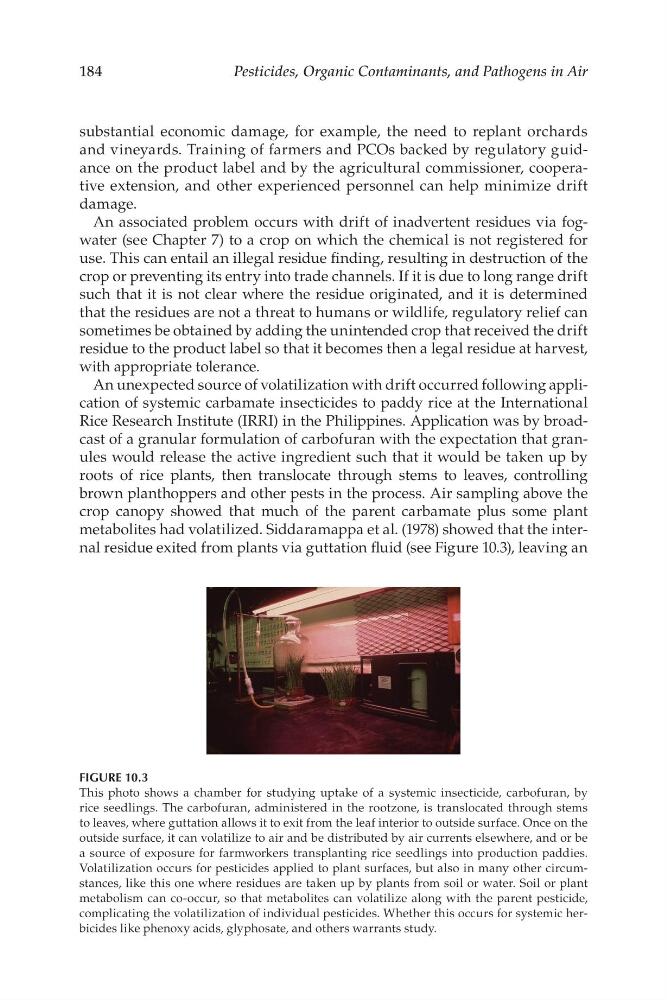
metabolites had volatilized. Siddaramappa et al. (1978) showed that the internal residue exited from plants via guttation fuid (see Figure 10.3), leaving an
FIGURE 10.3
This photo shows a chamber for studying uptake of a systemic insecticide, carbofuran, by
rice seedlings. The carbofuran, administered in the rootzone, is translocated through stems
to leaves, where guttation allows it to exit from the leaf interior to outside surface. Once on the
outside surface, it can volatilize to air and be distributed by air currents elsewhere, and or be
a source of exposure for farmworkers transplanting rice seedlings into production paddies.
Volatilization occurs for pesticides applied to plant surfaces, but also in many other circumstances, like this one where residues are taken up by plants from soil or water. Soil or plant
metabolism can co-occur, so that metabolites can volatilize along with the parent pesticide,
complicating the volatilization of individual pesticides. Whether this occurs for systemic herbicides like phenoxy acids, glyphosate, and others warrants study.
Pesticides, Organic Contaminants, and Pathogens in Air
substantial economic damage, for example, the need to replant orchards
and vineyards. Training of farmers and PCOs backed by regulatory guidance on the product label and by the agricultural commissioner, cooperative extension, and other experienced personnel can help minimize drift
damage.
An associated problem occurs with drift of inadvertent residues via fogwater (see Chapter 7) to a crop on which the chemical is not registered for
use. This can entail an illegal residue fnding, resulting in destruction of the
crop or preventing its entry into trade channels. If it is due to long range drift
such that it is not clear where the residue originated, and it is determined
that the residues are not a threat to humans or wildlife, regulatory relief can
sometimes be obtained by adding the unintended crop that received the drift
residue to the product label so that it becomes then a legal residue at harvest,
with appropriate tolerance.
An unexpected source of volatilization with drift occurred following application of systemic carbamate insecticides to paddy rice at the International
Rice Research Institute (IRRI) in the Philippines. Application was by broadcast of a granular formulation of carbofuran with the expectation that granules would release the active ingredient such that it would be taken up by
roots of rice plants, then translocate through stems to leaves, controlling
brown planthoppers and other pests in the process. Air sampling above the
crop canopy showed that much of the parent carbamate plus some plant
metabolites had volatilized. Siddaramappa et al. (1978) showed that the internal residue exited from plants via guttation fuid (see Figure 10.3), leaving an
FIGURE 10.3
This photo shows a chamber for studying uptake of a systemic insecticide, carbofuran, by
rice seedlings. The carbofuran, administered in the rootzone, is translocated through stems
to leaves, where guttation allows it to exit from the leaf interior to outside surface. Once on the
outside surface, it can volatilize to air and be distributed by air currents elsewhere, and or be
a source of exposure for farmworkers transplanting rice seedlings into production paddies.
Volatilization occurs for pesticides applied to plant surfaces, but also in many other circumstances, like this one where residues are taken up by plants from soil or water. Soil or plant
metabolism can co-occur, so that metabolites can volatilize along with the parent pesticide,
complicating the volatilization of individual pesticides. Whether this occurs for systemic herbicides like phenoxy acids, glyphosate, and others warrants study.