

162
Pesticides, Organic Contaminants, and Pathogens in Air
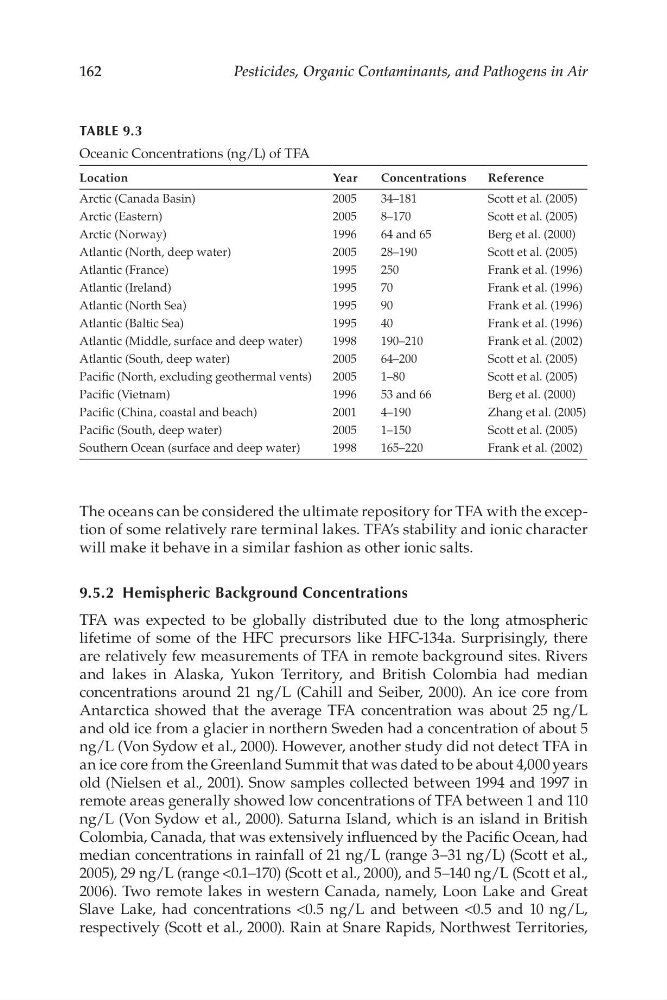
TABLE 9.3
Oceanic Concentrations (ng/L) of TFA
Location
Year
Concentrations
Reference
Arctic (Canada Basin)
2005
34–181
Scott et al. (2005)
Arctic (Eastern)
2005
8–170
Scott et al. (2005)
Arctic (Norway)
1996
64 and 65
Berg et al. (2000)
Atlantic (North, deep water)
2005
28–190
Scott et al. (2005)
Atlantic (France)
1995
250
Frank et al. (1996)
Atlantic (Ireland)
1995
70
Frank et al. (1996)
Atlantic (North Sea)
1995
90
Frank et al. (1996)
Atlantic (Baltic Sea)
1995
40
Frank et al. (1996)
Atlantic (Middle, surface and deep water)
1998
190–210
Frank et al. (2002)
Atlantic (South, deep water)
2005
64–200
Scott et al. (2005)
Pacifc (North, excluding geothermal vents)
2005
1–80
Scott et al. (2005)
Pacifc (Vietnam)
1996
53 and 66
Berg et al. (2000)
Pacifc (China, coastal and beach)
2001
4–190
Zhang et al. (2005)
Pacifc (South, deep water)
2005
1–150
Scott et al. (2005)
Southern Ocean (surface and deep water)
1998
165–220
Frank et al. (2002)
The oceans can be considered the ultimate repository for TFA with the exception of some relatively rare terminal lakes. TFA’s stability and ionic character
will make it behave in a similar fashion as other ionic salts.
9.5.2 Hemispheric Background Concentrations
TFA was expected to be globally distributed due to the long atmospheric
lifetime of some of the HFC precursors like HFC-134a. Surprisingly, there
are relatively few measurements of TFA in remote background sites. Rivers
and lakes in Alaska, Yukon Territory, and British Colombia had median
concentrations around 21 ng/L (Cahill and Seiber, 2000). An ice core from
Antarctica showed that the average TFA concentration was about 25 ng/L
and old ice from a glacier in northern Sweden had a concentration of about 5
ng/L (Von Sydow et al., 2000). However, another study did not detect TFA in
an ice core from the Greenland Summit that was dated to be about 4,000 years
old (Nielsen et al., 2001). Snow samples collected between 1994 and 1997 in
remote areas generally showed low concentrations of TFA between 1 and 110
ng/L (Von Sydow et al., 2000). Saturna Island, which is an island in British
Colombia, Canada, that was extensively infuenced by the Pacifc Ocean, had
median concentrations in rainfall of 21 ng/L (range 3–31 ng/L) (Scott et al.,
2005), 29 ng/L (range <0.1–170) (Scott et al., 2000), and 5–140 ng/L (Scott et al.,
2006). Two remote lakes in western Canada, namely, Loon Lake and Great
Slave Lake, had concentrations <0.5 ng/L and between <0.5 and 10 ng/L,
respectively (Scott et al., 2000). Rain at Snare Rapids, Northwest Territories,
Pesticides, Organic Contaminants, and Pathogens in Air
TABLE 9.3
Oceanic Concentrations (ng/L) of TFA
Location
Year
Concentrations
Reference
Arctic (Canada Basin)
2005
34–181
Scott et al. (2005)
Arctic (Eastern)
2005
8–170
Scott et al. (2005)
Arctic (Norway)
1996
64 and 65
Berg et al. (2000)
Atlantic (North, deep water)
2005
28–190
Scott et al. (2005)
Atlantic (France)
1995
250
Frank et al. (1996)
Atlantic (Ireland)
1995
70
Frank et al. (1996)
Atlantic (North Sea)
1995
90
Frank et al. (1996)
Atlantic (Baltic Sea)
1995
40
Frank et al. (1996)
Atlantic (Middle, surface and deep water)
1998
190–210
Frank et al. (2002)
Atlantic (South, deep water)
2005
64–200
Scott et al. (2005)
Pacifc (North, excluding geothermal vents)
2005
1–80
Scott et al. (2005)
Pacifc (Vietnam)
1996
53 and 66
Berg et al. (2000)
Pacifc (China, coastal and beach)
2001
4–190
Zhang et al. (2005)
Pacifc (South, deep water)
2005
1–150
Scott et al. (2005)
Southern Ocean (surface and deep water)
1998
165–220
Frank et al. (2002)
The oceans can be considered the ultimate repository for TFA with the exception of some relatively rare terminal lakes. TFA’s stability and ionic character
will make it behave in a similar fashion as other ionic salts.
9.5.2 Hemispheric Background Concentrations
TFA was expected to be globally distributed due to the long atmospheric
lifetime of some of the HFC precursors like HFC-134a. Surprisingly, there
are relatively few measurements of TFA in remote background sites. Rivers
and lakes in Alaska, Yukon Territory, and British Colombia had median
concentrations around 21 ng/L (Cahill and Seiber, 2000). An ice core from
Antarctica showed that the average TFA concentration was about 25 ng/L
and old ice from a glacier in northern Sweden had a concentration of about 5
ng/L (Von Sydow et al., 2000). However, another study did not detect TFA in
an ice core from the Greenland Summit that was dated to be about 4,000 years
old (Nielsen et al., 2001). Snow samples collected between 1994 and 1997 in
remote areas generally showed low concentrations of TFA between 1 and 110
ng/L (Von Sydow et al., 2000). Saturna Island, which is an island in British
Colombia, Canada, that was extensively infuenced by the Pacifc Ocean, had
median concentrations in rainfall of 21 ng/L (range 3–31 ng/L) (Scott et al.,
2005), 29 ng/L (range <0.1–170) (Scott et al., 2000), and 5–140 ng/L (Scott et al.,
2006). Two remote lakes in western Canada, namely, Loon Lake and Great
Slave Lake, had concentrations <0.5 ng/L and between <0.5 and 10 ng/L,
respectively (Scott et al., 2000). Rain at Snare Rapids, Northwest Territories,