

152
Pesticides, Organic Contaminants, and Pathogens in Air
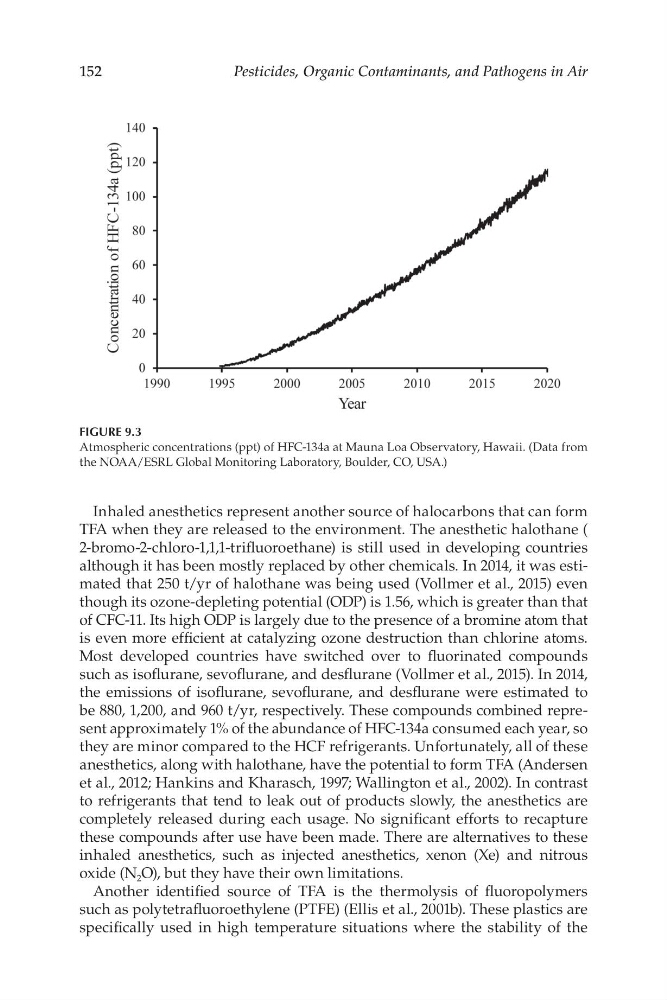
FIGURE 9.3
Atmospheric concentrations (ppt) of HFC-134a at Mauna Loa Observatory, Hawaii. (Data from
the NOAA/ESRL Global Monitoring Laboratory, Boulder, CO, USA.)
Inhaled anesthetics represent another source of halocarbons that can form
TFA when they are released to the environment. The anesthetic halothane (
2-bromo-2-chloro-1,1,1-trifuoroethane) is still used in developing countries
although it has been mostly replaced by other chemicals. In 2014, it was estimated that 250 t/yr of halothane was being used (Vollmer et al., 2015) even
though its ozone-depleting potential (ODP) is 1.56, which is greater than that
of CFC-11. Its high ODP is largely due to the presence of a bromine atom that
is even more effcient at catalyzing ozone destruction than chlorine atoms.
Most developed countries have switched over to fuorinated compounds
such as isofurane, sevofurane, and desfurane (Vollmer et al., 2015). In 2014,
the emissions of isofurane, sevofurane, and desfurane were estimated to
be 880, 1,200, and 960 t/yr, respectively. These compounds combined represent approximately 1% of the abundance of HFC-134a consumed each year, so
they are minor compared to the HCF refrigerants. Unfortunately, all of these
anesthetics, along with halothane, have the potential to form TFA (Andersen
et al., 2012; Hankins and Kharasch, 1997; Wallington et al., 2002). In contrast
to refrigerants that tend to leak out of products slowly, the anesthetics are
completely released during each usage. No signifcant efforts to recapture
these compounds after use have been made. There are alternatives to these
inhaled anesthetics, such as injected anesthetics, xenon (Xe) and nitrous
oxide (N 2 O), but they have their own limitations.
Another identifed source of TFA is the thermolysis of fuoropolymers
such as polytetrafuoroethylene (PTFE) (Ellis et al., 2001b). These plastics are
specifcally used in high temperature situations where the stability of the
Pesticides, Organic Contaminants, and Pathogens in Air
FIGURE 9.3
Atmospheric concentrations (ppt) of HFC-134a at Mauna Loa Observatory, Hawaii. (Data from
the NOAA/ESRL Global Monitoring Laboratory, Boulder, CO, USA.)
Inhaled anesthetics represent another source of halocarbons that can form
TFA when they are released to the environment. The anesthetic halothane (
2-bromo-2-chloro-1,1,1-trifuoroethane) is still used in developing countries
although it has been mostly replaced by other chemicals. In 2014, it was estimated that 250 t/yr of halothane was being used (Vollmer et al., 2015) even
though its ozone-depleting potential (ODP) is 1.56, which is greater than that
of CFC-11. Its high ODP is largely due to the presence of a bromine atom that
is even more effcient at catalyzing ozone destruction than chlorine atoms.
Most developed countries have switched over to fuorinated compounds
such as isofurane, sevofurane, and desfurane (Vollmer et al., 2015). In 2014,
the emissions of isofurane, sevofurane, and desfurane were estimated to
be 880, 1,200, and 960 t/yr, respectively. These compounds combined represent approximately 1% of the abundance of HFC-134a consumed each year, so
they are minor compared to the HCF refrigerants. Unfortunately, all of these
anesthetics, along with halothane, have the potential to form TFA (Andersen
et al., 2012; Hankins and Kharasch, 1997; Wallington et al., 2002). In contrast
to refrigerants that tend to leak out of products slowly, the anesthetics are
completely released during each usage. No signifcant efforts to recapture
these compounds after use have been made. There are alternatives to these
inhaled anesthetics, such as injected anesthetics, xenon (Xe) and nitrous
oxide (N 2 O), but they have their own limitations.
Another identifed source of TFA is the thermolysis of fuoropolymers
such as polytetrafuoroethylene (PTFE) (Ellis et al., 2001b). These plastics are
specifcally used in high temperature situations where the stability of the