

Authors
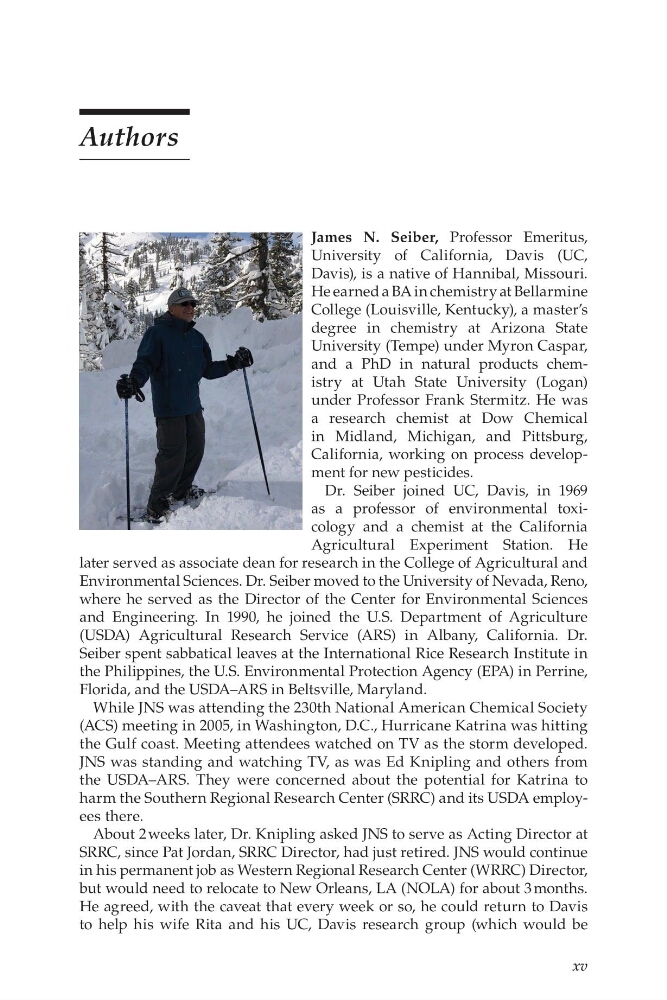
James N. Seiber, Professor Emeritus,
University of California, Davis (UC,
Davis), is a native of Hannibal, Missouri.
He earned a BA in chemistry at Bellarmine
College (Louisville, Kentucky), a master’s
degree in chemistry at Arizona State
University (Tempe) under Myron Caspar,
and a PhD in natural products chemistry at Utah State University (Logan)
under Professor Frank Stermitz. He was
a research chemist at Dow Chemical
in Midland, Michigan, and Pittsburg,
California, working on process development for new pesticides.
Dr. Seiber joined UC, Davis, in 1969
as a professor of environmental toxicology and a chemist at the California
Agricultural Experiment Station. He
later served as associate dean for research in the College of Agricultural and
Environmental Sciences. Dr. Seiber moved to the University of Nevada, Reno,
where he served as the Director of the Center for Environmental Sciences
and Engineering. In 1990, he joined the U.S. Department of Agriculture
(USDA) Agricultural Research Service (ARS) in Albany, California. Dr.
Seiber spent sabbatical leaves at the International Rice Research Institute in
the Philippines, the U.S. Environmental Protection Agency (EPA) in Perrine,
Florida, and the USDA–ARS in Beltsville, Maryland.
While JNS was attending the 230th National American Chemical Society
(ACS) meeting in 2005, in Washington, D.C., Hurricane Katrina was hitting
the Gulf coast. Meeting attendees watched on TV as the storm developed.
JNS was standing and watching TV, as was Ed Knipling and others from
the USDA–ARS. They were concerned about the potential for Katrina to
harm the Southern Regional Research Center (SRRC) and its USDA employees there.
About 2 weeks later, Dr. Knipling asked JNS to serve as Acting Director at
SRRC, since Pat Jordan, SRRC Director, had just retired. JNS would continue
in his permanent job as Western Regional Research Center (WRRC) Director,
but would need to relocate to New Orleans, LA (NOLA) for about 3 months.
He agreed, with the caveat that every week or so, he could return to Davis
to help his wife Rita and his UC, Davis research group (which would be
xv
James N. Seiber, Professor Emeritus,
University of California, Davis (UC,
Davis), is a native of Hannibal, Missouri.
He earned a BA in chemistry at Bellarmine
College (Louisville, Kentucky), a master’s
degree in chemistry at Arizona State
University (Tempe) under Myron Caspar,
and a PhD in natural products chemistry at Utah State University (Logan)
under Professor Frank Stermitz. He was
a research chemist at Dow Chemical
in Midland, Michigan, and Pittsburg,
California, working on process development for new pesticides.
Dr. Seiber joined UC, Davis, in 1969
as a professor of environmental toxicology and a chemist at the California
Agricultural Experiment Station. He
later served as associate dean for research in the College of Agricultural and
Environmental Sciences. Dr. Seiber moved to the University of Nevada, Reno,
where he served as the Director of the Center for Environmental Sciences
and Engineering. In 1990, he joined the U.S. Department of Agriculture
(USDA) Agricultural Research Service (ARS) in Albany, California. Dr.
Seiber spent sabbatical leaves at the International Rice Research Institute in
the Philippines, the U.S. Environmental Protection Agency (EPA) in Perrine,
Florida, and the USDA–ARS in Beltsville, Maryland.
While JNS was attending the 230th National American Chemical Society
(ACS) meeting in 2005, in Washington, D.C., Hurricane Katrina was hitting
the Gulf coast. Meeting attendees watched on TV as the storm developed.
JNS was standing and watching TV, as was Ed Knipling and others from
the USDA–ARS. They were concerned about the potential for Katrina to
harm the Southern Regional Research Center (SRRC) and its USDA employees there.
About 2 weeks later, Dr. Knipling asked JNS to serve as Acting Director at
SRRC, since Pat Jordan, SRRC Director, had just retired. JNS would continue
in his permanent job as Western Regional Research Center (WRRC) Director,
but would need to relocate to New Orleans, LA (NOLA) for about 3 months.
He agreed, with the caveat that every week or so, he could return to Davis
to help his wife Rita and his UC, Davis research group (which would be
xv