

128
Pesticides, Organic Contaminants, and Pathogens in Air
8.3 Emissions of MeBr from Agricultural Fields:
Rate Estimates and Methods of Reduction
Numerous scientists have studied the environmental fate and transport of
MeBr; searched for replacement chemicals and/or nonchemical alternatives;
and developed new methodology which improves containment of MeBr (or
any alternative fumigant) to the treatment zone, while maintaining adequate
pest control. Research on the environmental fate and transport of MeBr and
other fumigants follows the general U.S. Environmental Protection Agency
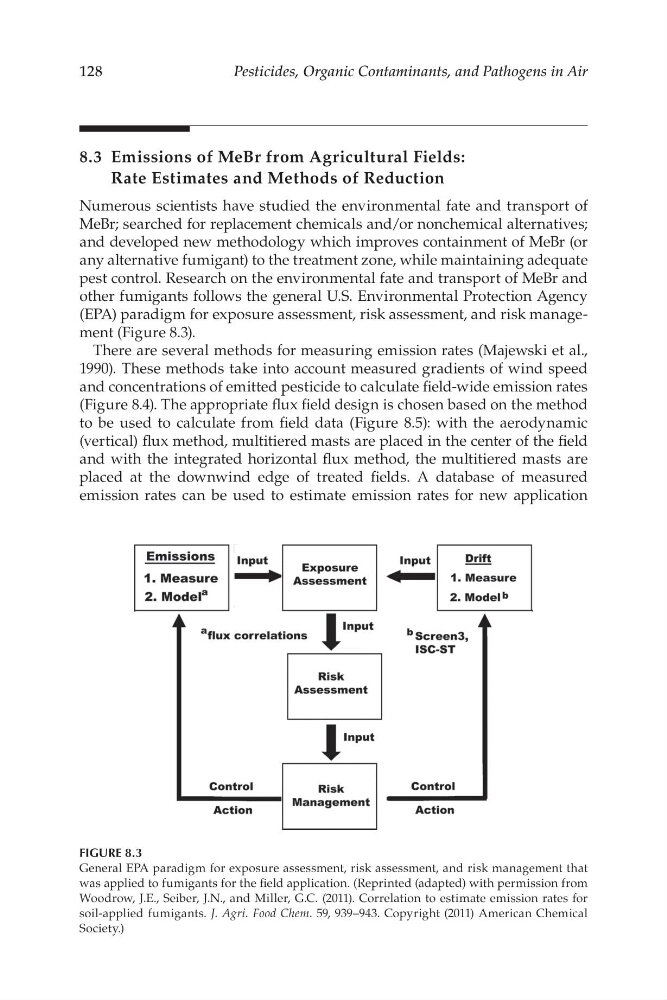
(EPA) paradigm for exposure assessment, risk assessment, and risk management (Figure 8.3).
There are several methods for measuring emission rates (Majewski et al.,
1990). These methods take into account measured gradients of wind speed
and concentrations of emitted pesticide to calculate feld-wide emission rates
(Figure 8.4). The appropriate fux feld design is chosen based on the method
to be used to calculate from feld data (Figure 8.5): with the aerodynamic
(vertical) fux method, multitiered masts are placed in the center of the feld
and with the integrated horizontal fux method, the multitiered masts are
placed at the downwind edge of treated felds. A database of measured
emission rates can be used to estimate emission rates for new application
FIGURE 8.3
General EPA paradigm for exposure assessment, risk assessment, and risk management that
was applied to fumigants for the feld application. (Reprinted (adapted) with permission from
Woodrow, J.E., Seiber, J.N., and Miller, G.C. (2011). Correlation to estimate emission rates for
soil-applied fumigants. J. Agri. Food Chem. 59, 939–943. Copyright (2011) American Chemical
Society.)
Pesticides, Organic Contaminants, and Pathogens in Air
8.3 Emissions of MeBr from Agricultural Fields:
Rate Estimates and Methods of Reduction
Numerous scientists have studied the environmental fate and transport of
MeBr; searched for replacement chemicals and/or nonchemical alternatives;
and developed new methodology which improves containment of MeBr (or
any alternative fumigant) to the treatment zone, while maintaining adequate
pest control. Research on the environmental fate and transport of MeBr and
other fumigants follows the general U.S. Environmental Protection Agency
(EPA) paradigm for exposure assessment, risk assessment, and risk management (Figure 8.3).
There are several methods for measuring emission rates (Majewski et al.,
1990). These methods take into account measured gradients of wind speed
and concentrations of emitted pesticide to calculate feld-wide emission rates
(Figure 8.4). The appropriate fux feld design is chosen based on the method
to be used to calculate from feld data (Figure 8.5): with the aerodynamic
(vertical) fux method, multitiered masts are placed in the center of the feld
and with the integrated horizontal fux method, the multitiered masts are
placed at the downwind edge of treated felds. A database of measured
emission rates can be used to estimate emission rates for new application
FIGURE 8.3
General EPA paradigm for exposure assessment, risk assessment, and risk management that
was applied to fumigants for the feld application. (Reprinted (adapted) with permission from
Woodrow, J.E., Seiber, J.N., and Miller, G.C. (2011). Correlation to estimate emission rates for
soil-applied fumigants. J. Agri. Food Chem. 59, 939–943. Copyright (2011) American Chemical
Society.)