

113
Pesticides in Fog
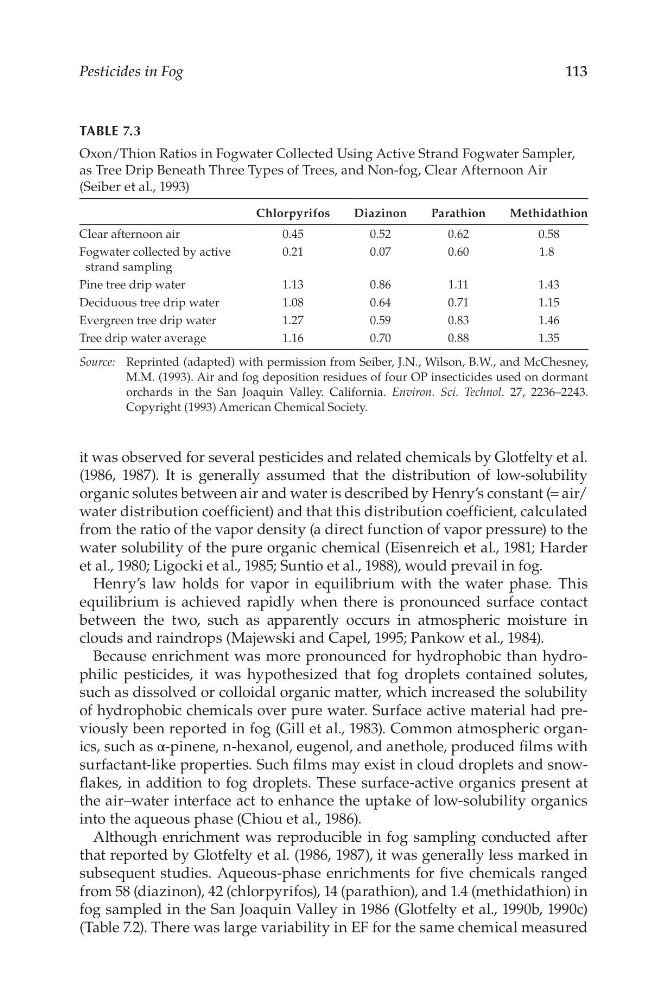
TABLE 7.3
Oxon/Thion Ratios in Fogwater Collected Using Active Strand Fogwater Sampler,
as Tree Drip Beneath Three Types of Trees, and Non-fog, Clear Afternoon Air
(Seiber et al., 1993)
Chlorpyrifos
Diazinon
Parathion
Methidathion
Clear afternoon air
0.45
0.52
0.62
0.58
Fogwater collected by active
0.21
0.07
0.60
1.8
strand sampling
Pine tree drip water
1.13
0.86
1.11
1.43
Deciduous tree drip water
1.08
0.64
0.71
1.15
Evergreen tree drip water
1.27
0.59
0.83
1.46
Tree drip water average
1.16
0.70
0.88
1.35
Source: Reprinted (adapted) with permission from Seiber, J.N., Wilson, B.W., and McChesney,
M.M. (1993). Air and fog deposition residues of four OP insecticides used on dormant
orchards in the San Joaquin Valley. California. Environ. Sci. Technol. 27, 2236–2243.
Copyright (1993) American Chemical Society.
it was observed for several pesticides and related chemicals by Glotfelty et al.
(1986, 1987). It is generally assumed that the distribution of low-solubility
organic solutes between air and water is described by Henry’s constant (= air/
water distribution coeffcient) and that this distribution coeffcient, calculated
from the ratio of the vapor density (a direct function of vapor pressure) to the
water solubility of the pure organic chemical (Eisenreich et al., 1981; Harder
et al., 1980; Ligocki et al., 1985; Suntio et al., 1988), would prevail in fog.
Henry’s law holds for vapor in equilibrium with the water phase. This
equilibrium is achieved rapidly when there is pronounced surface contact
between the two, such as apparently occurs in atmospheric moisture in
clouds and raindrops (Majewski and Capel, 1995; Pankow et al., 1984).
Because enrichment was more pronounced for hydrophobic than hydrophilic pesticides, it was hypothesized that fog droplets contained solutes,
such as dissolved or colloidal organic matter, which increased the solubility
of hydrophobic chemicals over pure water. Surface active material had previously been reported in fog (Gill et al., 1983). Common atmospheric organics, such as α-pinene, n-hexanol, eugenol, and anethole, produced flms with
surfactant-like properties. Such flms may exist in cloud droplets and snowfakes, in addition to fog droplets. These surface-active organics present at
the air–water interface act to enhance the uptake of low-solubility organics
into the aqueous phase (Chiou et al., 1986).
Although enrichment was reproducible in fog sampling conducted after
that reported by Glotfelty et al. (1986, 1987), it was generally less marked in
subsequent studies. Aqueous-phase enrichments for fve chemicals ranged
from 58 (diazinon), 42 (chlorpyrifos), 14 (parathion), and 1.4 (methidathion) in
fog sampled in the San Joaquin Valley in 1986 (Glotfelty et al., 1990b, 1990c)
(Table 7.2). There was large variability in EF for the same chemical measured
Pesticides in Fog
TABLE 7.3
Oxon/Thion Ratios in Fogwater Collected Using Active Strand Fogwater Sampler,
as Tree Drip Beneath Three Types of Trees, and Non-fog, Clear Afternoon Air
(Seiber et al., 1993)
Chlorpyrifos
Diazinon
Parathion
Methidathion
Clear afternoon air
0.45
0.52
0.62
0.58
Fogwater collected by active
0.21
0.07
0.60
1.8
strand sampling
Pine tree drip water
1.13
0.86
1.11
1.43
Deciduous tree drip water
1.08
0.64
0.71
1.15
Evergreen tree drip water
1.27
0.59
0.83
1.46
Tree drip water average
1.16
0.70
0.88
1.35
Source: Reprinted (adapted) with permission from Seiber, J.N., Wilson, B.W., and McChesney,
M.M. (1993). Air and fog deposition residues of four OP insecticides used on dormant
orchards in the San Joaquin Valley. California. Environ. Sci. Technol. 27, 2236–2243.
Copyright (1993) American Chemical Society.
it was observed for several pesticides and related chemicals by Glotfelty et al.
(1986, 1987). It is generally assumed that the distribution of low-solubility
organic solutes between air and water is described by Henry’s constant (= air/
water distribution coeffcient) and that this distribution coeffcient, calculated
from the ratio of the vapor density (a direct function of vapor pressure) to the
water solubility of the pure organic chemical (Eisenreich et al., 1981; Harder
et al., 1980; Ligocki et al., 1985; Suntio et al., 1988), would prevail in fog.
Henry’s law holds for vapor in equilibrium with the water phase. This
equilibrium is achieved rapidly when there is pronounced surface contact
between the two, such as apparently occurs in atmospheric moisture in
clouds and raindrops (Majewski and Capel, 1995; Pankow et al., 1984).
Because enrichment was more pronounced for hydrophobic than hydrophilic pesticides, it was hypothesized that fog droplets contained solutes,
such as dissolved or colloidal organic matter, which increased the solubility
of hydrophobic chemicals over pure water. Surface active material had previously been reported in fog (Gill et al., 1983). Common atmospheric organics, such as α-pinene, n-hexanol, eugenol, and anethole, produced flms with
surfactant-like properties. Such flms may exist in cloud droplets and snowfakes, in addition to fog droplets. These surface-active organics present at
the air–water interface act to enhance the uptake of low-solubility organics
into the aqueous phase (Chiou et al., 1986).
Although enrichment was reproducible in fog sampling conducted after
that reported by Glotfelty et al. (1986, 1987), it was generally less marked in
subsequent studies. Aqueous-phase enrichments for fve chemicals ranged
from 58 (diazinon), 42 (chlorpyrifos), 14 (parathion), and 1.4 (methidathion) in
fog sampled in the San Joaquin Valley in 1986 (Glotfelty et al., 1990b, 1990c)
(Table 7.2). There was large variability in EF for the same chemical measured