

92
Pesticides, Organic Contaminants, and Pathogens in Air
for being representative of the region in question. It is important to collect
suffcient volumes of air to exceed the limit of quantitation of the analytical
methods employed. Such characteristics will help in designing a sampling
approach that is quantitative and representative.
6.2.1 Sampler Design
In 1960, the U.S. Public Health Service (USPHS) embarked on companion studies of pesticides in air and in human adipose tissues in the United
States, mainly organochlorine (OC) insecticides and chlorinated contaminants like polychlorinated biphenyls (PCBs). The air study was contracted
to the University of Miami, which developed and applied Greenburg–Smith
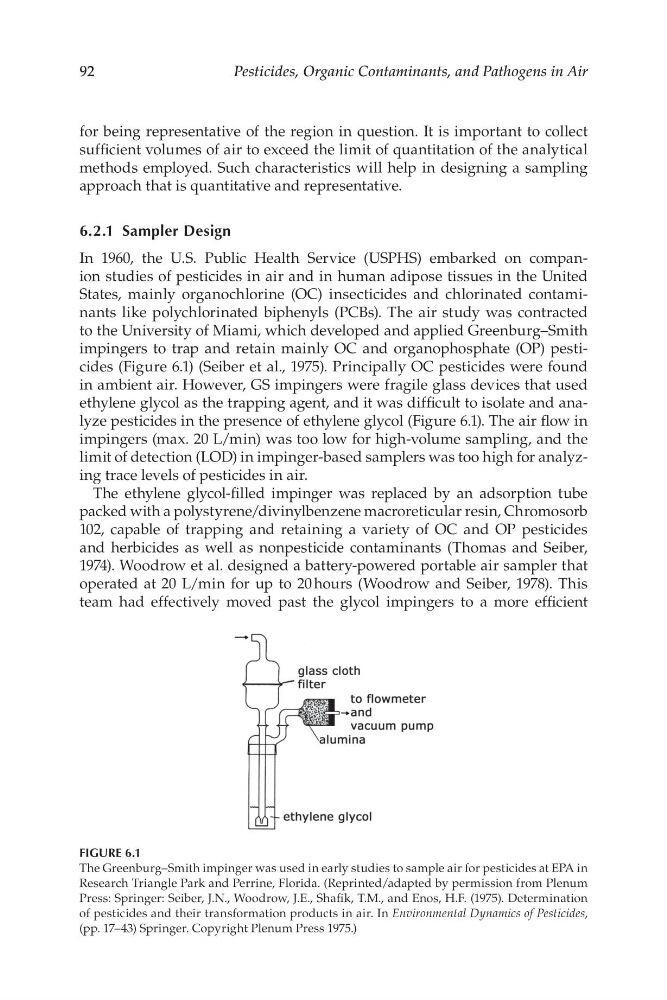
impingers to trap and retain mainly OC and organophosphate (OP) pesticides (Figure 6.1) (Seiber et al., 1975). Principally OC pesticides were found
in ambient air. However, GS impingers were fragile glass devices that used
ethylene glycol as the trapping agent, and it was diffcult to isolate and analyze pesticides in the presence of ethylene glycol (Figure 6.1). The air fow in
impingers (max. 20 L/min) was too low for high-volume sampling, and the
limit of detection (LOD) in impinger-based samplers was too high for analyzing trace levels of pesticides in air.
The ethylene glycol-flled impinger was replaced by an adsorption tube
packed with a polystyrene/divinylbenzene macroreticular resin, Chromosorb
102, capable of trapping and retaining a variety of OC and OP pesticides
and herbicides as well as nonpesticide contaminants (Thomas and Seiber,
1974). Woodrow et al. designed a battery-powered portable air sampler that
operated at 20 L/min for up to 20 hours (Woodrow and Seiber, 1978). This
team had effectively moved past the glycol impingers to a more effcient
FIGURE 6.1
The Greenburg–Smith impinger was used in early studies to sample air for pesticides at EPA in
Research Triangle Park and Perrine, Florida. (Reprinted/adapted by permission from Plenum
Press: Springer: Seiber, J.N., Woodrow, J.E., Shafk, T.M., and Enos, H.F. (1975). Determination
of pesticides and their transformation products in air. In Environmental Dynamics of Pesticides,
(pp. 17–43) Springer. Copyright Plenum Press 1975.)
Pesticides, Organic Contaminants, and Pathogens in Air
for being representative of the region in question. It is important to collect
suffcient volumes of air to exceed the limit of quantitation of the analytical
methods employed. Such characteristics will help in designing a sampling
approach that is quantitative and representative.
6.2.1 Sampler Design
In 1960, the U.S. Public Health Service (USPHS) embarked on companion studies of pesticides in air and in human adipose tissues in the United
States, mainly organochlorine (OC) insecticides and chlorinated contaminants like polychlorinated biphenyls (PCBs). The air study was contracted
to the University of Miami, which developed and applied Greenburg–Smith
impingers to trap and retain mainly OC and organophosphate (OP) pesticides (Figure 6.1) (Seiber et al., 1975). Principally OC pesticides were found
in ambient air. However, GS impingers were fragile glass devices that used
ethylene glycol as the trapping agent, and it was diffcult to isolate and analyze pesticides in the presence of ethylene glycol (Figure 6.1). The air fow in
impingers (max. 20 L/min) was too low for high-volume sampling, and the
limit of detection (LOD) in impinger-based samplers was too high for analyzing trace levels of pesticides in air.
The ethylene glycol-flled impinger was replaced by an adsorption tube
packed with a polystyrene/divinylbenzene macroreticular resin, Chromosorb
102, capable of trapping and retaining a variety of OC and OP pesticides
and herbicides as well as nonpesticide contaminants (Thomas and Seiber,
1974). Woodrow et al. designed a battery-powered portable air sampler that
operated at 20 L/min for up to 20 hours (Woodrow and Seiber, 1978). This
team had effectively moved past the glycol impingers to a more effcient
FIGURE 6.1
The Greenburg–Smith impinger was used in early studies to sample air for pesticides at EPA in
Research Triangle Park and Perrine, Florida. (Reprinted/adapted by permission from Plenum
Press: Springer: Seiber, J.N., Woodrow, J.E., Shafk, T.M., and Enos, H.F. (1975). Determination
of pesticides and their transformation products in air. In Environmental Dynamics of Pesticides,
(pp. 17–43) Springer. Copyright Plenum Press 1975.)