

86
Pesticides, Organic Contaminants, and Pathogens in Air
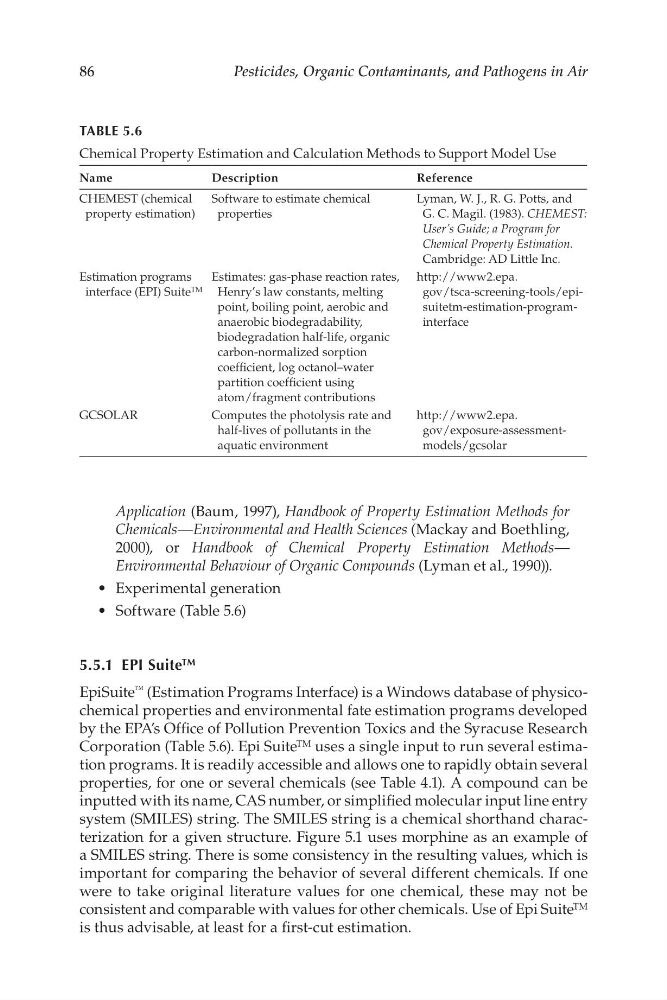
TABLE 5.6
Chemical Property Estimation and Calculation Methods to Support Model Use
Name
Description
Reference
CHEMEST (chemical
property estimation)
Estimation programs
interface (EPI) Suite TM
GCSOLAR
Software to estimate chemical
properties
Estimates: gas-phase reaction rates,
Henry’s law constants, melting
point, boiling point, aerobic and
anaerobic biodegradability,
biodegradation half-life, organic
carbon-normalized sorption
coeffcient, log octanol–water
partition coeffcient using
atom/fragment contributions
Computes the photolysis rate and
half-lives of pollutants in the
aquatic environment
Lyman, W. J., R. G. Potts, and
G. C. Magil. (1983). CHEMEST:
User’s Guide; a Program for
Chemical Property Estimation.
Cambridge: AD Little Inc.
http://www2.epa.
suitetm-estimation-programinterface
http://www2.epa.
gov/exposure-assessmentmodels/gcsolar
Application (Baum, 1997), Handbook of Property Estimation Methods for
Chemicals—Environmental and Health Sciences (Mackay and Boethling,
2000), or Handbook of Chemical Property Estimation Methods—
Environmental Behaviour of Organic Compounds (Lyman et al., 1990)).
• Experimental generation
• Software (Table 5.6)
5.5.1 EPI Suite TM
EpiSuite ™ (Estimation Programs Interface) is a Windows database of physicochemical properties and environmental fate estimation programs developed
by the EPA’s Offce of Pollution Prevention Toxics and the Syracuse Research
Corporation (Table 5.6). Epi Suite TM uses a single input to run several estimation programs. It is readily accessible and allows one to rapidly obtain several
properties, for one or several chemicals (see Table 4.1). A compound can be
inputted with its name, CAS number, or simplifed molecular input line entry
system (SMILES) string. The SMILES string is a chemical shorthand characterization for a given structure. Figure 5.1 uses morphine as an example of
a SMILES string. There is some consistency in the resulting values, which is
important for comparing the behavior of several different chemicals. If one
were to take original literature values for one chemical, these may not be
consistent and comparable with values for other chemicals. Use of Epi Suite TM
is thus advisable, at least for a frst-cut estimation.
Pesticides, Organic Contaminants, and Pathogens in Air
TABLE 5.6
Chemical Property Estimation and Calculation Methods to Support Model Use
Name
Description
Reference
CHEMEST (chemical
property estimation)
Estimation programs
interface (EPI) Suite TM
GCSOLAR
Software to estimate chemical
properties
Estimates: gas-phase reaction rates,
Henry’s law constants, melting
point, boiling point, aerobic and
anaerobic biodegradability,
biodegradation half-life, organic
carbon-normalized sorption
coeffcient, log octanol–water
partition coeffcient using
atom/fragment contributions
Computes the photolysis rate and
half-lives of pollutants in the
aquatic environment
Lyman, W. J., R. G. Potts, and
G. C. Magil. (1983). CHEMEST:
User’s Guide; a Program for
Chemical Property Estimation.
Cambridge: AD Little Inc.
http://www2.epa.
suitetm-estimation-programinterface
http://www2.epa.
gov/exposure-assessmentmodels/gcsolar
Application (Baum, 1997), Handbook of Property Estimation Methods for
Chemicals—Environmental and Health Sciences (Mackay and Boethling,
2000), or Handbook of Chemical Property Estimation Methods—
Environmental Behaviour of Organic Compounds (Lyman et al., 1990)).
• Experimental generation
• Software (Table 5.6)
5.5.1 EPI Suite TM
EpiSuite ™ (Estimation Programs Interface) is a Windows database of physicochemical properties and environmental fate estimation programs developed
by the EPA’s Offce of Pollution Prevention Toxics and the Syracuse Research
Corporation (Table 5.6). Epi Suite TM uses a single input to run several estimation programs. It is readily accessible and allows one to rapidly obtain several
properties, for one or several chemicals (see Table 4.1). A compound can be
inputted with its name, CAS number, or simplifed molecular input line entry
system (SMILES) string. The SMILES string is a chemical shorthand characterization for a given structure. Figure 5.1 uses morphine as an example of
a SMILES string. There is some consistency in the resulting values, which is
important for comparing the behavior of several different chemicals. If one
were to take original literature values for one chemical, these may not be
consistent and comparable with values for other chemicals. Use of Epi Suite TM
is thus advisable, at least for a frst-cut estimation.