

78
Pesticides, Organic Contaminants, and Pathogens in Air
5.4.1 Water/Multimedia Models
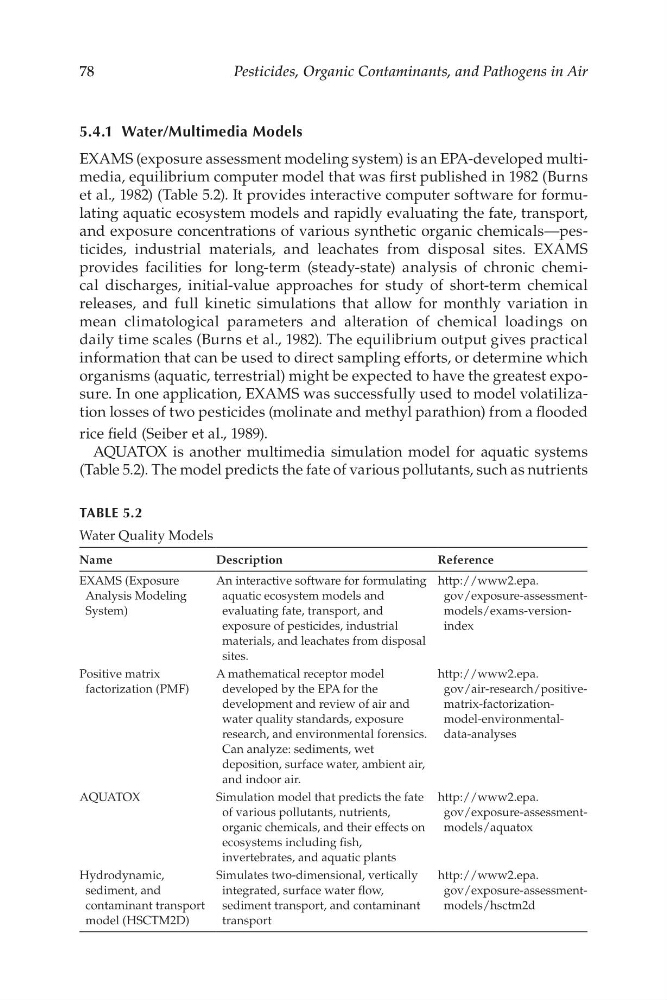
EXAMS (exposure assessment modeling system) is an EPA-developed multimedia, equilibrium computer model that was frst published in 1982 (Burns
et al., 1982) (Table 5.2). It provides interactive computer software for formulating aquatic ecosystem models and rapidly evaluating the fate, transport,
and exposure concentrations of various synthetic organic chemicals—pesticides, industrial materials, and leachates from disposal sites. EXAMS
provides facilities for long-term (steady-state) analysis of chronic chemical discharges, initial-value approaches for study of short-term chemical
releases, and full kinetic simulations that allow for monthly variation in
mean climatological parameters and alteration of chemical loadings on
daily time scales (Burns et al., 1982). The equilibrium output gives practical
information that can be used to direct sampling efforts, or determine which
organisms (aquatic, terrestrial) might be expected to have the greatest exposure. In one application, EXAMS was successfully used to model volatilization losses of two pesticides (molinate and methyl parathion) from a fooded
rice feld (Seiber et al., 1989).
AQUATOX is another multimedia simulation model for aquatic systems
(Table 5.2). The model predicts the fate of various pollutants, such as nutrients
TABLE 5.2
Water Quality Models
Name
Description
Reference
EXAMS (Exposure
Analysis Modeling
System)
Positive matrix
factorization (PMF)
AQUATOX
Hydrodynamic,
sediment, and
contaminant transport
model (HSCTM2D)
An interactive software for formulating
aquatic ecosystem models and
evaluating fate, transport, and
exposure of pesticides, industrial
materials, and leachates from disposal
sites.
A mathematical receptor model
developed by the EPA for the
development and review of air and
water quality standards, exposure
research, and environmental forensics.
Can analyze: sediments, wet
deposition, surface water, ambient air,
and indoor air.
Simulation model that predicts the fate
of various pollutants, nutrients,
organic chemicals, and their effects on
ecosystems including fsh,
invertebrates, and aquatic plants
Simulates two-dimensional, vertically
integrated, surface water fow,
sediment transport, and contaminant
transport
http://www2.epa.
models/exams-versionindex
http://www2.epa.
model-environmentaldata-analyses
http://www2.epa.
gov/exposure-assessmentmodels/aquatox
http://www2.epa.
gov/exposure-assessmentmodels/hsctm2d
Pesticides, Organic Contaminants, and Pathogens in Air
5.4.1 Water/Multimedia Models
EXAMS (exposure assessment modeling system) is an EPA-developed multimedia, equilibrium computer model that was frst published in 1982 (Burns
et al., 1982) (Table 5.2). It provides interactive computer software for formulating aquatic ecosystem models and rapidly evaluating the fate, transport,
and exposure concentrations of various synthetic organic chemicals—pesticides, industrial materials, and leachates from disposal sites. EXAMS
provides facilities for long-term (steady-state) analysis of chronic chemical discharges, initial-value approaches for study of short-term chemical
releases, and full kinetic simulations that allow for monthly variation in
mean climatological parameters and alteration of chemical loadings on
daily time scales (Burns et al., 1982). The equilibrium output gives practical
information that can be used to direct sampling efforts, or determine which
organisms (aquatic, terrestrial) might be expected to have the greatest exposure. In one application, EXAMS was successfully used to model volatilization losses of two pesticides (molinate and methyl parathion) from a fooded
rice feld (Seiber et al., 1989).
AQUATOX is another multimedia simulation model for aquatic systems
(Table 5.2). The model predicts the fate of various pollutants, such as nutrients
TABLE 5.2
Water Quality Models
Name
Description
Reference
EXAMS (Exposure
Analysis Modeling
System)
Positive matrix
factorization (PMF)
AQUATOX
Hydrodynamic,
sediment, and
contaminant transport
model (HSCTM2D)
An interactive software for formulating
aquatic ecosystem models and
evaluating fate, transport, and
exposure of pesticides, industrial
materials, and leachates from disposal
sites.
A mathematical receptor model
developed by the EPA for the
development and review of air and
water quality standards, exposure
research, and environmental forensics.
Can analyze: sediments, wet
deposition, surface water, ambient air,
and indoor air.
Simulation model that predicts the fate
of various pollutants, nutrients,
organic chemicals, and their effects on
ecosystems including fsh,
invertebrates, and aquatic plants
Simulates two-dimensional, vertically
integrated, surface water fow,
sediment transport, and contaminant
transport
http://www2.epa.
models/exams-versionindex
http://www2.epa.
model-environmentaldata-analyses
http://www2.epa.
gov/exposure-assessmentmodels/aquatox
http://www2.epa.
gov/exposure-assessmentmodels/hsctm2d