

75
Environmental Fate Models
With numeric computer-based models, the time course of the amount or
concentration of the chemical in question in each compartment and fnal conditions at equilibrium constitute output, from which the rate of loss or dissipation of the chemical from each compartment can be calculated. This is a huge
advantage for the regulator or emergency responder faced with a spill or other
accident requiring decisions on how best to protect humans and wildlife from
both immediate and long-term harm. You can play “what if” scenarios, such
as the use of dispersants in an oil spill into water, or how extensive the effect
might be on fsh or other wildlife downwind or downstream from a spill. The
extent and immediacy of evacuation of workers or nearby residents can be
calculated; or, in the case of pesticide applications, the setting of buffer zones.
This chapter summarizes some examples of environmental fate models
(empirical and computer-based). Included are CHEMEST and EPI Suite TM ,
which are examples of physiochemical property calculation/estimation models
for generating property data as input to the environmental fate models. Some
models broadly address multimedia aspects of behavior and fate such as EPA’s
EXAMS or CalEPA’s CalTOX, models used widely in regulatory risk assessments and other predictive efforts. Other models predict for just one or a few of
the media involved in transport and fate, such as AQUATOX (water) or PRZM
(plant soil root zone) or AERMOD and CALPUFF for air. Some are designed
for specifc classes of chemicals, such as pesticides, or fumigants (FEMS and
PERFUM), or petroleum constituents. Examples of selected models follow.
5.3 Empirical Models
5.3.1 Empirical Models (Microcosm)
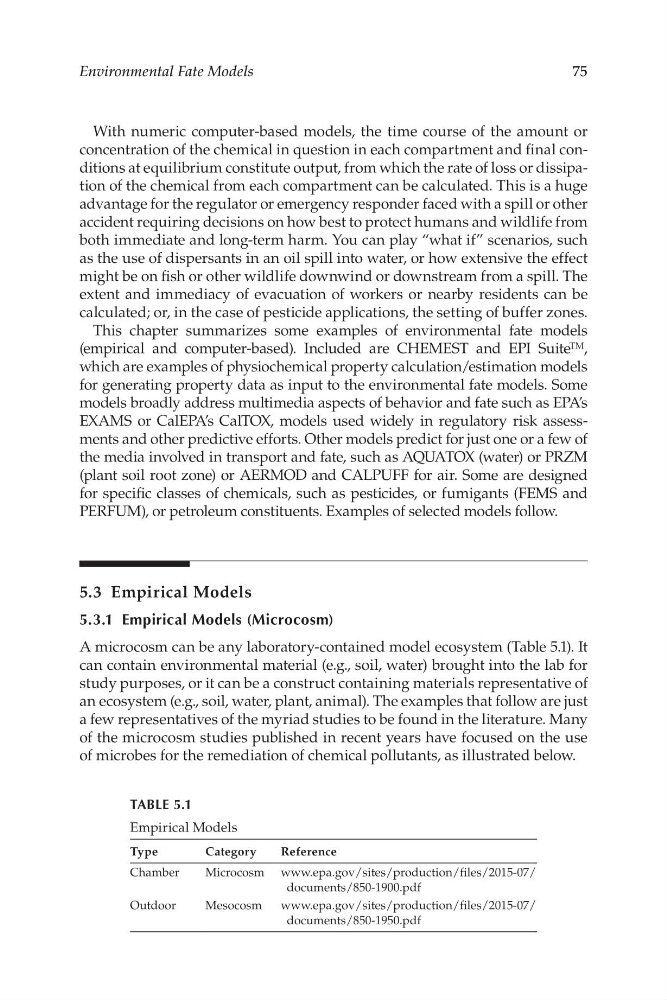
A microcosm can be any laboratory-contained model ecosystem (Table 5.1). It
can contain environmental material (e.g., soil, water) brought into the lab for
study purposes, or it can be a construct containing materials representative of
an ecosystem (e.g., soil, water, plant, animal). The examples that follow are just
a few representatives of the myriad studies to be found in the literature. Many
of the microcosm studies published in recent years have focused on the use
of microbes for the remediation of chemical pollutants, as illustrated below.
TABLE 5.1
Empirical Models
Type
Category
Reference
Chamber
Microcosm www.epa.gov/sites/production/fles/2015-07/
documents/850-1900.pdf
Outdoor
Mesocosm
www.epa.gov/sites/production/fles/2015-07/
documents/850-1950.pdf
Environmental Fate Models
With numeric computer-based models, the time course of the amount or
concentration of the chemical in question in each compartment and fnal conditions at equilibrium constitute output, from which the rate of loss or dissipation of the chemical from each compartment can be calculated. This is a huge
advantage for the regulator or emergency responder faced with a spill or other
accident requiring decisions on how best to protect humans and wildlife from
both immediate and long-term harm. You can play “what if” scenarios, such
as the use of dispersants in an oil spill into water, or how extensive the effect
might be on fsh or other wildlife downwind or downstream from a spill. The
extent and immediacy of evacuation of workers or nearby residents can be
calculated; or, in the case of pesticide applications, the setting of buffer zones.
This chapter summarizes some examples of environmental fate models
(empirical and computer-based). Included are CHEMEST and EPI Suite TM ,
which are examples of physiochemical property calculation/estimation models
for generating property data as input to the environmental fate models. Some
models broadly address multimedia aspects of behavior and fate such as EPA’s
EXAMS or CalEPA’s CalTOX, models used widely in regulatory risk assessments and other predictive efforts. Other models predict for just one or a few of
the media involved in transport and fate, such as AQUATOX (water) or PRZM
(plant soil root zone) or AERMOD and CALPUFF for air. Some are designed
for specifc classes of chemicals, such as pesticides, or fumigants (FEMS and
PERFUM), or petroleum constituents. Examples of selected models follow.
5.3 Empirical Models
5.3.1 Empirical Models (Microcosm)
A microcosm can be any laboratory-contained model ecosystem (Table 5.1). It
can contain environmental material (e.g., soil, water) brought into the lab for
study purposes, or it can be a construct containing materials representative of
an ecosystem (e.g., soil, water, plant, animal). The examples that follow are just
a few representatives of the myriad studies to be found in the literature. Many
of the microcosm studies published in recent years have focused on the use
of microbes for the remediation of chemical pollutants, as illustrated below.
TABLE 5.1
Empirical Models
Type
Category
Reference
Chamber
Microcosm www.epa.gov/sites/production/fles/2015-07/
documents/850-1900.pdf
Outdoor
Mesocosm
www.epa.gov/sites/production/fles/2015-07/
documents/850-1950.pdf