

12
Subtle Agroecologies
Reductionism
Holism?
Invisible
Physical
Reductionism
Reductionism
Holism
Holism?
Systems
approach
Physical
Invisible
Invisible
Physical
(a)
( b)
(c)
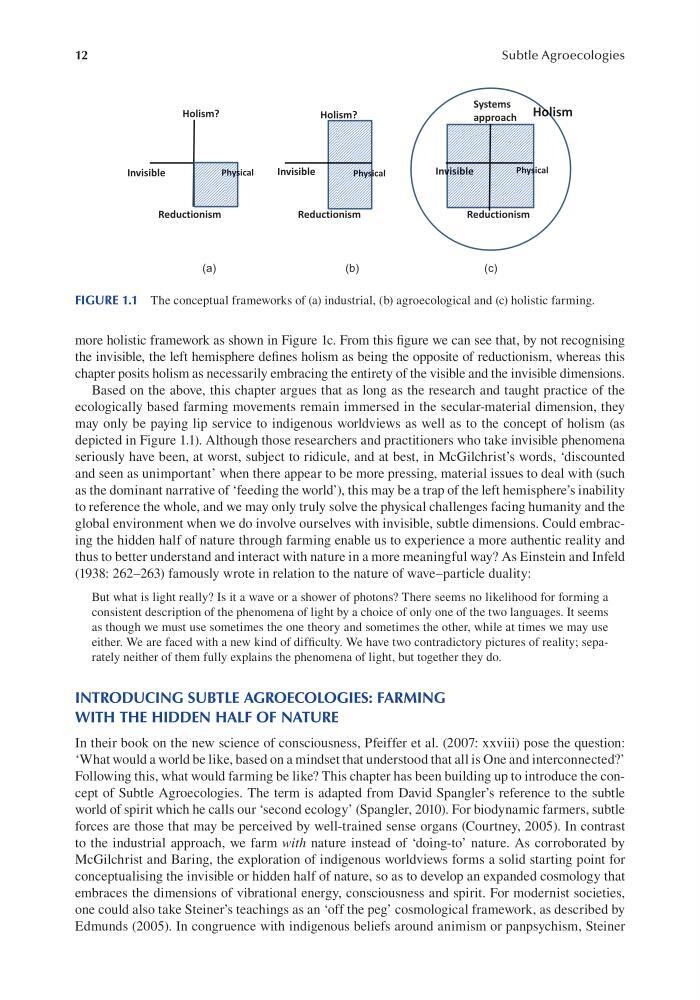
FIGURE 1.1 The conceptual frameworks of (a) industrial, (b) agroecological and (c) holistic farming.
more holistic framework as shown in Figure 1c. From this fgure we can see that, by not recognising
the invisible, the left hemisphere defnes holism as being the opposite of reductionism, whereas this
chapter posits holism as necessarily embracing the entirety of the visible and the invisible dimensions.
Based on the above, this chapter argues that as long as the research and taught practice of the
ecologically based farming movements remain immersed in the secular-material dimension, they
may only be paying lip service to indigenous worldviews as well as to the concept of holism (as
depicted in Figure 1.1). Although those researchers and practitioners who take invisible phenomena
seriously have been, at worst, subject to ridicule, and at best, in McGilchrist’s words, ‘discounted
and seen as unimportant’ when there appear to be more pressing, material issues to deal with (such
as the dominant narrative of ‘feeding the world’), this may be a trap of the left hemisphere’s inability
to reference the whole, and we may only truly solve the physical challenges facing humanity and the
global environment when we do involve ourselves with invisible, subtle dimensions. Could embracing the hidden half of nature through farming enable us to experience a more authentic reality and
thus to better understand and interact with nature in a more meaningful way? As Einstein and Infeld
(1938: 262–263) famously wrote in relation to the nature of wave–particle duality:
But what is light really? Is it a wave or a shower of photons? There seems no likelihood for forming a
consistent description of the phenomena of light by a choice of only one of the two languages. It seems
as though we must use sometimes the one theory and sometimes the other, while at times we may use
either. We are faced with a new kind of diffculty. We have two contradictory pictures of reality; separately neither of them fully explains the phenomena of light, but together they do.
INTRODUCING SUBTLE AGROECOLOGIES: FARMING
WITH THE HIDDEN HALF OF NATURE
In their book on the new science of consciousness, Pfeiffer et al. (2007: xxviii) pose the question:
‘What would a world be like, based on a mindset that understood that all is One and interconnected?’
Following this, what would farming be like? This chapter has been building up to introduce the concept of Subtle Agroecologies. The term is adapted from David Spangler’s reference to the subtle
world of spirit which he calls our ‘second ecology’ (Spangler, 2010). For biodynamic farmers, subtle
forces are those that may be perceived by well-trained sense organs (Courtney, 2005). In contrast
to the industrial approach, we farm with nature instead of ‘doing-to’ nature. As corroborated by
McGilchrist and Baring, the exploration of indigenous worldviews forms a solid starting point for
conceptualising the invisible or hidden half of nature, so as to develop an expanded cosmology that
embraces the dimensions of vibrational energy, consciousness and spirit. For modernist societies,
one could also take Steiner’s teachings as an ‘off the peg’ cosmological framework, as described by
Edmunds (2005). In congruence with indigenous beliefs around animism or panpsychism, Steiner
Subtle Agroecologies
Reductionism
Holism?
Invisible
Physical
Reductionism
Reductionism
Holism
Holism?
Systems
approach
Physical
Invisible
Invisible
Physical
(a)
( b)
(c)
FIGURE 1.1 The conceptual frameworks of (a) industrial, (b) agroecological and (c) holistic farming.
more holistic framework as shown in Figure 1c. From this fgure we can see that, by not recognising
the invisible, the left hemisphere defnes holism as being the opposite of reductionism, whereas this
chapter posits holism as necessarily embracing the entirety of the visible and the invisible dimensions.
Based on the above, this chapter argues that as long as the research and taught practice of the
ecologically based farming movements remain immersed in the secular-material dimension, they
may only be paying lip service to indigenous worldviews as well as to the concept of holism (as
depicted in Figure 1.1). Although those researchers and practitioners who take invisible phenomena
seriously have been, at worst, subject to ridicule, and at best, in McGilchrist’s words, ‘discounted
and seen as unimportant’ when there appear to be more pressing, material issues to deal with (such
as the dominant narrative of ‘feeding the world’), this may be a trap of the left hemisphere’s inability
to reference the whole, and we may only truly solve the physical challenges facing humanity and the
global environment when we do involve ourselves with invisible, subtle dimensions. Could embracing the hidden half of nature through farming enable us to experience a more authentic reality and
thus to better understand and interact with nature in a more meaningful way? As Einstein and Infeld
(1938: 262–263) famously wrote in relation to the nature of wave–particle duality:
But what is light really? Is it a wave or a shower of photons? There seems no likelihood for forming a
consistent description of the phenomena of light by a choice of only one of the two languages. It seems
as though we must use sometimes the one theory and sometimes the other, while at times we may use
either. We are faced with a new kind of diffculty. We have two contradictory pictures of reality; separately neither of them fully explains the phenomena of light, but together they do.
INTRODUCING SUBTLE AGROECOLOGIES: FARMING
WITH THE HIDDEN HALF OF NATURE
In their book on the new science of consciousness, Pfeiffer et al. (2007: xxviii) pose the question:
‘What would a world be like, based on a mindset that understood that all is One and interconnected?’
Following this, what would farming be like? This chapter has been building up to introduce the concept of Subtle Agroecologies. The term is adapted from David Spangler’s reference to the subtle
world of spirit which he calls our ‘second ecology’ (Spangler, 2010). For biodynamic farmers, subtle
forces are those that may be perceived by well-trained sense organs (Courtney, 2005). In contrast
to the industrial approach, we farm with nature instead of ‘doing-to’ nature. As corroborated by
McGilchrist and Baring, the exploration of indigenous worldviews forms a solid starting point for
conceptualising the invisible or hidden half of nature, so as to develop an expanded cosmology that
embraces the dimensions of vibrational energy, consciousness and spirit. For modernist societies,
one could also take Steiner’s teachings as an ‘off the peg’ cosmological framework, as described by
Edmunds (2005). In congruence with indigenous beliefs around animism or panpsychism, Steiner