

9
Re-Enchanting Agriculture
and this distinctive spiritual relationship is enshrined in the United Nations Declaration on
the Rights of Indigenous Peoples (Article 15, UNDRIP, 2007). In a critique of the impacts of
colonialism on African Indigenous Knowledge Systems, Mashingaidze (2016: 25) writes, ‘For
indigenous peoples, the land is the core of all spirituality and this relationship to the spirit of
the earth is central to all the issues that are important to indigenous peoples today’. Similarly,
in a comparative study of traditional ecological knowledge systems of the Māori and Quechua
peoples, Huambachano explains that ‘For Indigenous peoples, land is both an agricultural and
sacred space where both human and nonhuman relations work together as stewards’ (2019: 1).
Marsden (1988) describes the body of knowledge that Māori peoples refer to as ‘mātauranga’,
as being ‘the knowledge, comprehension or understanding of everything visible or invisible
that exists across the universe; this includes all Māori knowledge systems or ways of knowing
and doing’.
The work of Huambachano and others (e.g. Haverkort et al., 2002; Tchombe and Lukong,
2018) provides a generic picture of the dynamic and mutually reinforcing relationships between
the human, spirit and natural worlds. These animistic or panpsychic traditions share three pertinent ontological characteristics: (1) that life has an invisible, spirit or energetic dimension;
(2) that everything in nature has sentience or consciousness; and (3) that there is every-day
communicative interaction between humans and the other-than-human. They also share axiological issues around the need to maintain harmony and equilibrium, to right relationship, to
sacredness and to collaboration with the other-than-human. These provide the context for, and
infuence, their farming and food gathering activities. In his essay on indigenous knowledge,
Posey (1998) explains that knowledge of the environment depends on the relationship not only
between humans and nature, but also between the visible world and the spirit world. Within this,
agriculture provides balance through relationships amongst not only people, but also nature
and deities, so that, for example, the blessing of a new feld is not a mere spectacle but rather
an inseparable part of life where the highest value is harmony with the earth. Following this,
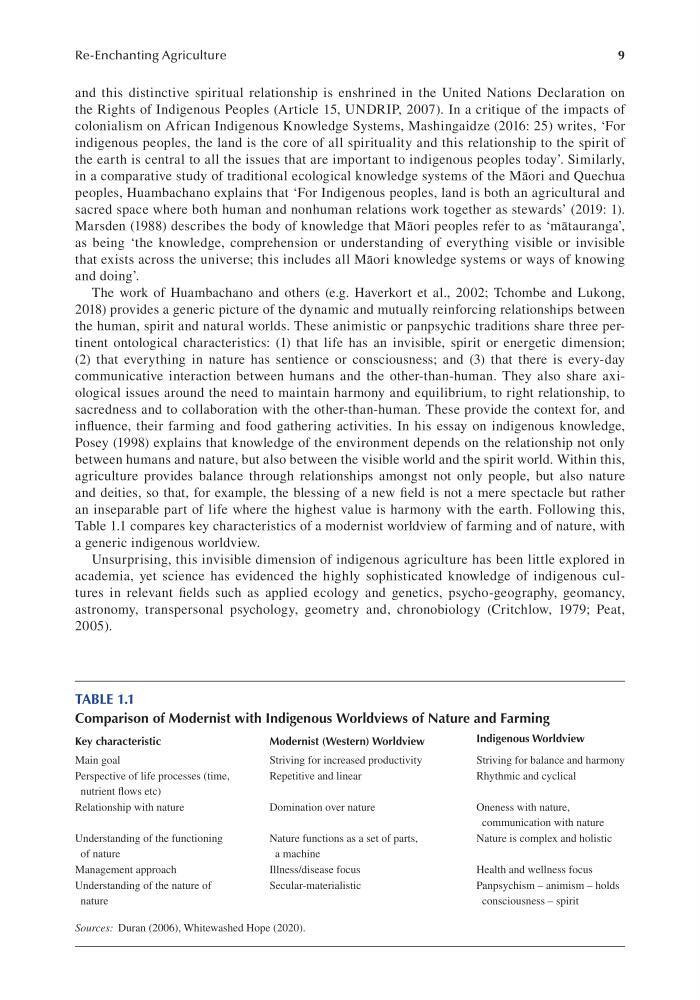
Table 1.1 compares key characteristics of a modernist worldview of farming and of nature, with
a generic indigenous worldview.
Unsurprising, this invisible dimension of indigenous agriculture has been little explored in
academia, yet science has evidenced the highly sophisticated knowledge of indigenous cultures in relevant felds such as applied ecology and genetics, psycho-geography, geomancy,
astronomy, transpersonal psychology, geometry and, chronobiology (Critchlow, 1979; Peat,
2005).
TABLE 1.1
Comparison of Modernist with Indigenous Worldviews of Nature and Farming
Key characteristic
Modernist (Western) Worldview
Indigenous Worldview
Main goal
Striving for increased productivity
Striving for balance and harmony
Perspective of life processes (time,
Repetitive and linear
Rhythmic and cyclical
nutrient fows etc)
Relationship with nature
Domination over nature
Oneness with nature,
communication with nature
Understanding of the functioning
Nature functions as a set of parts,
Nature is complex and holistic
of nature
a machine
Management approach
Illness/disease focus
Health and wellness focus
Understanding of the nature of
Secular-materialistic
Panpsychism – animism – holds
nature
consciousness – spirit
Sources: Duran (2006), Whitewashed Hope (2020).
Re-Enchanting Agriculture
and this distinctive spiritual relationship is enshrined in the United Nations Declaration on
the Rights of Indigenous Peoples (Article 15, UNDRIP, 2007). In a critique of the impacts of
colonialism on African Indigenous Knowledge Systems, Mashingaidze (2016: 25) writes, ‘For
indigenous peoples, the land is the core of all spirituality and this relationship to the spirit of
the earth is central to all the issues that are important to indigenous peoples today’. Similarly,
in a comparative study of traditional ecological knowledge systems of the Māori and Quechua
peoples, Huambachano explains that ‘For Indigenous peoples, land is both an agricultural and
sacred space where both human and nonhuman relations work together as stewards’ (2019: 1).
Marsden (1988) describes the body of knowledge that Māori peoples refer to as ‘mātauranga’,
as being ‘the knowledge, comprehension or understanding of everything visible or invisible
that exists across the universe; this includes all Māori knowledge systems or ways of knowing
and doing’.
The work of Huambachano and others (e.g. Haverkort et al., 2002; Tchombe and Lukong,
2018) provides a generic picture of the dynamic and mutually reinforcing relationships between
the human, spirit and natural worlds. These animistic or panpsychic traditions share three pertinent ontological characteristics: (1) that life has an invisible, spirit or energetic dimension;
(2) that everything in nature has sentience or consciousness; and (3) that there is every-day
communicative interaction between humans and the other-than-human. They also share axiological issues around the need to maintain harmony and equilibrium, to right relationship, to
sacredness and to collaboration with the other-than-human. These provide the context for, and
infuence, their farming and food gathering activities. In his essay on indigenous knowledge,
Posey (1998) explains that knowledge of the environment depends on the relationship not only
between humans and nature, but also between the visible world and the spirit world. Within this,
agriculture provides balance through relationships amongst not only people, but also nature
and deities, so that, for example, the blessing of a new feld is not a mere spectacle but rather
an inseparable part of life where the highest value is harmony with the earth. Following this,
Table 1.1 compares key characteristics of a modernist worldview of farming and of nature, with
a generic indigenous worldview.
Unsurprising, this invisible dimension of indigenous agriculture has been little explored in
academia, yet science has evidenced the highly sophisticated knowledge of indigenous cultures in relevant felds such as applied ecology and genetics, psycho-geography, geomancy,
astronomy, transpersonal psychology, geometry and, chronobiology (Critchlow, 1979; Peat,
2005).
TABLE 1.1
Comparison of Modernist with Indigenous Worldviews of Nature and Farming
Key characteristic
Modernist (Western) Worldview
Indigenous Worldview
Main goal
Striving for increased productivity
Striving for balance and harmony
Perspective of life processes (time,
Repetitive and linear
Rhythmic and cyclical
nutrient fows etc)
Relationship with nature
Domination over nature
Oneness with nature,
communication with nature
Understanding of the functioning
Nature functions as a set of parts,
Nature is complex and holistic
of nature
a machine
Management approach
Illness/disease focus
Health and wellness focus
Understanding of the nature of
Secular-materialistic
Panpsychism – animism – holds
nature
consciousness – spirit
Sources: Duran (2006), Whitewashed Hope (2020).