

xxxviii
Introduction to the Book
Yet the impact of subtle techniques on both material and invisible dimensions of the farming
and food system is only part of their reason for being. As Wohlers et al. explain in Chapter 15,
‘Research also shows that the use of biodynamic preparations may result in enhanced product
quality… The term “may” is used here rather than “does” because the biodynamic preparations
do not work like standard industrial inputs, such as nitrogen fertiliser, and thus should not be
compared to or treated as such. The preparations enhance quality in the way that is appropriate
for each given situation; they encourage growth and enable other possibilities without forcing the
plant’. This implies that the impact of these techniques is situation-specific, and in addition may
also be dependent on the presence of the human being involved, as is stressed by Boff et al. in
relation to homeopathy (Chapter 13) and Charter in terms of the challenges of replicating trials
of subtle influences of living things (Chapter 25). By limiting our choice of research objects to
phenomena that can be replicated in trials, and by not considering the potential interference of the
research subject, we are limiting both the scope of the research and our understanding of reality.
Following this, two further functions of the application of subtle techniques are suggested, firstly
to enable the development and refining of specific abilities and faculties of the human being,
including awareness and intuition (as described in Chapters 17, 21 and 22), and secondly to bring
holistic balance and harmony to the agroecosystem, one that is so valued by indigenous cultures
(Chapters 1, 2 and 4).
Inherent in the above is the need for more involvement and contributions on subtle farming
techniques from indigenous writers themselves (Chapter 3 goes some way towards this through a
co-authored dialogue on the indigenous practices of communities in Chikukwa, Zimbabwe). There
is a gap in the literature, and Chapter 1 explains how much of this knowledge has historically been
passed down through oral rather than written tradition. Chapter 1 also describes how such practices
have multiple functions and may not necessarily relate solely to agriculture, such as the Indian
tradition of Panchakavya, a concoction of animal products that not only has proven benefits as a
biofertiliser, as a biopesticide and for restoring soil fertility, but also has medicinal applications and
is used in ceremonies and rituals (Ramprasad, 2012). Moreover, food acquisition in indigenous cultures is not solely dependent on settled agriculture, and indigenous authors have tended to explore
their cosmologies and epistemologies in relation to nature and the environment rather than directly
to agriculture. From New Mexico, Cajete (2000) is an exception, describing gardening, farming and
hunting activities as including prayer, ritual, negotiations with nature spirits, totemic relationship
with animals, and the importance of a sense of place, as well as more material activities including advanced plant breeding and knowledge of herbal medicines. He explains, ‘The Native garden
involved a deep understanding of “practiced” relationship. Therefore, Native gardens were as much
a mythic-spiritual-cultural-aesthetic expression of tribal participation and relationship with nature
as was Native art, architecture and ceremonialisation. The technology of Native farming was only
one dimension of such practiced relationship’ (2000: 131).
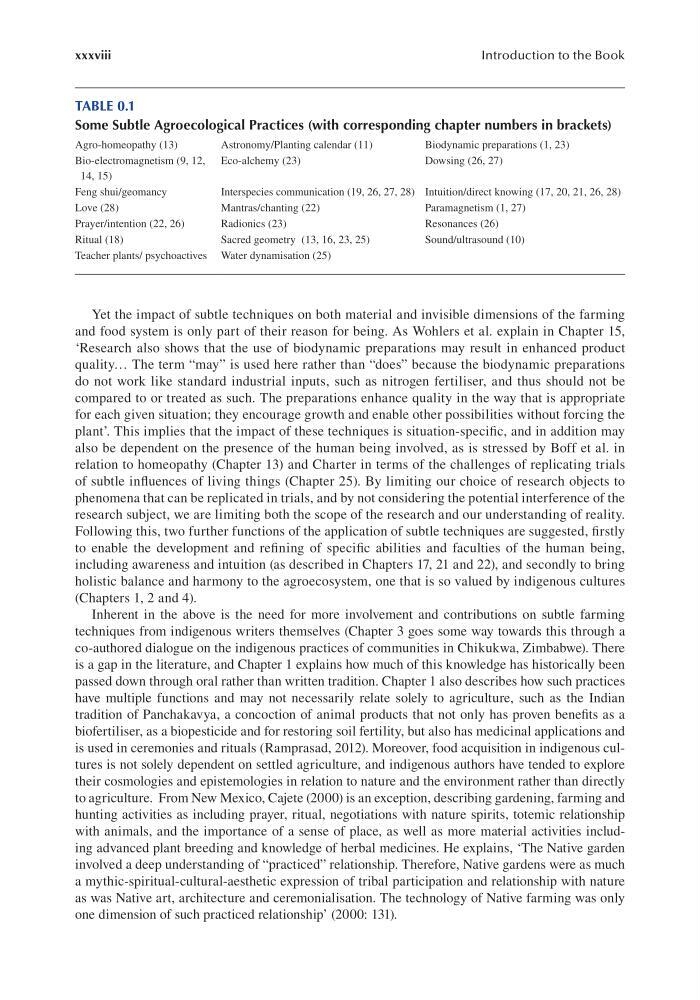
TABLE 0.1
Some Subtle Agroecological Practices (with corresponding chapter numbers in brackets)
Agro-homeopathy (13)
Astronomy/Planting calendar (11)
Biodynamic preparations (1, 23)
Bio-electromagnetism (9, 12,
14, 15)
Eco-alchemy (23)
Dowsing (26, 27)
Feng shui/geomancy
Interspecies communication (19, 26, 27, 28) Intuition/direct knowing (17, 20, 21, 26, 28)
Love (28)
Mantras/chanting (22)
Paramagnetism (1, 27)
Prayer/intention (22, 26)
Radionics (23)
Resonances (26)
Ritual (18)
Sacred geometry (13, 16, 23, 25)
Sound/ultrasound (10)
Teacher plants/ psychoactives Water dynamisation (25)
Introduction to the Book
Yet the impact of subtle techniques on both material and invisible dimensions of the farming
and food system is only part of their reason for being. As Wohlers et al. explain in Chapter 15,
‘Research also shows that the use of biodynamic preparations may result in enhanced product
quality… The term “may” is used here rather than “does” because the biodynamic preparations
do not work like standard industrial inputs, such as nitrogen fertiliser, and thus should not be
compared to or treated as such. The preparations enhance quality in the way that is appropriate
for each given situation; they encourage growth and enable other possibilities without forcing the
plant’. This implies that the impact of these techniques is situation-specific, and in addition may
also be dependent on the presence of the human being involved, as is stressed by Boff et al. in
relation to homeopathy (Chapter 13) and Charter in terms of the challenges of replicating trials
of subtle influences of living things (Chapter 25). By limiting our choice of research objects to
phenomena that can be replicated in trials, and by not considering the potential interference of the
research subject, we are limiting both the scope of the research and our understanding of reality.
Following this, two further functions of the application of subtle techniques are suggested, firstly
to enable the development and refining of specific abilities and faculties of the human being,
including awareness and intuition (as described in Chapters 17, 21 and 22), and secondly to bring
holistic balance and harmony to the agroecosystem, one that is so valued by indigenous cultures
(Chapters 1, 2 and 4).
Inherent in the above is the need for more involvement and contributions on subtle farming
techniques from indigenous writers themselves (Chapter 3 goes some way towards this through a
co-authored dialogue on the indigenous practices of communities in Chikukwa, Zimbabwe). There
is a gap in the literature, and Chapter 1 explains how much of this knowledge has historically been
passed down through oral rather than written tradition. Chapter 1 also describes how such practices
have multiple functions and may not necessarily relate solely to agriculture, such as the Indian
tradition of Panchakavya, a concoction of animal products that not only has proven benefits as a
biofertiliser, as a biopesticide and for restoring soil fertility, but also has medicinal applications and
is used in ceremonies and rituals (Ramprasad, 2012). Moreover, food acquisition in indigenous cultures is not solely dependent on settled agriculture, and indigenous authors have tended to explore
their cosmologies and epistemologies in relation to nature and the environment rather than directly
to agriculture. From New Mexico, Cajete (2000) is an exception, describing gardening, farming and
hunting activities as including prayer, ritual, negotiations with nature spirits, totemic relationship
with animals, and the importance of a sense of place, as well as more material activities including advanced plant breeding and knowledge of herbal medicines. He explains, ‘The Native garden
involved a deep understanding of “practiced” relationship. Therefore, Native gardens were as much
a mythic-spiritual-cultural-aesthetic expression of tribal participation and relationship with nature
as was Native art, architecture and ceremonialisation. The technology of Native farming was only
one dimension of such practiced relationship’ (2000: 131).
TABLE 0.1
Some Subtle Agroecological Practices (with corresponding chapter numbers in brackets)
Agro-homeopathy (13)
Astronomy/Planting calendar (11)
Biodynamic preparations (1, 23)
Bio-electromagnetism (9, 12,
14, 15)
Eco-alchemy (23)
Dowsing (26, 27)
Feng shui/geomancy
Interspecies communication (19, 26, 27, 28) Intuition/direct knowing (17, 20, 21, 26, 28)
Love (28)
Mantras/chanting (22)
Paramagnetism (1, 27)
Prayer/intention (22, 26)
Radionics (23)
Resonances (26)
Ritual (18)
Sacred geometry (13, 16, 23, 25)
Sound/ultrasound (10)
Teacher plants/ psychoactives Water dynamisation (25)