

281
A Dynamic Role for Water in Agriculture
angles. Projective geometry, developed mainly in the nineteenth and twentieth centuries, encompasses the Euclidian while also including the infnite, which is brought in from the far distance, such
as through perspective drawings with vanishing points on the horizon line. This enables us to work
with new spaces, in which the familiar Euclidian geometrical ideas are seen to be more restrictive
cases of fexible thinking and universal ideas (Whicher, 2013).
Lawrence Edwards’ work with projective geometry and natural form (2006) gives the defning
geometrical idea of the spiral vortex in its pure form, which we see when water is being drawn
towards a single distant point (under gravity this point is the earth’s centre). We see this vortex every
day as water goes down a plughole of a bath or sink. Edwards called this the watery vortex; I will
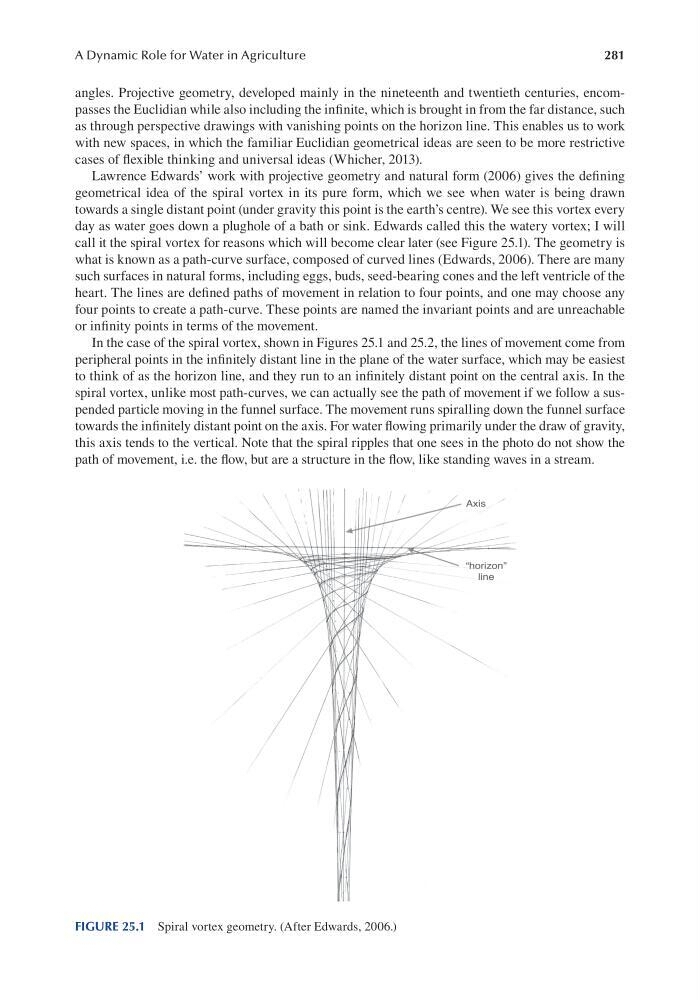
call it the spiral vortex for reasons which will become clear later (see Figure 25.1). The geometry is
what is known as a path-curve surface, composed of curved lines (Edwards, 2006). There are many
such surfaces in natural forms, including eggs, buds, seed-bearing cones and the left ventricle of the
heart. The lines are defned paths of movement in relation to four points, and one may choose any
four points to create a path-curve. These points are named the invariant points and are unreachable
or infnity points in terms of the movement.
In the case of the spiral vortex, shown in Figures 25.1 and 25.2, the lines of movement come from
peripheral points in the infnitely distant line in the plane of the water surface, which may be easiest
to think of as the horizon line, and they run to an infnitely distant point on the central axis. In the
spiral vortex, unlike most path-curves, we can actually see the path of movement if we follow a suspended particle moving in the funnel surface. The movement runs spiralling down the funnel surface
towards the infnitely distant point on the axis. For water fowing primarily under the draw of gravity,
this axis tends to the vertical. Note that the spiral ripples that one sees in the photo do not show the
path of movement, i.e. the fow, but are a structure in the fow, like standing waves in a stream.
FIGURE 25.1 Spiral vortex geometry. (After Edwards, 2006.)
A Dynamic Role for Water in Agriculture
angles. Projective geometry, developed mainly in the nineteenth and twentieth centuries, encompasses the Euclidian while also including the infnite, which is brought in from the far distance, such
as through perspective drawings with vanishing points on the horizon line. This enables us to work
with new spaces, in which the familiar Euclidian geometrical ideas are seen to be more restrictive
cases of fexible thinking and universal ideas (Whicher, 2013).
Lawrence Edwards’ work with projective geometry and natural form (2006) gives the defning
geometrical idea of the spiral vortex in its pure form, which we see when water is being drawn
towards a single distant point (under gravity this point is the earth’s centre). We see this vortex every
day as water goes down a plughole of a bath or sink. Edwards called this the watery vortex; I will
call it the spiral vortex for reasons which will become clear later (see Figure 25.1). The geometry is
what is known as a path-curve surface, composed of curved lines (Edwards, 2006). There are many
such surfaces in natural forms, including eggs, buds, seed-bearing cones and the left ventricle of the
heart. The lines are defned paths of movement in relation to four points, and one may choose any
four points to create a path-curve. These points are named the invariant points and are unreachable
or infnity points in terms of the movement.
In the case of the spiral vortex, shown in Figures 25.1 and 25.2, the lines of movement come from
peripheral points in the infnitely distant line in the plane of the water surface, which may be easiest
to think of as the horizon line, and they run to an infnitely distant point on the central axis. In the
spiral vortex, unlike most path-curves, we can actually see the path of movement if we follow a suspended particle moving in the funnel surface. The movement runs spiralling down the funnel surface
towards the infnitely distant point on the axis. For water fowing primarily under the draw of gravity,
this axis tends to the vertical. Note that the spiral ripples that one sees in the photo do not show the
path of movement, i.e. the fow, but are a structure in the fow, like standing waves in a stream.
FIGURE 25.1 Spiral vortex geometry. (After Edwards, 2006.)