

249
Sustainable Yogic Agriculture
Rural Development Wing (RDW), which subsequently developed and launched them as an initiative
to improve the lives and livelihoods of farmers (Ramsay, 2012a). Ramsay (2012a: 118) defnes SYA
as ‘a unique form of farming that combines thought-based meditative practices with the methods
of organic agriculture’. SYA sets its foundation on standard organic principles that prohibit the use
of non-organic fertilisers and biocides. The metaphysical or subtle element of meditation is subsequently added as a core component of all farming practices throughout the year.
THE METAPHYSICAL COMPONENT: PRACTICE OF RAJA YOGA MEDITATION
SYA farmers are frstly trained in the practice of Raja Yoga, a style of open-eyed meditation taught
by the Brahma Kumaris that is inspired by ancient Indian practices. The method is described in the
SYA Manual (RDW, 2009: 21–22) and summarised as follows:
The frst step of Raja Yoga Meditation is to attain the soul-conscious stage. Pure thoughts are the source
of pure vibrations, and pure vibrations create a pure atmosphere. After having entered into such a state,
if you think positive about any person, animal, or vegetation irrespective of where they are, very far or
very close, our vibrations reach them and activate every gene.
The manual also states that the ideal time to perform this meditation is between 4 and 5 am (part
of the time period referred to as ‘Amrit Vela’). Farmers should also transmit positive intentions
outside this time period during specifc farming activities. These regular meditation sessions can be
conducted remotely or in the feld, with focused thought practices and affrmations to support each
phase of the crop growth cycle, from sowing, irrigation and growth to harvest and soil rehabilitation
(Ramsay, 2012c; RDW, 2009). As well as focused meditation on the feld crops, Ramsay (2012c)
describes the practice of seeds being taken to local Brahma Kumaris meditation centres where
experienced meditators focus thoughts of peace, non-violence, love, strength and resilience on them
from between 10 days and 1 month prior to sowing. This is believed to enhance seed germination.
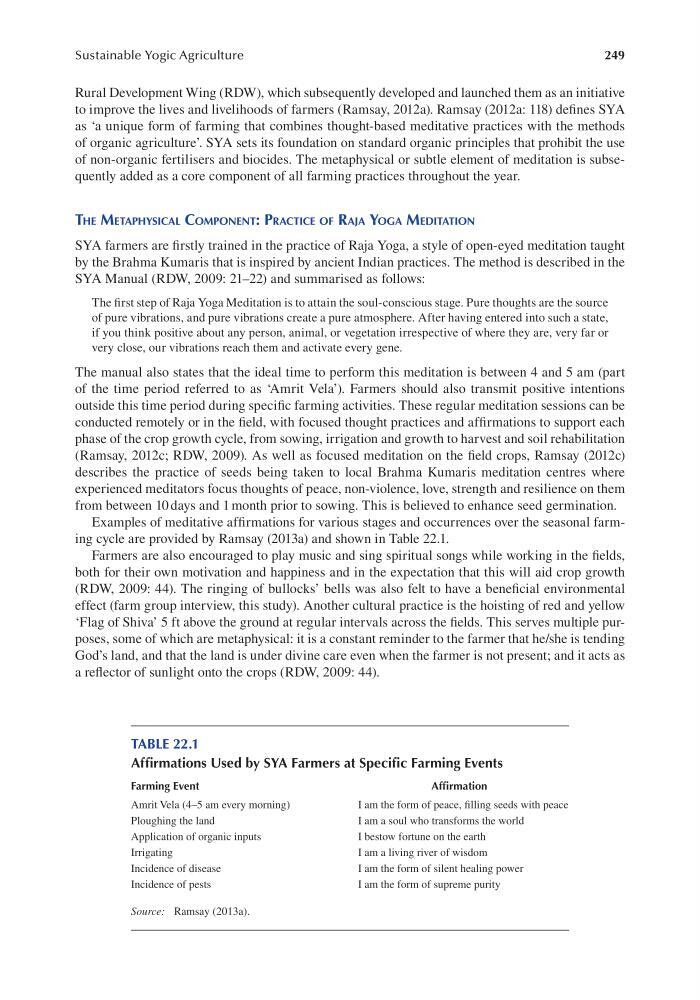
Examples of meditative affrmations for various stages and occurrences over the seasonal farming cycle are provided by Ramsay (2013a) and shown in Table 22.1.
Farmers are also encouraged to play music and sing spiritual songs while working in the felds,
both for their own motivation and happiness and in the expectation that this will aid crop growth
(RDW, 2009: 44). The ringing of bullocks’ bells was also felt to have a benefcial environmental
effect (farm group interview, this study). Another cultural practice is the hoisting of red and yellow
‘Flag of Shiva’ 5 ft above the ground at regular intervals across the felds. This serves multiple purposes, some of which are metaphysical: it is a constant reminder to the farmer that he/she is tending
God’s land, and that the land is under divine care even when the farmer is not present; and it acts as
a refector of sunlight onto the crops (RDW, 2009: 44).
TABLE 22.1
Affrmations Used by SYA Farmers at Specifc Farming Events
Farming Event
Affrmation
Amrit Vela (4–5 am every morning)
I am the form of peace, flling seeds with peace
Ploughing the land
I am a soul who transforms the world
Application of organic inputs
I bestow fortune on the earth
Irrigating
I am a living river of wisdom
Incidence of disease
I am the form of silent healing power
Incidence of pests
I am the form of supreme purity
Source: Ramsay (2013a).
Sustainable Yogic Agriculture
Rural Development Wing (RDW), which subsequently developed and launched them as an initiative
to improve the lives and livelihoods of farmers (Ramsay, 2012a). Ramsay (2012a: 118) defnes SYA
as ‘a unique form of farming that combines thought-based meditative practices with the methods
of organic agriculture’. SYA sets its foundation on standard organic principles that prohibit the use
of non-organic fertilisers and biocides. The metaphysical or subtle element of meditation is subsequently added as a core component of all farming practices throughout the year.
THE METAPHYSICAL COMPONENT: PRACTICE OF RAJA YOGA MEDITATION
SYA farmers are frstly trained in the practice of Raja Yoga, a style of open-eyed meditation taught
by the Brahma Kumaris that is inspired by ancient Indian practices. The method is described in the
SYA Manual (RDW, 2009: 21–22) and summarised as follows:
The frst step of Raja Yoga Meditation is to attain the soul-conscious stage. Pure thoughts are the source
of pure vibrations, and pure vibrations create a pure atmosphere. After having entered into such a state,
if you think positive about any person, animal, or vegetation irrespective of where they are, very far or
very close, our vibrations reach them and activate every gene.
The manual also states that the ideal time to perform this meditation is between 4 and 5 am (part
of the time period referred to as ‘Amrit Vela’). Farmers should also transmit positive intentions
outside this time period during specifc farming activities. These regular meditation sessions can be
conducted remotely or in the feld, with focused thought practices and affrmations to support each
phase of the crop growth cycle, from sowing, irrigation and growth to harvest and soil rehabilitation
(Ramsay, 2012c; RDW, 2009). As well as focused meditation on the feld crops, Ramsay (2012c)
describes the practice of seeds being taken to local Brahma Kumaris meditation centres where
experienced meditators focus thoughts of peace, non-violence, love, strength and resilience on them
from between 10 days and 1 month prior to sowing. This is believed to enhance seed germination.
Examples of meditative affrmations for various stages and occurrences over the seasonal farming cycle are provided by Ramsay (2013a) and shown in Table 22.1.
Farmers are also encouraged to play music and sing spiritual songs while working in the felds,
both for their own motivation and happiness and in the expectation that this will aid crop growth
(RDW, 2009: 44). The ringing of bullocks’ bells was also felt to have a benefcial environmental
effect (farm group interview, this study). Another cultural practice is the hoisting of red and yellow
‘Flag of Shiva’ 5 ft above the ground at regular intervals across the felds. This serves multiple purposes, some of which are metaphysical: it is a constant reminder to the farmer that he/she is tending
God’s land, and that the land is under divine care even when the farmer is not present; and it acts as
a refector of sunlight onto the crops (RDW, 2009: 44).
TABLE 22.1
Affrmations Used by SYA Farmers at Specifc Farming Events
Farming Event
Affrmation
Amrit Vela (4–5 am every morning)
I am the form of peace, flling seeds with peace
Ploughing the land
I am a soul who transforms the world
Application of organic inputs
I bestow fortune on the earth
Irrigating
I am a living river of wisdom
Incidence of disease
I am the form of silent healing power
Incidence of pests
I am the form of supreme purity
Source: Ramsay (2013a).