

236
Subtle Agroecologies
action, not only in the sense of wanting to express something of the being, as in the third stage, but
to do something about it. We feel ‘fred up’. Because of the journey that precedes it, this is not a
subjective expression of your own personal will. The intention is to combine the being of the phenomenon with the human ability to both think and to act in the world.
How you arrive at this is harder to explain, in my experience it just arrives suddenly when working in stage three. It is as if from the acquiescent air process, where our usual thinking is held back,
concept or idea or determination suddenly arrives, but with a strange clarity, a kind of shininess,
that is unlike one’s normal thought processes or perceptions.
In teaching this method with groups, particularly with regard to landscape, it is interesting to note
the difference between a pre-stage impulse to do something – make a change, clear an area, develop
a path – and an impulse that arrives out of combining one’s thinking with the phenomenon. The
pre-stage and the four steps are intended to bring us to a point of understanding and collaboration with
the phenomenon. Now we are in a position to move forward, to act in unison with the phenomenon.
CONCLUSION
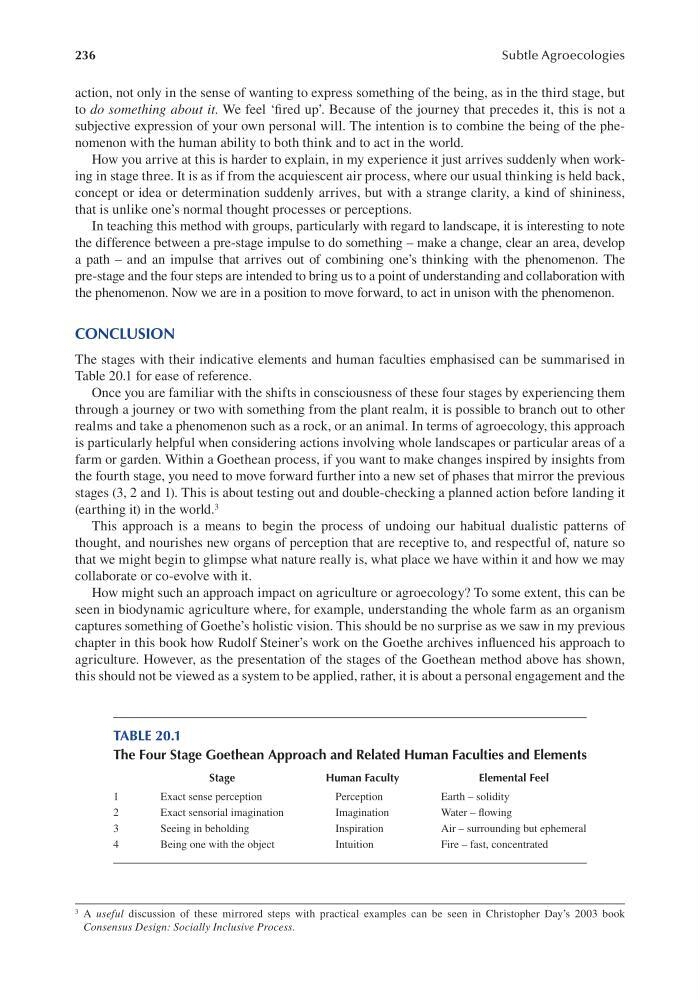
The stages with their indicative elements and human faculties emphasised can be summarised in
Table 20.1 for ease of reference.
Once you are familiar with the shifts in consciousness of these four stages by experiencing them
through a journey or two with something from the plant realm, it is possible to branch out to other
realms and take a phenomenon such as a rock, or an animal. In terms of agroecology, this approach
is particularly helpful when considering actions involving whole landscapes or particular areas of a
farm or garden. Within a Goethean process, if you want to make changes inspired by insights from
the fourth stage, you need to move forward further into a new set of phases that mirror the previous
stages (3, 2 and 1). This is about testing out and double-checking a planned action before landing it
(earthing it) in the world. 3
This approach is a means to begin the process of undoing our habitual dualistic patterns of
thought, and nourishes new organs of perception that are receptive to, and respectful of, nature so
that we might begin to glimpse what nature really is, what place we have within it and how we may
collaborate or co-evolve with it.
How might such an approach impact on agriculture or agroecology? To some extent, this can be
seen in biodynamic agriculture where, for example, understanding the whole farm as an organism
captures something of Goethe’s holistic vision. This should be no surprise as we saw in my previous
chapter in this book how Rudolf Steiner’s work on the Goethe archives infuenced his approach to
agriculture. However, as the presentation of the stages of the Goethean method above has shown,
this should not be viewed as a system to be applied, rather, it is about a personal engagement and the
TABLE 20.1
The Four Stage Goethean Approach and Related Human Faculties and Elements
Stage
Human Faculty
Elemental Feel
1
Exact sense perception
Perception
Earth – solidity
2
Exact sensorial imagination
Imagination
Water – fowing
3
Seeing in beholding
Inspiration
Air – surrounding but ephemeral
4
Being one with the object
Intuition
Fire – fast, concentrated
3 A useful discussion of these mirrored steps with practical examples can be seen in Christopher Day’s 2003 book
Consensus Design: Socially Inclusive Process.
Subtle Agroecologies
action, not only in the sense of wanting to express something of the being, as in the third stage, but
to do something about it. We feel ‘fred up’. Because of the journey that precedes it, this is not a
subjective expression of your own personal will. The intention is to combine the being of the phenomenon with the human ability to both think and to act in the world.
How you arrive at this is harder to explain, in my experience it just arrives suddenly when working in stage three. It is as if from the acquiescent air process, where our usual thinking is held back,
concept or idea or determination suddenly arrives, but with a strange clarity, a kind of shininess,
that is unlike one’s normal thought processes or perceptions.
In teaching this method with groups, particularly with regard to landscape, it is interesting to note
the difference between a pre-stage impulse to do something – make a change, clear an area, develop
a path – and an impulse that arrives out of combining one’s thinking with the phenomenon. The
pre-stage and the four steps are intended to bring us to a point of understanding and collaboration with
the phenomenon. Now we are in a position to move forward, to act in unison with the phenomenon.
CONCLUSION
The stages with their indicative elements and human faculties emphasised can be summarised in
Table 20.1 for ease of reference.
Once you are familiar with the shifts in consciousness of these four stages by experiencing them
through a journey or two with something from the plant realm, it is possible to branch out to other
realms and take a phenomenon such as a rock, or an animal. In terms of agroecology, this approach
is particularly helpful when considering actions involving whole landscapes or particular areas of a
farm or garden. Within a Goethean process, if you want to make changes inspired by insights from
the fourth stage, you need to move forward further into a new set of phases that mirror the previous
stages (3, 2 and 1). This is about testing out and double-checking a planned action before landing it
(earthing it) in the world. 3
This approach is a means to begin the process of undoing our habitual dualistic patterns of
thought, and nourishes new organs of perception that are receptive to, and respectful of, nature so
that we might begin to glimpse what nature really is, what place we have within it and how we may
collaborate or co-evolve with it.
How might such an approach impact on agriculture or agroecology? To some extent, this can be
seen in biodynamic agriculture where, for example, understanding the whole farm as an organism
captures something of Goethe’s holistic vision. This should be no surprise as we saw in my previous
chapter in this book how Rudolf Steiner’s work on the Goethe archives infuenced his approach to
agriculture. However, as the presentation of the stages of the Goethean method above has shown,
this should not be viewed as a system to be applied, rather, it is about a personal engagement and the
TABLE 20.1
The Four Stage Goethean Approach and Related Human Faculties and Elements
Stage
Human Faculty
Elemental Feel
1
Exact sense perception
Perception
Earth – solidity
2
Exact sensorial imagination
Imagination
Water – fowing
3
Seeing in beholding
Inspiration
Air – surrounding but ephemeral
4
Being one with the object
Intuition
Fire – fast, concentrated
3 A useful discussion of these mirrored steps with practical examples can be seen in Christopher Day’s 2003 book
Consensus Design: Socially Inclusive Process.