

106
Subtle Agroecologies
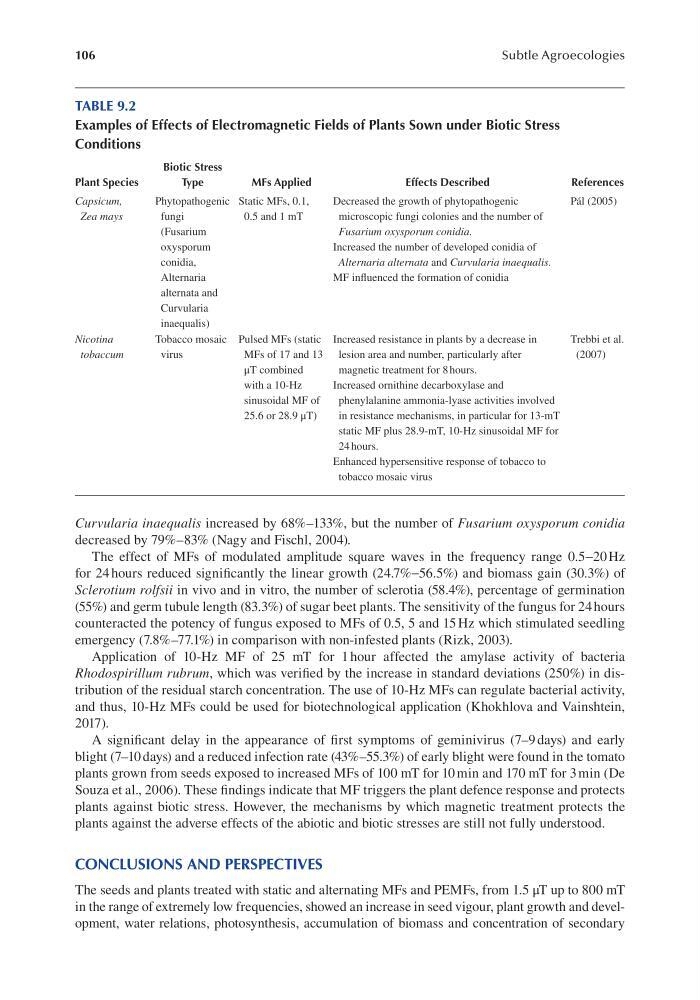
TABLE 9.2
Examples of Effects of Electromagnetic Fields of Plants Sown under Biotic Stress
Conditions
Biotic Stress
Plant Species
Type
Capsicum,
Zea mays
Phytopathogenic
fungi
(Fusarium
oxysporum
conidia,
Alternaria
alternata and
Curvularia
Nicotina
inaequalis)
Tobacco mosaic
tobaccum
virus
MFs Applied
Static MFs, 0.1,
0.5 and 1 mT
Pulsed MFs (static
MFs of 17 and 13
μT combined
with a 10-Hz
sinusoidal MF of
25.6 or 28.9 μT)
Effects Described
References
Decreased the growth of phytopathogenic
Pál (2005)
microscopic fungi colonies and the number of
Fusarium oxysporum conidia.
Increased the number of developed conidia of
Alternaria alternata and Curvularia inaequalis.
MF infuenced the formation of conidia
Increased resistance in plants by a decrease in
Trebbi et al.
lesion area and number, particularly after
(2007)
magnetic treatment for 8 hours.
Increased ornithine decarboxylase and
phenylalanine ammonia-lyase activities involved
in resistance mechanisms, in particular for 13-mT
static MF plus 28.9-mT, 10-Hz sinusoidal MF for
24 hours.
Enhanced hypersensitive response of tobacco to
tobacco mosaic virus
Curvularia inaequalis increased by 68%–133%, but the number of Fusarium oxysporum conidia
decreased by 79%–83% (Nagy and Fischl, 2004).
The effect of MFs of modulated amplitude square waves in the frequency range 0.5−20 Hz
for 24 hours reduced signifcantly the linear growth (24.7%−56.5%) and biomass gain (30.3%) of
Sclerotium rolfsii in vivo and in vitro, the number of sclerotia (58.4%), percentage of germination
(55%) and germ tubule length (83.3%) of sugar beet plants. The sensitivity of the fungus for 24 hours
counteracted the potency of fungus exposed to MFs of 0.5, 5 and 15 Hz which stimulated seedling
emergency (7.8%–77.1%) in comparison with non-infested plants (Rizk, 2003).
Application of 10-Hz MF of 25 mT for 1 hour affected the amylase activity of bacteria
Rhodospirillum rubrum, which was verifed by the increase in standard deviations (250%) in distribution of the residual starch concentration. The use of 10-Hz MFs can regulate bacterial activity,
and thus, 10-Hz MFs could be used for biotechnological application (Khokhlova and Vainshtein,
2017).
A signifcant delay in the appearance of frst symptoms of geminivirus (7–9 days) and early
blight (7–10 days) and a reduced infection rate (43%–55.3%) of early blight were found in the tomato
plants grown from seeds exposed to increased MFs of 100 mT for 10 min and 170 mT for 3 min (De
Souza et al., 2006). These fndings indicate that MF triggers the plant defence response and protects
plants against biotic stress. However, the mechanisms by which magnetic treatment protects the
plants against the adverse effects of the abiotic and biotic stresses are still not fully understood.
CONCLUSIONS AND PERSPECTIVES
The seeds and plants treated with static and alternating MFs and PEMFs, from 1.5 μT up to 800 mT
in the range of extremely low frequencies, showed an increase in seed vigour, plant growth and development, water relations, photosynthesis, accumulation of biomass and concentration of secondary
Subtle Agroecologies
TABLE 9.2
Examples of Effects of Electromagnetic Fields of Plants Sown under Biotic Stress
Conditions
Biotic Stress
Plant Species
Type
Capsicum,
Zea mays
Phytopathogenic
fungi
(Fusarium
oxysporum
conidia,
Alternaria
alternata and
Curvularia
Nicotina
inaequalis)
Tobacco mosaic
tobaccum
virus
MFs Applied
Static MFs, 0.1,
0.5 and 1 mT
Pulsed MFs (static
MFs of 17 and 13
μT combined
with a 10-Hz
sinusoidal MF of
25.6 or 28.9 μT)
Effects Described
References
Decreased the growth of phytopathogenic
Pál (2005)
microscopic fungi colonies and the number of
Fusarium oxysporum conidia.
Increased the number of developed conidia of
Alternaria alternata and Curvularia inaequalis.
MF infuenced the formation of conidia
Increased resistance in plants by a decrease in
Trebbi et al.
lesion area and number, particularly after
(2007)
magnetic treatment for 8 hours.
Increased ornithine decarboxylase and
phenylalanine ammonia-lyase activities involved
in resistance mechanisms, in particular for 13-mT
static MF plus 28.9-mT, 10-Hz sinusoidal MF for
24 hours.
Enhanced hypersensitive response of tobacco to
tobacco mosaic virus
Curvularia inaequalis increased by 68%–133%, but the number of Fusarium oxysporum conidia
decreased by 79%–83% (Nagy and Fischl, 2004).
The effect of MFs of modulated amplitude square waves in the frequency range 0.5−20 Hz
for 24 hours reduced signifcantly the linear growth (24.7%−56.5%) and biomass gain (30.3%) of
Sclerotium rolfsii in vivo and in vitro, the number of sclerotia (58.4%), percentage of germination
(55%) and germ tubule length (83.3%) of sugar beet plants. The sensitivity of the fungus for 24 hours
counteracted the potency of fungus exposed to MFs of 0.5, 5 and 15 Hz which stimulated seedling
emergency (7.8%–77.1%) in comparison with non-infested plants (Rizk, 2003).
Application of 10-Hz MF of 25 mT for 1 hour affected the amylase activity of bacteria
Rhodospirillum rubrum, which was verifed by the increase in standard deviations (250%) in distribution of the residual starch concentration. The use of 10-Hz MFs can regulate bacterial activity,
and thus, 10-Hz MFs could be used for biotechnological application (Khokhlova and Vainshtein,
2017).
A signifcant delay in the appearance of frst symptoms of geminivirus (7–9 days) and early
blight (7–10 days) and a reduced infection rate (43%–55.3%) of early blight were found in the tomato
plants grown from seeds exposed to increased MFs of 100 mT for 10 min and 170 mT for 3 min (De
Souza et al., 2006). These fndings indicate that MF triggers the plant defence response and protects
plants against biotic stress. However, the mechanisms by which magnetic treatment protects the
plants against the adverse effects of the abiotic and biotic stresses are still not fully understood.
CONCLUSIONS AND PERSPECTIVES
The seeds and plants treated with static and alternating MFs and PEMFs, from 1.5 μT up to 800 mT
in the range of extremely low frequencies, showed an increase in seed vigour, plant growth and development, water relations, photosynthesis, accumulation of biomass and concentration of secondary