

14 Siderophore in Plant Nutritional Management …
323
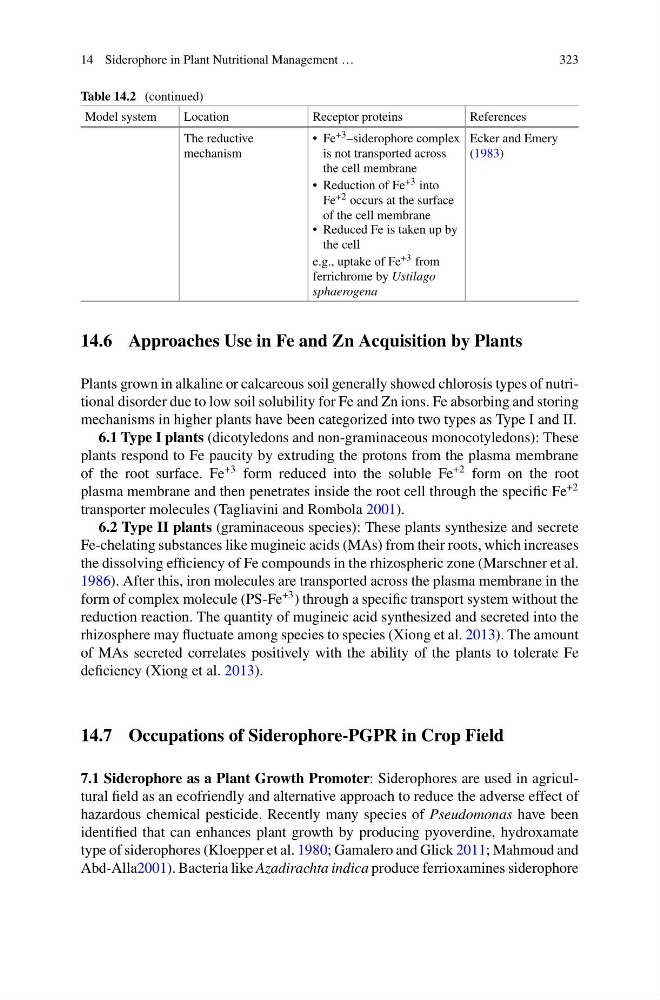
Table 14.2 (continued)
Model system
Location
Receptor proteins
References
The reductive
mechanism
• Fe +3 –siderophore complex
is not transported across
the cell membrane
• Reduction of Fe +3 into
Fe +2 occurs at the surface
of the cell membrane
• Reduced Fe is taken up by
the cell
e.g., uptake of Fe +3 from
ferrichrome by Ustilago
sphaerogena
Ecker and Emery
(1983)
14.6 Approaches Use in Fe and Zn Acquisition by Plants
Plants grown in alkaline or calcareous soil generally showed chlorosis types of nutritional disorder due to low soil solubility for Fe and Zn ions. Fe absorbing and storing
mechanisms in higher plants have been categorized into two types as Type I and II.
6.1 Type I plants (dicotyledons and non-graminaceous monocotyledons): These
plants respond to Fe paucity by extruding the protons from the plasma membrane
of the root surface. Fe
+3 form reduced into the soluble Fe
+2 form on the root
plasma membrane and then penetrates inside the root cell through the specific Fe
+2
transporter molecules (Tagliavini and Rombola 2001).
6.2 Type II plants (graminaceous species): These plants synthesize and secrete
Fe-chelating substances like mugineic acids (MAs) from their roots, which increases
the dissolving efficiency of Fe compounds in the rhizospheric zone (Marschner et al.
1986). After this, iron molecules are transported across the plasma membrane in the
form of complex molecule (PS-Fe
+3 ) through a specific transport system without the
reduction reaction. The quantity of mugineic acid synthesized and secreted into the
rhizosphere may fluctuate among species to species (Xiong et al. 2013). The amount
of MAs secreted correlates positively with the ability of the plants to tolerate Fe
deficiency (Xiong et al. 2013).
14.7 Occupations of Siderophore-PGPR in Crop Field
7.1 Siderophore as a Plant Growth Promoter: Siderophores are used in agricultural field as an ecofriendly and alternative approach to reduce the adverse effect of
hazardous chemical pesticide. Recently many species of Pseudomonas have been
identified that can enhances plant growth by producing pyoverdine, hydroxamate
type of siderophores (Kloepper et al. 1980; Gamalero and Glick 2011; Mahmoud and
Abd-Alla2001). Bacteria like Azadirachta indica produce ferrioxamines siderophore
323
Table 14.2 (continued)
Model system
Location
Receptor proteins
References
The reductive
mechanism
• Fe +3 –siderophore complex
is not transported across
the cell membrane
• Reduction of Fe +3 into
Fe +2 occurs at the surface
of the cell membrane
• Reduced Fe is taken up by
the cell
e.g., uptake of Fe +3 from
ferrichrome by Ustilago
sphaerogena
Ecker and Emery
(1983)
14.6 Approaches Use in Fe and Zn Acquisition by Plants
Plants grown in alkaline or calcareous soil generally showed chlorosis types of nutritional disorder due to low soil solubility for Fe and Zn ions. Fe absorbing and storing
mechanisms in higher plants have been categorized into two types as Type I and II.
6.1 Type I plants (dicotyledons and non-graminaceous monocotyledons): These
plants respond to Fe paucity by extruding the protons from the plasma membrane
of the root surface. Fe
+3 form reduced into the soluble Fe
+2 form on the root
plasma membrane and then penetrates inside the root cell through the specific Fe
+2
transporter molecules (Tagliavini and Rombola 2001).
6.2 Type II plants (graminaceous species): These plants synthesize and secrete
Fe-chelating substances like mugineic acids (MAs) from their roots, which increases
the dissolving efficiency of Fe compounds in the rhizospheric zone (Marschner et al.
1986). After this, iron molecules are transported across the plasma membrane in the
form of complex molecule (PS-Fe
+3 ) through a specific transport system without the
reduction reaction. The quantity of mugineic acid synthesized and secreted into the
rhizosphere may fluctuate among species to species (Xiong et al. 2013). The amount
of MAs secreted correlates positively with the ability of the plants to tolerate Fe
deficiency (Xiong et al. 2013).
14.7 Occupations of Siderophore-PGPR in Crop Field
7.1 Siderophore as a Plant Growth Promoter: Siderophores are used in agricultural field as an ecofriendly and alternative approach to reduce the adverse effect of
hazardous chemical pesticide. Recently many species of Pseudomonas have been
identified that can enhances plant growth by producing pyoverdine, hydroxamate
type of siderophores (Kloepper et al. 1980; Gamalero and Glick 2011; Mahmoud and
Abd-Alla2001). Bacteria like Azadirachta indica produce ferrioxamines siderophore