

13 Plant Growth-Promoting Bacteria …
301
13.2.2 Nutrient Use Efficiency (NUE)
Nutrient use efficiency reflects the ability of a plant to use the available nutrients
at its maximum potential. It can be defined as yield (biomass) per unit input of
fertilizer/nutrient content). NUE, therefore, depends on the plant’s ability to take up
nutrients efficiently from the soil but also depends on internal transport, storage, and
remobilization of nutrients. NUE is a critically important concept for evaluating crop
production systems and can be greatly impacted by fertilizer management (Baligar
et al. 2001). It is classified into four different subtypes (i) Agronomic efficiency, (ii)
Physiological efficiency, (iii) Apparent recovery efficiency, (iv) Utilization efficiency
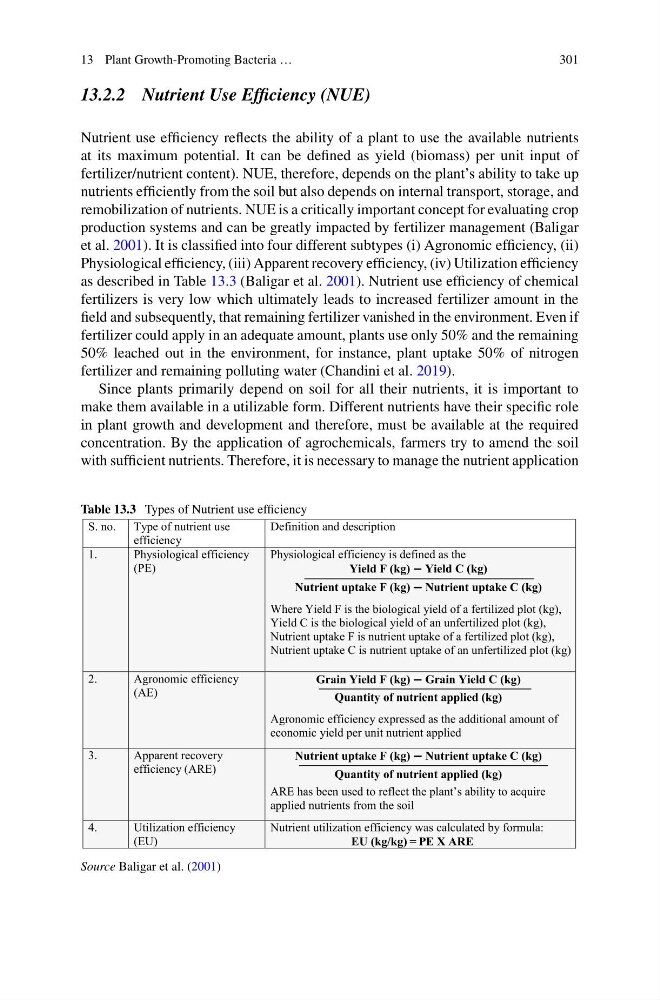
as described in Table 13.3 (Baligar et al. 2001). Nutrient use efficiency of chemical
fertilizers is very low which ultimately leads to increased fertilizer amount in the
field and subsequently, that remaining fertilizer vanished in the environment. Even if
fertilizer could apply in an adequate amount, plants use only 50% and the remaining
50% leached out in the environment, for instance, plant uptake 50% of nitrogen
fertilizer and remaining polluting water (Chandini et al. 2019).
Since plants primarily depend on soil for all their nutrients, it is important to
make them available in a utilizable form. Different nutrients have their specific role
in plant growth and development and therefore, must be available at the required
concentration. By the application of agrochemicals, farmers try to amend the soil
with sufficient nutrients. Therefore, it is necessary to manage the nutrient application
Table 13.3 Types of Nutrient use efficiency
S. no.
Type of nutrient use
efficiency
Definition and description
1.
Physiological efficiency
(PE)
Physiological efficiency is defined as the
Yield F (kg) Yield C (kg)
Nutrient uptake F (kg) Nutrient uptake C (kg)
Where Yield F is the biological yield of a fertilized plot (kg),
Yield C is the biological yield of an unfertilized plot (kg),
Nutrient uptake F is nutrient uptake of a fertilized plot (kg),
Nutrient uptake C is nutrient uptake of an unfertilized plot (kg)
2.
Agronomic efficiency
(AE)
Grain Yield F (kg) Grain Yield C (kg)
Quantity of nutrient applied (kg)
Agronomic efficiency expressed as the additional amount of
economic yield per unit nutrient applied
3.
Apparent recovery
efficiency (ARE)
Nutrient uptake F (kg) Nutrient uptake C (kg)
Quantity of nutrient applied (kg)
ARE has been used to reflect the plant’s ability to acquire
applied nutrients from the soil
4.
Utilization efficiency
(EU)
Nutrient utilization efficiency was calculated by formula:
EU (kg/kg) = PE X ARE
Source Baligar et al. (2001)
301
13.2.2 Nutrient Use Efficiency (NUE)
Nutrient use efficiency reflects the ability of a plant to use the available nutrients
at its maximum potential. It can be defined as yield (biomass) per unit input of
fertilizer/nutrient content). NUE, therefore, depends on the plant’s ability to take up
nutrients efficiently from the soil but also depends on internal transport, storage, and
remobilization of nutrients. NUE is a critically important concept for evaluating crop
production systems and can be greatly impacted by fertilizer management (Baligar
et al. 2001). It is classified into four different subtypes (i) Agronomic efficiency, (ii)
Physiological efficiency, (iii) Apparent recovery efficiency, (iv) Utilization efficiency
as described in Table 13.3 (Baligar et al. 2001). Nutrient use efficiency of chemical
fertilizers is very low which ultimately leads to increased fertilizer amount in the
field and subsequently, that remaining fertilizer vanished in the environment. Even if
fertilizer could apply in an adequate amount, plants use only 50% and the remaining
50% leached out in the environment, for instance, plant uptake 50% of nitrogen
fertilizer and remaining polluting water (Chandini et al. 2019).
Since plants primarily depend on soil for all their nutrients, it is important to
make them available in a utilizable form. Different nutrients have their specific role
in plant growth and development and therefore, must be available at the required
concentration. By the application of agrochemicals, farmers try to amend the soil
with sufficient nutrients. Therefore, it is necessary to manage the nutrient application
Table 13.3 Types of Nutrient use efficiency
S. no.
Type of nutrient use
efficiency
Definition and description
1.
Physiological efficiency
(PE)
Physiological efficiency is defined as the
Yield F (kg) Yield C (kg)
Nutrient uptake F (kg) Nutrient uptake C (kg)
Where Yield F is the biological yield of a fertilized plot (kg),
Yield C is the biological yield of an unfertilized plot (kg),
Nutrient uptake F is nutrient uptake of a fertilized plot (kg),
Nutrient uptake C is nutrient uptake of an unfertilized plot (kg)
2.
Agronomic efficiency
(AE)
Grain Yield F (kg) Grain Yield C (kg)
Quantity of nutrient applied (kg)
Agronomic efficiency expressed as the additional amount of
economic yield per unit nutrient applied
3.
Apparent recovery
efficiency (ARE)
Nutrient uptake F (kg) Nutrient uptake C (kg)
Quantity of nutrient applied (kg)
ARE has been used to reflect the plant’s ability to acquire
applied nutrients from the soil
4.
Utilization efficiency
(EU)
Nutrient utilization efficiency was calculated by formula:
EU (kg/kg) = PE X ARE
Source Baligar et al. (2001)