

13 Plant Growth-Promoting Bacteria …
299
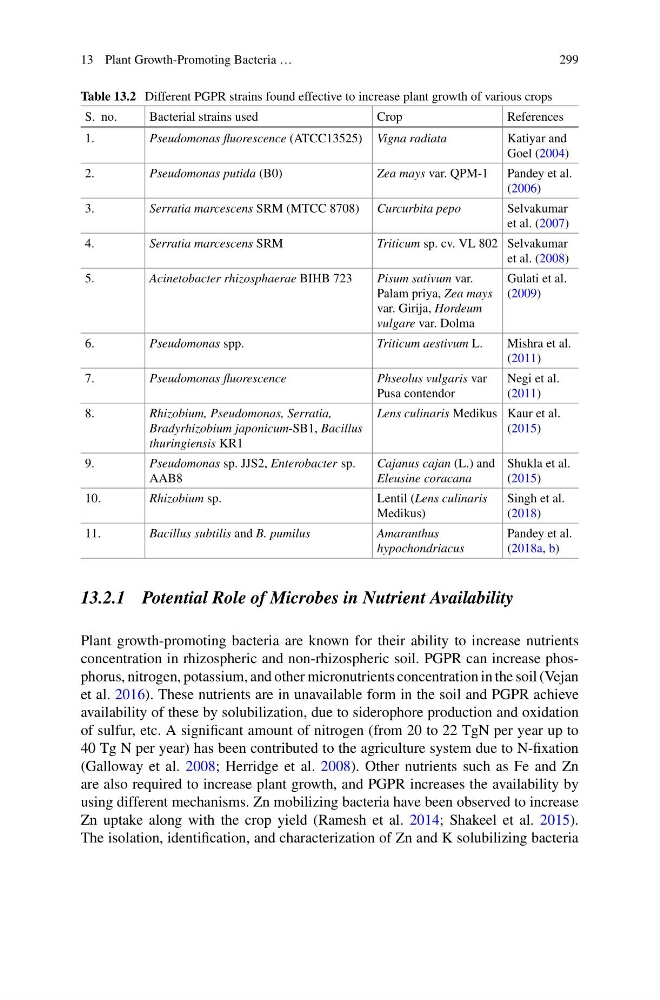
Table 13.2 Different PGPR strains found effective to increase plant growth of various crops
S. no.
Bacterial strains used
Crop
References
1.
Pseudomonas fluorescence (ATCC13525) Vigna radiata
Katiyar and
Goel (2004)
2.
Pseudomonas putida (B0)
Zea mays var. QPM-1 Pandey et al.
(2006)
3.
Serratia marcescens SRM (MTCC 8708) Curcurbita pepo
Selvakumar
et al. (2007)
4.
Serratia marcescens SRM
Triticum sp. cv. VL 802 Selvakumar
et al. (2008)
5.
Acinetobacter rhizosphaerae BIHB 723
Pisum sativum var.
Palam priya, Zea mays
var. Girija, Hordeum
vulgare var. Dolma
Gulati et al.
(2009)
6.
Pseudomonas spp.
Triticum aestivum L.
Mishra et al.
(2011)
7.
Pseudomonas fluorescence
Phseolus vulgaris var
Pusa contendor
Negi et al.
(2011)
8.
Rhizobium, Pseudomonas, Serratia,
Bradyrhizobium japonicum-SB1, Bacillus
thuringiensis KR1
Lens culinaris Medikus Kaur et al.
(2015)
9.
Pseudomonas sp. JJS2, Enterobacter sp.
AAB8
Cajanus cajan (L.) and
Eleusine coracana
Shukla et al.
(2015)
10.
Rhizobium sp.
Lentil (Lens culinaris
Medikus)
Singh et al.
(2018)
11.
Bacillus subtilis and B. pumilus
Amaranthus
hypochondriacus
Pandey et al.
(2018a, b)
13.2.1 Potential Role of Microbes in Nutrient Availability
Plant growth-promoting bacteria are known for their ability to increase nutrients
concentration in rhizospheric and non-rhizospheric soil. PGPR can increase phosphorus, nitrogen, potassium, and other micronutrients concentration in the soil (Vejan
et al. 2016). These nutrients are in unavailable form in the soil and PGPR achieve
availability of these by solubilization, due to siderophore production and oxidation
of sulfur, etc. A significant amount of nitrogen (from 20 to 22 TgN per year up to
40 Tg N per year) has been contributed to the agriculture system due to N-fixation
(Galloway et al. 2008; Herridge et al. 2008). Other nutrients such as Fe and Zn
are also required to increase plant growth, and PGPR increases the availability by
using different mechanisms. Zn mobilizing bacteria have been observed to increase
Zn uptake along with the crop yield (Ramesh et al. 2014; Shakeel et al. 2015).
The isolation, identification, and characterization of Zn and K solubilizing bacteria
299
Table 13.2 Different PGPR strains found effective to increase plant growth of various crops
S. no.
Bacterial strains used
Crop
References
1.
Pseudomonas fluorescence (ATCC13525) Vigna radiata
Katiyar and
Goel (2004)
2.
Pseudomonas putida (B0)
Zea mays var. QPM-1 Pandey et al.
(2006)
3.
Serratia marcescens SRM (MTCC 8708) Curcurbita pepo
Selvakumar
et al. (2007)
4.
Serratia marcescens SRM
Triticum sp. cv. VL 802 Selvakumar
et al. (2008)
5.
Acinetobacter rhizosphaerae BIHB 723
Pisum sativum var.
Palam priya, Zea mays
var. Girija, Hordeum
vulgare var. Dolma
Gulati et al.
(2009)
6.
Pseudomonas spp.
Triticum aestivum L.
Mishra et al.
(2011)
7.
Pseudomonas fluorescence
Phseolus vulgaris var
Pusa contendor
Negi et al.
(2011)
8.
Rhizobium, Pseudomonas, Serratia,
Bradyrhizobium japonicum-SB1, Bacillus
thuringiensis KR1
Lens culinaris Medikus Kaur et al.
(2015)
9.
Pseudomonas sp. JJS2, Enterobacter sp.
AAB8
Cajanus cajan (L.) and
Eleusine coracana
Shukla et al.
(2015)
10.
Rhizobium sp.
Lentil (Lens culinaris
Medikus)
Singh et al.
(2018)
11.
Bacillus subtilis and B. pumilus
Amaranthus
hypochondriacus
Pandey et al.
(2018a, b)
13.2.1 Potential Role of Microbes in Nutrient Availability
Plant growth-promoting bacteria are known for their ability to increase nutrients
concentration in rhizospheric and non-rhizospheric soil. PGPR can increase phosphorus, nitrogen, potassium, and other micronutrients concentration in the soil (Vejan
et al. 2016). These nutrients are in unavailable form in the soil and PGPR achieve
availability of these by solubilization, due to siderophore production and oxidation
of sulfur, etc. A significant amount of nitrogen (from 20 to 22 TgN per year up to
40 Tg N per year) has been contributed to the agriculture system due to N-fixation
(Galloway et al. 2008; Herridge et al. 2008). Other nutrients such as Fe and Zn
are also required to increase plant growth, and PGPR increases the availability by
using different mechanisms. Zn mobilizing bacteria have been observed to increase
Zn uptake along with the crop yield (Ramesh et al. 2014; Shakeel et al. 2015).
The isolation, identification, and characterization of Zn and K solubilizing bacteria