

256
C. García-Latorre et al.
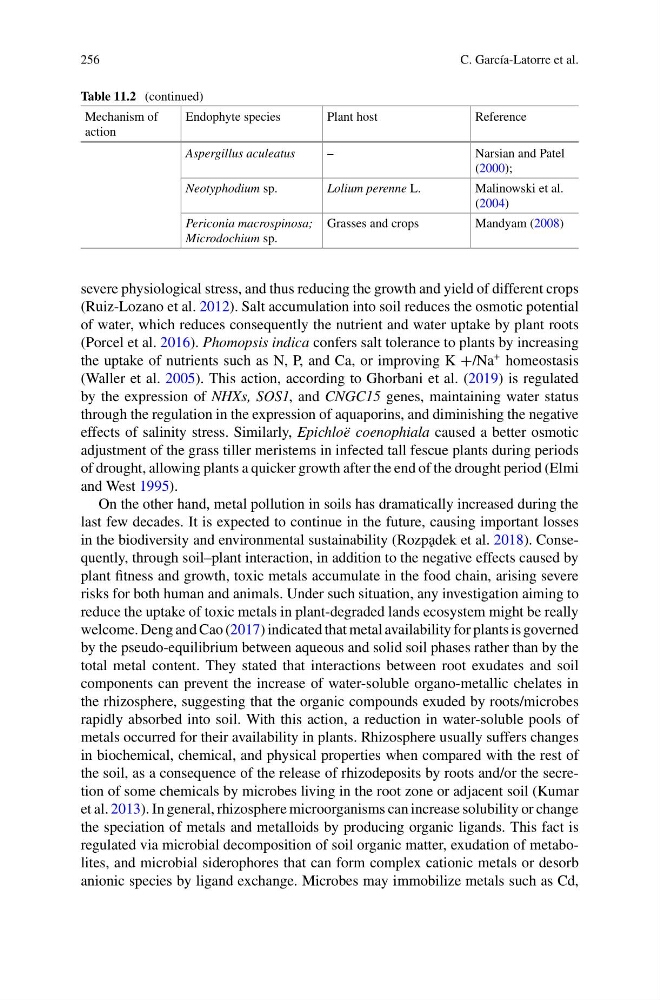
Table 11.2 (continued)
Mechanism of
action
Endophyte species
Plant host
Reference
Aspergillus aculeatus
–
Narsian and Patel
(2000);
Neotyphodium sp.
Lolium perenne L.
Malinowski et al.
(2004)
Periconia macrospinosa;
Microdochium sp.
Grasses and crops
Mandyam (2008)
severe physiological stress, and thus reducing the growth and yield of different crops
(Ruiz-Lozano et al. 2012). Salt accumulation into soil reduces the osmotic potential
of water, which reduces consequently the nutrient and water uptake by plant roots
(Porcel et al. 2016). Phomopsis indica confers salt tolerance to plants by increasing
the uptake of nutrients such as N, P, and Ca, or improving K +/Na
+ homeostasis
(Waller et al. 2005). This action, according to Ghorbani et al. (2019) is regulated
by the expression of NHXs, SOS1, and CNGC15 genes, maintaining water status
through the regulation in the expression of aquaporins, and diminishing the negative
effects of salinity stress. Similarly, Epichloë coenophiala caused a better osmotic
adjustment of the grass tiller meristems in infected tall fescue plants during periods
of drought, allowing plants a quicker growth after the end of the drought period (Elmi
and West 1995).
On the other hand, metal pollution in soils has dramatically increased during the
last few decades. It is expected to continue in the future, causing important losses
in the biodiversity and environmental sustainability (Rozp˛ adek et al. 2018). Consequently, through soil–plant interaction, in addition to the negative effects caused by
plant fitness and growth, toxic metals accumulate in the food chain, arising severe
risks for both human and animals. Under such situation, any investigation aiming to
reduce the uptake of toxic metals in plant-degraded lands ecosystem might be really
welcome. Deng and Cao (2017) indicated that metal availability for plants is governed
by the pseudo-equilibrium between aqueous and solid soil phases rather than by the
total metal content. They stated that interactions between root exudates and soil
components can prevent the increase of water-soluble organo-metallic chelates in
the rhizosphere, suggesting that the organic compounds exuded by roots/microbes
rapidly absorbed into soil. With this action, a reduction in water-soluble pools of
metals occurred for their availability in plants. Rhizosphere usually suffers changes
in biochemical, chemical, and physical properties when compared with the rest of
the soil, as a consequence of the release of rhizodeposits by roots and/or the secretion of some chemicals by microbes living in the root zone or adjacent soil (Kumar
et al. 2013). In general, rhizosphere microorganisms can increase solubility or change
the speciation of metals and metalloids by producing organic ligands. This fact is
regulated via microbial decomposition of soil organic matter, exudation of metabolites, and microbial siderophores that can form complex cationic metals or desorb
anionic species by ligand exchange. Microbes may immobilize metals such as Cd,
C. García-Latorre et al.
Table 11.2 (continued)
Mechanism of
action
Endophyte species
Plant host
Reference
Aspergillus aculeatus
–
Narsian and Patel
(2000);
Neotyphodium sp.
Lolium perenne L.
Malinowski et al.
(2004)
Periconia macrospinosa;
Microdochium sp.
Grasses and crops
Mandyam (2008)
severe physiological stress, and thus reducing the growth and yield of different crops
(Ruiz-Lozano et al. 2012). Salt accumulation into soil reduces the osmotic potential
of water, which reduces consequently the nutrient and water uptake by plant roots
(Porcel et al. 2016). Phomopsis indica confers salt tolerance to plants by increasing
the uptake of nutrients such as N, P, and Ca, or improving K +/Na
+ homeostasis
(Waller et al. 2005). This action, according to Ghorbani et al. (2019) is regulated
by the expression of NHXs, SOS1, and CNGC15 genes, maintaining water status
through the regulation in the expression of aquaporins, and diminishing the negative
effects of salinity stress. Similarly, Epichloë coenophiala caused a better osmotic
adjustment of the grass tiller meristems in infected tall fescue plants during periods
of drought, allowing plants a quicker growth after the end of the drought period (Elmi
and West 1995).
On the other hand, metal pollution in soils has dramatically increased during the
last few decades. It is expected to continue in the future, causing important losses
in the biodiversity and environmental sustainability (Rozp˛ adek et al. 2018). Consequently, through soil–plant interaction, in addition to the negative effects caused by
plant fitness and growth, toxic metals accumulate in the food chain, arising severe
risks for both human and animals. Under such situation, any investigation aiming to
reduce the uptake of toxic metals in plant-degraded lands ecosystem might be really
welcome. Deng and Cao (2017) indicated that metal availability for plants is governed
by the pseudo-equilibrium between aqueous and solid soil phases rather than by the
total metal content. They stated that interactions between root exudates and soil
components can prevent the increase of water-soluble organo-metallic chelates in
the rhizosphere, suggesting that the organic compounds exuded by roots/microbes
rapidly absorbed into soil. With this action, a reduction in water-soluble pools of
metals occurred for their availability in plants. Rhizosphere usually suffers changes
in biochemical, chemical, and physical properties when compared with the rest of
the soil, as a consequence of the release of rhizodeposits by roots and/or the secretion of some chemicals by microbes living in the root zone or adjacent soil (Kumar
et al. 2013). In general, rhizosphere microorganisms can increase solubility or change
the speciation of metals and metalloids by producing organic ligands. This fact is
regulated via microbial decomposition of soil organic matter, exudation of metabolites, and microbial siderophores that can form complex cationic metals or desorb
anionic species by ligand exchange. Microbes may immobilize metals such as Cd,