

11 Endophytes as Plant Nutrient Uptake-Promoter in Plants
251
Table 11.1 (continued)
Endophyte species
Plant host
Functional effect
(nutrient uptake
increase)
Reference
Sordaria fimicola
Ornithopus
compressus L.
B, Mn, Mo, S, Zn
Sporormiella
intermedia
Ornithopus
compressus L.
B, Mn, Mo, P, S, Zn
DSE 2 endophytes
Solanum lycopersicum
L.
N, P, K, Ca, Mg,
Fe, Mn, Zn
Vergara et al. (2017)
1 AM: Arbuscular mycorrhizal fungi; 2 DSE: Dark septate endophyte
60%, respectively in comparison with free-endophyte plants) when it was inoculated
in Trifolium subterraneum L. plants cultivated under greenhouse conditions (Lledó
et al. 2016). Such effects were dependent on environmental conditions, because when
the same endophytic species was inoculated in the parent host T. subterraneum, under
field conditions, the increase in the concentration of minerals was recorded in Al, Fe,
Pb, and Li (Lledó et al. 2016). In a similar study, in the experiments performed in
the field, an endophyte belonging to Pleosporales order named as E244, was found
to increase concentration of K (72%) and Pb (225%) when compared to the control
(uninfected plants) which inoculated in the aerial tissues of the plant host.
On the other hand, the enhancement of nutrient uptake in plants caused by fungal
endophytes is mainly achieved indirectly. In the case of Trichoderma spp. in addition
to their biocontrol activity, this endophyte can improve the solubility of soil micronutrients such as Fe, Zn, Cu, and Mn, due to its influence on arbuscular mycorrhiza
(AM) activity (Yedidia et al. 1999; Nzanza et al. 2012). Thus, in order to understand
it more, wheat seeds coated with an AM fungus and Trichoderma atroviride Karst.,
once cultivated in the field, produced grain with a higher nutritive value in terms
of protein, P, K, and Fe (Colla et al. 2015). According to authors, it was probably
due to the higher chlorophyll content and the higher photochemical activity of the
pigment-protein complex, photosystem II (PSII), besides better nutritional status
(higher leaf content of N, P, K, Fe, and Zn) of the wheat plant. On the other hand, a
specific group of endophytes named as dark septate endophytes (DSE) has also been
observed to cause an enhancement of the mineral uptake in pine seedlings (Jumpponen et al. 1998), by increasing their uptake of P and N in presence of DSE, and
in Deschampsia antarctica Desvaux plants inoculated with DSE, which increased
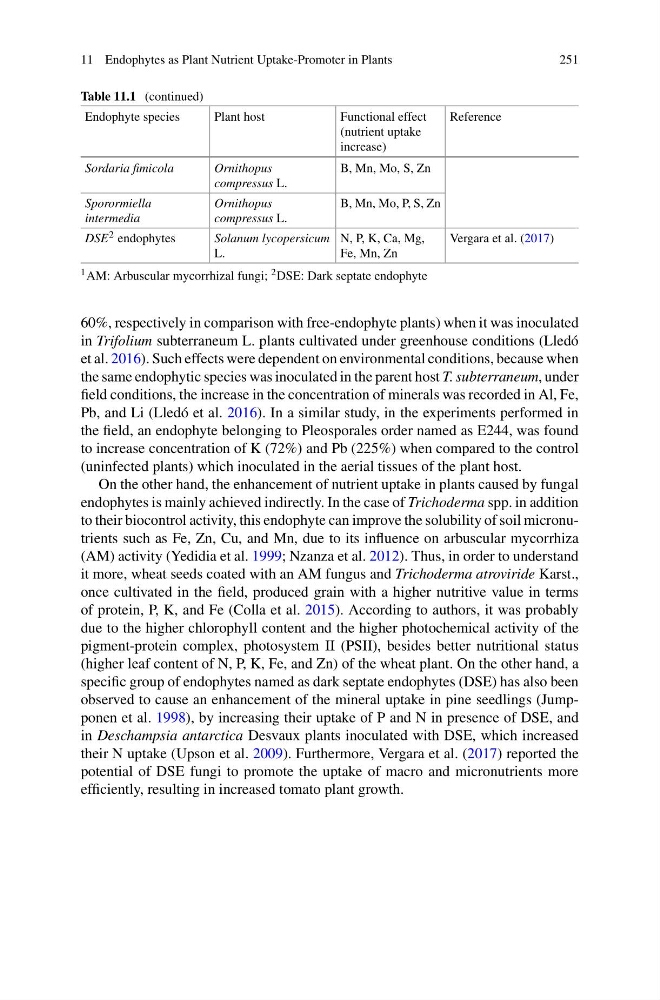
their N uptake (Upson et al. 2009). Furthermore, Vergara et al. (2017) reported the
potential of DSE fungi to promote the uptake of macro and micronutrients more
efficiently, resulting in increased tomato plant growth.
251
Table 11.1 (continued)
Endophyte species
Plant host
Functional effect
(nutrient uptake
increase)
Reference
Sordaria fimicola
Ornithopus
compressus L.
B, Mn, Mo, S, Zn
Sporormiella
intermedia
Ornithopus
compressus L.
B, Mn, Mo, P, S, Zn
DSE 2 endophytes
Solanum lycopersicum
L.
N, P, K, Ca, Mg,
Fe, Mn, Zn
Vergara et al. (2017)
1 AM: Arbuscular mycorrhizal fungi; 2 DSE: Dark septate endophyte
60%, respectively in comparison with free-endophyte plants) when it was inoculated
in Trifolium subterraneum L. plants cultivated under greenhouse conditions (Lledó
et al. 2016). Such effects were dependent on environmental conditions, because when
the same endophytic species was inoculated in the parent host T. subterraneum, under
field conditions, the increase in the concentration of minerals was recorded in Al, Fe,
Pb, and Li (Lledó et al. 2016). In a similar study, in the experiments performed in
the field, an endophyte belonging to Pleosporales order named as E244, was found
to increase concentration of K (72%) and Pb (225%) when compared to the control
(uninfected plants) which inoculated in the aerial tissues of the plant host.
On the other hand, the enhancement of nutrient uptake in plants caused by fungal
endophytes is mainly achieved indirectly. In the case of Trichoderma spp. in addition
to their biocontrol activity, this endophyte can improve the solubility of soil micronutrients such as Fe, Zn, Cu, and Mn, due to its influence on arbuscular mycorrhiza
(AM) activity (Yedidia et al. 1999; Nzanza et al. 2012). Thus, in order to understand
it more, wheat seeds coated with an AM fungus and Trichoderma atroviride Karst.,
once cultivated in the field, produced grain with a higher nutritive value in terms
of protein, P, K, and Fe (Colla et al. 2015). According to authors, it was probably
due to the higher chlorophyll content and the higher photochemical activity of the
pigment-protein complex, photosystem II (PSII), besides better nutritional status
(higher leaf content of N, P, K, Fe, and Zn) of the wheat plant. On the other hand, a
specific group of endophytes named as dark septate endophytes (DSE) has also been
observed to cause an enhancement of the mineral uptake in pine seedlings (Jumpponen et al. 1998), by increasing their uptake of P and N in presence of DSE, and
in Deschampsia antarctica Desvaux plants inoculated with DSE, which increased
their N uptake (Upson et al. 2009). Furthermore, Vergara et al. (2017) reported the
potential of DSE fungi to promote the uptake of macro and micronutrients more
efficiently, resulting in increased tomato plant growth.