

10 Endophytic Actinobacteria Associated …
237
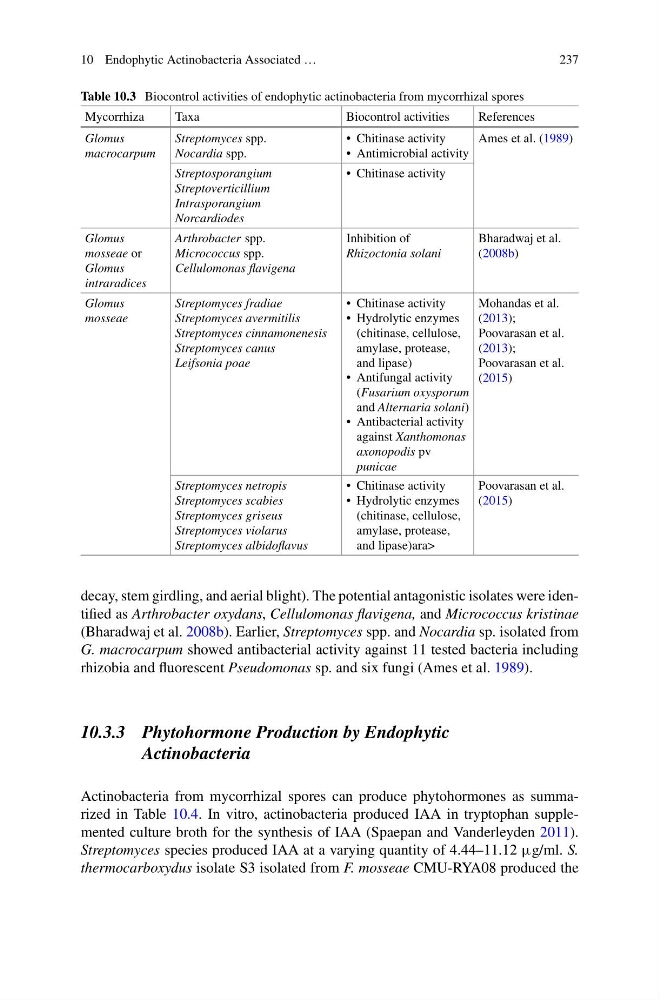
Table 10.3 Biocontrol activities of endophytic actinobacteria from mycorrhizal spores
Mycorrhiza
Taxa
Biocontrol activities
References
Glomus
macrocarpum
Streptomyces spp.
Nocardia spp.
• Chitinase activity
• Antimicrobial activity
Ames et al. (1989)
Streptosporangium
Streptoverticillium
Intrasporangium
Norcardiodes
• Chitinase activity
Glomus
mosseae or
Glomus
intraradices
Arthrobacter spp.
Micrococcus spp.
Cellulomonas flavigena
Inhibition of
Rhizoctonia solani
Bharadwaj et al.
(2008b)
Glomus
mosseae
Streptomyces fradiae
Streptomyces avermitilis
Streptomyces cinnamonenesis
Streptomyces canus
Leifsonia poae
• Chitinase activity
• Hydrolytic enzymes
(chitinase, cellulose,
amylase, protease,
and lipase)
• Antifungal activity
(Fusarium oxysporum
and Alternaria solani)
• Antibacterial activity
against Xanthomonas
axonopodis pv
punicae
Mohandas et al.
(2013);
Poovarasan et al.
(2013);
Poovarasan et al.
(2015)
Streptomyces netropis
Streptomyces scabies
Streptomyces griseus
Streptomyces violarus
Streptomyces albidoflavus
• Chitinase activity
• Hydrolytic enzymes
(chitinase, cellulose,
amylase, protease,
and lipase)ara>
Poovarasan et al.
(2015)
decay, stem girdling, and aerial blight). The potential antagonistic isolates were identified as Arthrobacter oxydans, Cellulomonas flavigena, and Micrococcus kristinae
(Bharadwaj et al. 2008b). Earlier, Streptomyces spp. and Nocardia sp. isolated from
G. macrocarpum showed antibacterial activity against 11 tested bacteria including
rhizobia and fluorescent Pseudomonas sp. and six fungi (Ames et al. 1989).
10.3.3 Phytohormone Production by Endophytic
Actinobacteria
Actinobacteria from mycorrhizal spores can produce phytohormones as summarized in Table 10.4. In vitro, actinobacteria produced IAA in tryptophan supplemented culture broth for the synthesis of IAA (Spaepan and Vanderleyden 2011).
Streptomyces species produced IAA at a varying quantity of 4.44–11.12 µg/ml. S.
thermocarboxydus isolate S3 isolated from F. mosseae CMU-RYA08 produced the
237
Table 10.3 Biocontrol activities of endophytic actinobacteria from mycorrhizal spores
Mycorrhiza
Taxa
Biocontrol activities
References
Glomus
macrocarpum
Streptomyces spp.
Nocardia spp.
• Chitinase activity
• Antimicrobial activity
Ames et al. (1989)
Streptosporangium
Streptoverticillium
Intrasporangium
Norcardiodes
• Chitinase activity
Glomus
mosseae or
Glomus
intraradices
Arthrobacter spp.
Micrococcus spp.
Cellulomonas flavigena
Inhibition of
Rhizoctonia solani
Bharadwaj et al.
(2008b)
Glomus
mosseae
Streptomyces fradiae
Streptomyces avermitilis
Streptomyces cinnamonenesis
Streptomyces canus
Leifsonia poae
• Chitinase activity
• Hydrolytic enzymes
(chitinase, cellulose,
amylase, protease,
and lipase)
• Antifungal activity
(Fusarium oxysporum
and Alternaria solani)
• Antibacterial activity
against Xanthomonas
axonopodis pv
punicae
Mohandas et al.
(2013);
Poovarasan et al.
(2013);
Poovarasan et al.
(2015)
Streptomyces netropis
Streptomyces scabies
Streptomyces griseus
Streptomyces violarus
Streptomyces albidoflavus
• Chitinase activity
• Hydrolytic enzymes
(chitinase, cellulose,
amylase, protease,
and lipase)ara>
Poovarasan et al.
(2015)
decay, stem girdling, and aerial blight). The potential antagonistic isolates were identified as Arthrobacter oxydans, Cellulomonas flavigena, and Micrococcus kristinae
(Bharadwaj et al. 2008b). Earlier, Streptomyces spp. and Nocardia sp. isolated from
G. macrocarpum showed antibacterial activity against 11 tested bacteria including
rhizobia and fluorescent Pseudomonas sp. and six fungi (Ames et al. 1989).
10.3.3 Phytohormone Production by Endophytic
Actinobacteria
Actinobacteria from mycorrhizal spores can produce phytohormones as summarized in Table 10.4. In vitro, actinobacteria produced IAA in tryptophan supplemented culture broth for the synthesis of IAA (Spaepan and Vanderleyden 2011).
Streptomyces species produced IAA at a varying quantity of 4.44–11.12 µg/ml. S.
thermocarboxydus isolate S3 isolated from F. mosseae CMU-RYA08 produced the