

8 Biotechnology and Bioinformatics of Endophytes …
183
(1992) mentioned that they are microorganisms that establish beneficial cooperation (endosymbiosis) with plants. In the same year, Kado (1992) included neutral
bacteria (reside in the interior of living plants and benefit from a secure residence)
to the endophytic community. In 1997, James and colleagues stated that all microorganisms colonizing internal plant tissues, including active and latent pathogens
were considered endophytes (James et al. 1997). In agronomy, endophyte definition was expanded to cover all microorganisms emerging from surface-sterilized
plant tissues and establishing mutualistic associations with host plants, but cause no
symptoms of the disease (Hallmann et al. 1997; Azevedo et al. 2000). Schulz and
Boyle (2006) defined endophytes as microorganisms colonizing internal plant tissues
without causing any injuries and or adverse reaction on their host, whereas Thrall
et al. (2007) pointed out that endophytes result from a positive selection to invade
the plants’ tissues, during at least a period of their life cycle and perform mutualistic
associations with them. The concept of endophytism was defined in several ways,
however many scientists approved that endophytic microbial communities reside
inside plant tissues with no harmful effect to hosts (Johnston-Monje and Raizada
2011; Hardoim et al. 2012; Gupta et al. 2013; Sarethy et al. 2019).
8.3 Endophytes Ongoing Researches and Major Trends
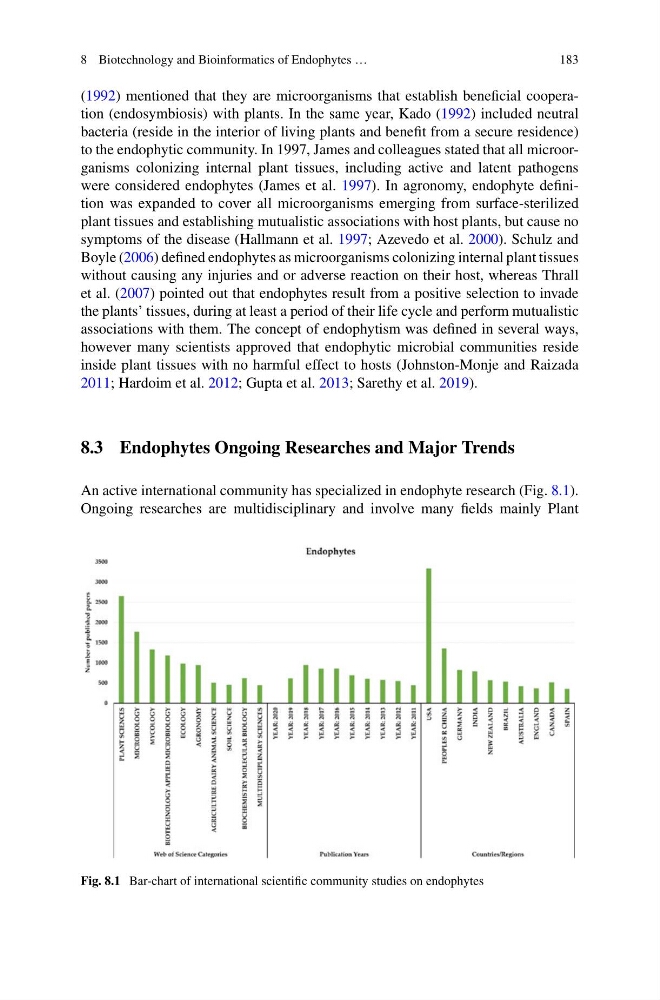
An active international community has specialized in endophyte research (Fig. 8.1).
Ongoing researches are multidisciplinary and involve many fields mainly Plant
Fig. 8.1 Bar-chart of international scientific community studies on endophytes
183
(1992) mentioned that they are microorganisms that establish beneficial cooperation (endosymbiosis) with plants. In the same year, Kado (1992) included neutral
bacteria (reside in the interior of living plants and benefit from a secure residence)
to the endophytic community. In 1997, James and colleagues stated that all microorganisms colonizing internal plant tissues, including active and latent pathogens
were considered endophytes (James et al. 1997). In agronomy, endophyte definition was expanded to cover all microorganisms emerging from surface-sterilized
plant tissues and establishing mutualistic associations with host plants, but cause no
symptoms of the disease (Hallmann et al. 1997; Azevedo et al. 2000). Schulz and
Boyle (2006) defined endophytes as microorganisms colonizing internal plant tissues
without causing any injuries and or adverse reaction on their host, whereas Thrall
et al. (2007) pointed out that endophytes result from a positive selection to invade
the plants’ tissues, during at least a period of their life cycle and perform mutualistic
associations with them. The concept of endophytism was defined in several ways,
however many scientists approved that endophytic microbial communities reside
inside plant tissues with no harmful effect to hosts (Johnston-Monje and Raizada
2011; Hardoim et al. 2012; Gupta et al. 2013; Sarethy et al. 2019).
8.3 Endophytes Ongoing Researches and Major Trends
An active international community has specialized in endophyte research (Fig. 8.1).
Ongoing researches are multidisciplinary and involve many fields mainly Plant
Fig. 8.1 Bar-chart of international scientific community studies on endophytes