

7 Tropical Endophytic Bacillus Species …
159
Members of the Bacillus are reported as one of the most predominant plant endophytic bacteria presenting several plant growth-promoting traits. Once established
within the plant, the ability of these endophytes to promote plant growth occurs
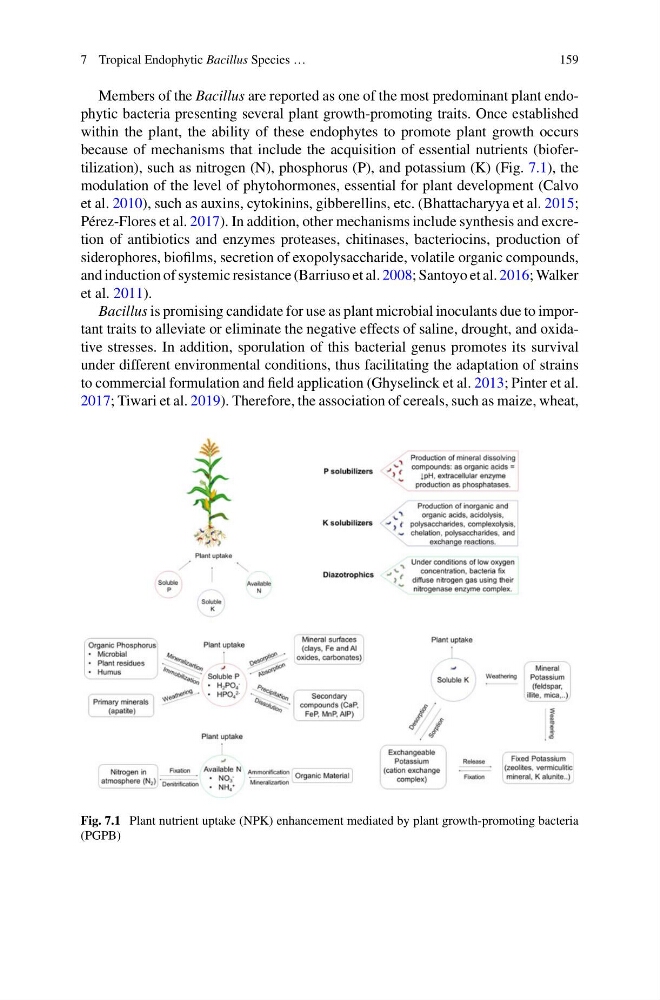
because of mechanisms that include the acquisition of essential nutrients (biofertilization), such as nitrogen (N), phosphorus (P), and potassium (K) (Fig. 7.1), the
modulation of the level of phytohormones, essential for plant development (Calvo
et al. 2010), such as auxins, cytokinins, gibberellins, etc. (Bhattacharyya et al. 2015;
Pérez-Flores et al. 2017). In addition, other mechanisms include synthesis and excretion of antibiotics and enzymes proteases, chitinases, bacteriocins, production of
siderophores, biofilms, secretion of exopolysaccharide, volatile organic compounds,
and induction of systemic resistance (Barriuso et al. 2008; Santoyo et al. 2016; Walker
et al. 2011).
Bacillus is promising candidate for use as plant microbial inoculants due to important traits to alleviate or eliminate the negative effects of saline, drought, and oxidative stresses. In addition, sporulation of this bacterial genus promotes its survival
under different environmental conditions, thus facilitating the adaptation of strains
to commercial formulation and field application (Ghyselinck et al. 2013; Pinter et al.
2017; Tiwari et al. 2019). Therefore, the association of cereals, such as maize, wheat,
Fig. 7.1 Plant nutrient uptake (NPK) enhancement mediated by plant growth-promoting bacteria
(PGPB)
159
Members of the Bacillus are reported as one of the most predominant plant endophytic bacteria presenting several plant growth-promoting traits. Once established
within the plant, the ability of these endophytes to promote plant growth occurs
because of mechanisms that include the acquisition of essential nutrients (biofertilization), such as nitrogen (N), phosphorus (P), and potassium (K) (Fig. 7.1), the
modulation of the level of phytohormones, essential for plant development (Calvo
et al. 2010), such as auxins, cytokinins, gibberellins, etc. (Bhattacharyya et al. 2015;
Pérez-Flores et al. 2017). In addition, other mechanisms include synthesis and excretion of antibiotics and enzymes proteases, chitinases, bacteriocins, production of
siderophores, biofilms, secretion of exopolysaccharide, volatile organic compounds,
and induction of systemic resistance (Barriuso et al. 2008; Santoyo et al. 2016; Walker
et al. 2011).
Bacillus is promising candidate for use as plant microbial inoculants due to important traits to alleviate or eliminate the negative effects of saline, drought, and oxidative stresses. In addition, sporulation of this bacterial genus promotes its survival
under different environmental conditions, thus facilitating the adaptation of strains
to commercial formulation and field application (Ghyselinck et al. 2013; Pinter et al.
2017; Tiwari et al. 2019). Therefore, the association of cereals, such as maize, wheat,
Fig. 7.1 Plant nutrient uptake (NPK) enhancement mediated by plant growth-promoting bacteria
(PGPB)