

136
A. Ghasemnezhad et al.
broad. For example, the plant associated Paraphaeosphaeria quadriseptata starts
producing six new secondary metabolites when only the water used to make the
media is changed from tap water to distilled water (Kusari et al. 2012).
6.8 Endophytes and Abiotic Stresses
Human activities such as smelting, mining, electroplating, refineries, fertilizer use
and fungicides, sewage sludge have accumulated heavy metals such as cadmium
(Cd) in natural resources, soil and climate. The accumulation of Cd in plants causes
severe damage to the cell membrane, organelle and nucleus as a result of reduced
metabolism, photosynthesis and absorption of water and nutrients. In addition, Cd
enrichment in crops can pose a risk to human health (Tang et al. 2019). Recently,
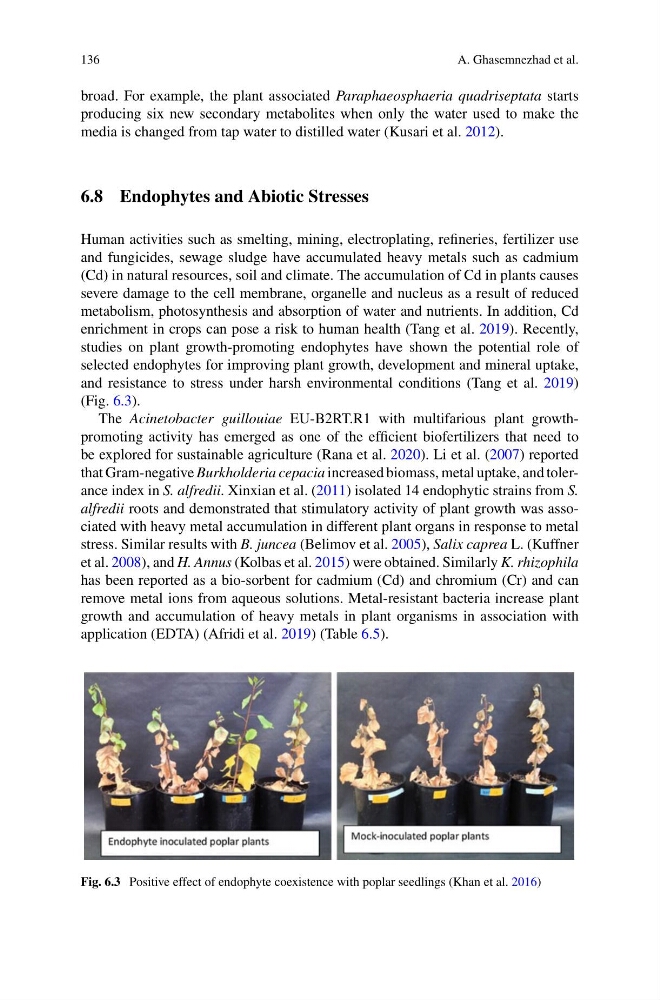
studies on plant growth-promoting endophytes have shown the potential role of
selected endophytes for improving plant growth, development and mineral uptake,
and resistance to stress under harsh environmental conditions (Tang et al. 2019)
(Fig. 6.3).
The Acinetobacter guillouiae EU-B2RT.R1 with multifarious plant growthpromoting activity has emerged as one of the efficient biofertilizers that need to
be explored for sustainable agriculture (Rana et al. 2020). Li et al. (2007) reported
that Gram-negative Burkholderia cepacia increased biomass, metal uptake, and tolerance index in S. alfredii. Xinxian et al. (2011) isolated 14 endophytic strains from S.
alfredii roots and demonstrated that stimulatory activity of plant growth was associated with heavy metal accumulation in different plant organs in response to metal
stress. Similar results with B. juncea (Belimov et al. 2005), Salix caprea L. (Kuffner
et al. 2008), and H. Annus (Kolbas et al. 2015) were obtained. Similarly K. rhizophila
has been reported as a bio-sorbent for cadmium (Cd) and chromium (Cr) and can
remove metal ions from aqueous solutions. Metal-resistant bacteria increase plant
growth and accumulation of heavy metals in plant organisms in association with
application (EDTA) (Afridi et al. 2019) (Table 6.5).
Fig. 6.3 Positive effect of endophyte coexistence with poplar seedlings (Khan et al. 2016)
A. Ghasemnezhad et al.
broad. For example, the plant associated Paraphaeosphaeria quadriseptata starts
producing six new secondary metabolites when only the water used to make the
media is changed from tap water to distilled water (Kusari et al. 2012).
6.8 Endophytes and Abiotic Stresses
Human activities such as smelting, mining, electroplating, refineries, fertilizer use
and fungicides, sewage sludge have accumulated heavy metals such as cadmium
(Cd) in natural resources, soil and climate. The accumulation of Cd in plants causes
severe damage to the cell membrane, organelle and nucleus as a result of reduced
metabolism, photosynthesis and absorption of water and nutrients. In addition, Cd
enrichment in crops can pose a risk to human health (Tang et al. 2019). Recently,
studies on plant growth-promoting endophytes have shown the potential role of
selected endophytes for improving plant growth, development and mineral uptake,
and resistance to stress under harsh environmental conditions (Tang et al. 2019)
(Fig. 6.3).
The Acinetobacter guillouiae EU-B2RT.R1 with multifarious plant growthpromoting activity has emerged as one of the efficient biofertilizers that need to
be explored for sustainable agriculture (Rana et al. 2020). Li et al. (2007) reported
that Gram-negative Burkholderia cepacia increased biomass, metal uptake, and tolerance index in S. alfredii. Xinxian et al. (2011) isolated 14 endophytic strains from S.
alfredii roots and demonstrated that stimulatory activity of plant growth was associated with heavy metal accumulation in different plant organs in response to metal
stress. Similar results with B. juncea (Belimov et al. 2005), Salix caprea L. (Kuffner
et al. 2008), and H. Annus (Kolbas et al. 2015) were obtained. Similarly K. rhizophila
has been reported as a bio-sorbent for cadmium (Cd) and chromium (Cr) and can
remove metal ions from aqueous solutions. Metal-resistant bacteria increase plant
growth and accumulation of heavy metals in plant organisms in association with
application (EDTA) (Afridi et al. 2019) (Table 6.5).
Fig. 6.3 Positive effect of endophyte coexistence with poplar seedlings (Khan et al. 2016)