

116
C. Dileep et al.
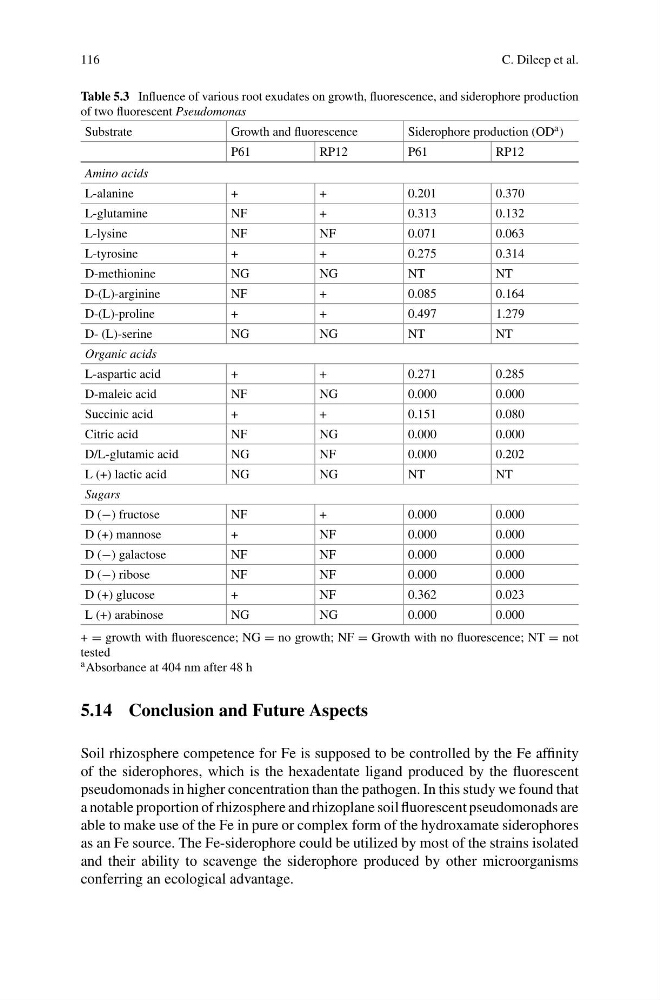
Table 5.3 Influence of various root exudates on growth, fluorescence, and siderophore production
of two fluorescent Pseudomonas
Substrate
Growth and fluorescence
Siderophore production (OD a )
P61
RP12
P61
RP12
Amino acids
L-alanine
+
+
0.201
0.370
L-glutamine
NF
+
0.313
0.132
L-lysine
NF
NF
0.071
0.063
L-tyrosine
+
+
0.275
0.314
D-methionine
NG
NG
NT
NT
D-(L)-arginine
NF
+
0.085
0.164
D-(L)-proline
+
+
0.497
1.279
D- (L)-serine
NG
NG
NT
NT
Organic acids
L-aspartic acid
+
+
0.271
0.285
D-maleic acid
NF
NG
0.000
0.000
Succinic acid
+
+
0.151
0.080
Citric acid
NF
NG
0.000
0.000
D/L-glutamic acid
NG
NF
0.000
0.202
L (+) lactic acid
NG
NG
NT
NT
Sugars
D (−) fructose
NF
+
0.000
0.000
D (+) mannose
+
NF
0.000
0.000
D (−) galactose
NF
NF
0.000
0.000
D (−) ribose
NF
NF
0.000
0.000
D (+) glucose
+
NF
0.362
0.023
L (+) arabinose
NG
NG
0.000
0.000
+ = growth with fluorescence; NG = no growth; NF = Growth with no fluorescence; NT = not
tested
a Absorbance at 404 nm after 48 h
5.14 Conclusion and Future Aspects
Soil rhizosphere competence for Fe is supposed to be controlled by the Fe affinity
of the siderophores, which is the hexadentate ligand produced by the fluorescent
pseudomonads in higher concentration than the pathogen. In this study we found that
a notable proportion of rhizosphere and rhizoplane soil fluorescent pseudomonads are
able to make use of the Fe in pure or complex form of the hydroxamate siderophores
as an Fe source. The Fe-siderophore could be utilized by most of the strains isolated
and their ability to scavenge the siderophore produced by other microorganisms
conferring an ecological advantage.
C. Dileep et al.
Table 5.3 Influence of various root exudates on growth, fluorescence, and siderophore production
of two fluorescent Pseudomonas
Substrate
Growth and fluorescence
Siderophore production (OD a )
P61
RP12
P61
RP12
Amino acids
L-alanine
+
+
0.201
0.370
L-glutamine
NF
+
0.313
0.132
L-lysine
NF
NF
0.071
0.063
L-tyrosine
+
+
0.275
0.314
D-methionine
NG
NG
NT
NT
D-(L)-arginine
NF
+
0.085
0.164
D-(L)-proline
+
+
0.497
1.279
D- (L)-serine
NG
NG
NT
NT
Organic acids
L-aspartic acid
+
+
0.271
0.285
D-maleic acid
NF
NG
0.000
0.000
Succinic acid
+
+
0.151
0.080
Citric acid
NF
NG
0.000
0.000
D/L-glutamic acid
NG
NF
0.000
0.202
L (+) lactic acid
NG
NG
NT
NT
Sugars
D (−) fructose
NF
+
0.000
0.000
D (+) mannose
+
NF
0.000
0.000
D (−) galactose
NF
NF
0.000
0.000
D (−) ribose
NF
NF
0.000
0.000
D (+) glucose
+
NF
0.362
0.023
L (+) arabinose
NG
NG
0.000
0.000
+ = growth with fluorescence; NG = no growth; NF = Growth with no fluorescence; NT = not
tested
a Absorbance at 404 nm after 48 h
5.14 Conclusion and Future Aspects
Soil rhizosphere competence for Fe is supposed to be controlled by the Fe affinity
of the siderophores, which is the hexadentate ligand produced by the fluorescent
pseudomonads in higher concentration than the pathogen. In this study we found that
a notable proportion of rhizosphere and rhizoplane soil fluorescent pseudomonads are
able to make use of the Fe in pure or complex form of the hydroxamate siderophores
as an Fe source. The Fe-siderophore could be utilized by most of the strains isolated
and their ability to scavenge the siderophore produced by other microorganisms
conferring an ecological advantage.