

5 Fluorescent Pseudomonads …
107
with its siderophore, which cannot be used by harmful DRB, resulting in a decrease
in their number and activities, and (ii) to the harmful microorganisms effectively,
the fluorescent pseudomonads must be capable of colonizing and thus protecting the
whole root system of the plant.
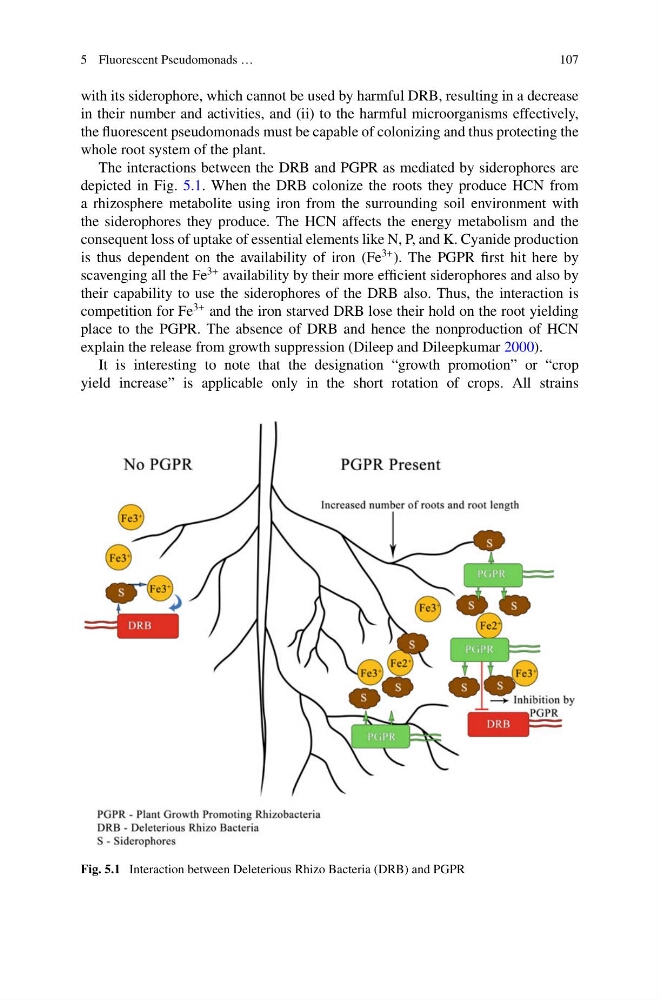
The interactions between the DRB and PGPR as mediated by siderophores are
depicted in Fig. 5.1. When the DRB colonize the roots they produce HCN from
a rhizosphere metabolite using iron from the surrounding soil environment with
the siderophores they produce. The HCN affects the energy metabolism and the
consequent loss of uptake of essential elements like N, P, and K. Cyanide production
is thus dependent on the availability of iron (Fe
3+ ). The PGPR first hit here by
scavenging all the Fe
3+ availability by their more efficient siderophores and also by
their capability to use the siderophores of the DRB also. Thus, the interaction is
competition for Fe
3+ and the iron starved DRB lose their hold on the root yielding
place to the PGPR. The absence of DRB and hence the nonproduction of HCN
explain the release from growth suppression (Dileep and Dileepkumar 2000).
It is interesting to note that the designation “growth promotion” or “crop
yield increase” is applicable only in the short rotation of crops. All strains
Fig. 5.1 Interaction between Deleterious Rhizo Bacteria (DRB) and PGPR
107
with its siderophore, which cannot be used by harmful DRB, resulting in a decrease
in their number and activities, and (ii) to the harmful microorganisms effectively,
the fluorescent pseudomonads must be capable of colonizing and thus protecting the
whole root system of the plant.
The interactions between the DRB and PGPR as mediated by siderophores are
depicted in Fig. 5.1. When the DRB colonize the roots they produce HCN from
a rhizosphere metabolite using iron from the surrounding soil environment with
the siderophores they produce. The HCN affects the energy metabolism and the
consequent loss of uptake of essential elements like N, P, and K. Cyanide production
is thus dependent on the availability of iron (Fe
3+ ). The PGPR first hit here by
scavenging all the Fe
3+ availability by their more efficient siderophores and also by
their capability to use the siderophores of the DRB also. Thus, the interaction is
competition for Fe
3+ and the iron starved DRB lose their hold on the root yielding
place to the PGPR. The absence of DRB and hence the nonproduction of HCN
explain the release from growth suppression (Dileep and Dileepkumar 2000).
It is interesting to note that the designation “growth promotion” or “crop
yield increase” is applicable only in the short rotation of crops. All strains
Fig. 5.1 Interaction between Deleterious Rhizo Bacteria (DRB) and PGPR