

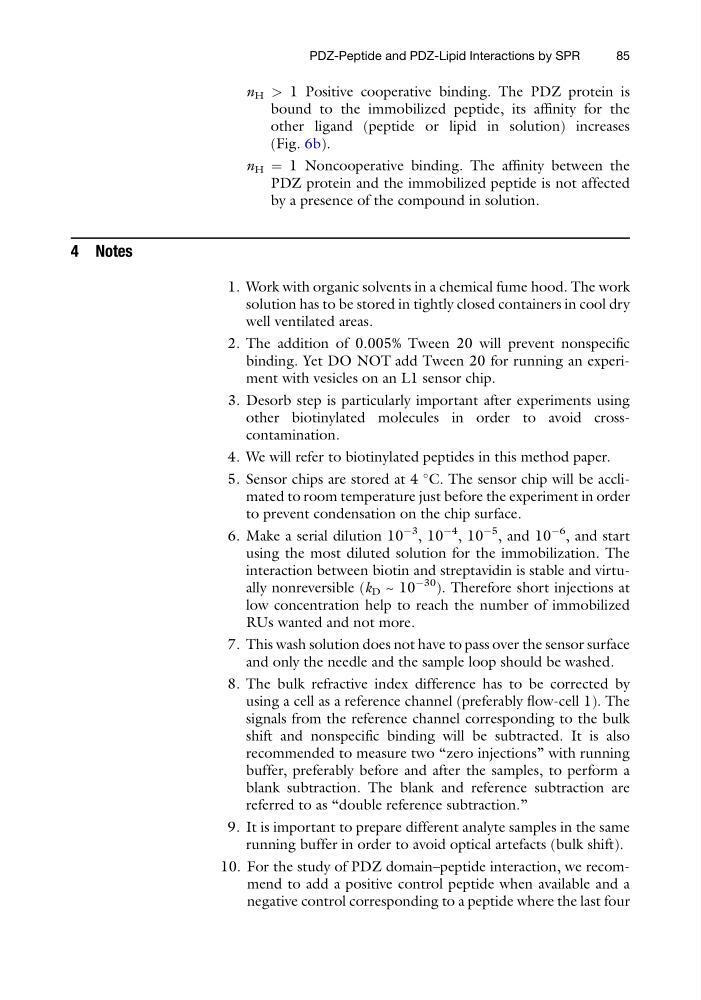
n H > 1 Positive cooperative binding. The PDZ protein is
bound to the immobilized peptide, its affinity for the
other ligand (peptide or lipid in solution) increases
(Fig. 6b).
n H ¼ 1 Noncooperative binding. The affinity between the
PDZ protein and the immobilized peptide is not affected
by a presence of the compound in solution.
4 Notes
1. Work with organic solvents in a chemical fume hood. The work
solution has to be stored in tightly closed containers in cool dry
well ventilated areas.
2. The addition of 0.005% Tween 20 will prevent nonspecific
binding. Yet DO NOT add Tween 20 for running an experiment with vesicles on an L1 sensor chip.
3. Desorb step is particularly important after experiments using
other biotinylated molecules in order to avoid crosscontamination.
4. We will refer to biotinylated peptides in this method paper.
5. Sensor chips are stored at 4
C. The sensor chip will be acclimated to room temperature just before the experiment in order
to prevent condensation on the chip surface.
6. Make a serial dilution 10
À3
, 10
À4 , 10
À5 , and 10
À6
, and start
using the most diluted solution for the immobilization. The
interaction between biotin and streptavidin is stable and virtually nonreversible (k D ~ 10
À30 ). Therefore short injections at
low concentration help to reach the number of immobilized
RUs wanted and not more.
7. This wash solution does not have to pass over the sensor surface
and only the needle and the sample loop should be washed.
8. The bulk refractive index difference has to be corrected by
using a cell as a reference channel (preferably flow-cell 1). The
signals from the reference channel corresponding to the bulk
shift and nonspecific binding will be subtracted. It is also
recommended to measure two “zero injections” with running
buffer, preferably before and after the samples, to perform a
blank subtraction. The blank and reference subtraction are
referred to as “double reference subtraction.”
9. It is important to prepare different analyte samples in the same
running buffer in order to avoid optical artefacts (bulk shift).
10. For the study of PDZ domain–peptide interaction, we recommend to add a positive control peptide when available and a
negative control corresponding to a peptide where the last four
PDZ-Peptide and PDZ-Lipid Interactions by SPR
85
bound to the immobilized peptide, its affinity for the
other ligand (peptide or lipid in solution) increases
(Fig. 6b).
n H ¼ 1 Noncooperative binding. The affinity between the
PDZ protein and the immobilized peptide is not affected
by a presence of the compound in solution.
4 Notes
1. Work with organic solvents in a chemical fume hood. The work
solution has to be stored in tightly closed containers in cool dry
well ventilated areas.
2. The addition of 0.005% Tween 20 will prevent nonspecific
binding. Yet DO NOT add Tween 20 for running an experiment with vesicles on an L1 sensor chip.
3. Desorb step is particularly important after experiments using
other biotinylated molecules in order to avoid crosscontamination.
4. We will refer to biotinylated peptides in this method paper.
5. Sensor chips are stored at 4
C. The sensor chip will be acclimated to room temperature just before the experiment in order
to prevent condensation on the chip surface.
6. Make a serial dilution 10
À3
, 10
À4 , 10
À5 , and 10
À6
, and start
using the most diluted solution for the immobilization. The
interaction between biotin and streptavidin is stable and virtually nonreversible (k D ~ 10
À30 ). Therefore short injections at
low concentration help to reach the number of immobilized
RUs wanted and not more.
7. This wash solution does not have to pass over the sensor surface
and only the needle and the sample loop should be washed.
8. The bulk refractive index difference has to be corrected by
using a cell as a reference channel (preferably flow-cell 1). The
signals from the reference channel corresponding to the bulk
shift and nonspecific binding will be subtracted. It is also
recommended to measure two “zero injections” with running
buffer, preferably before and after the samples, to perform a
blank subtraction. The blank and reference subtraction are
referred to as “double reference subtraction.”
9. It is important to prepare different analyte samples in the same
running buffer in order to avoid optical artefacts (bulk shift).
10. For the study of PDZ domain–peptide interaction, we recommend to add a positive control peptide when available and a
negative control corresponding to a peptide where the last four
PDZ-Peptide and PDZ-Lipid Interactions by SPR
85