

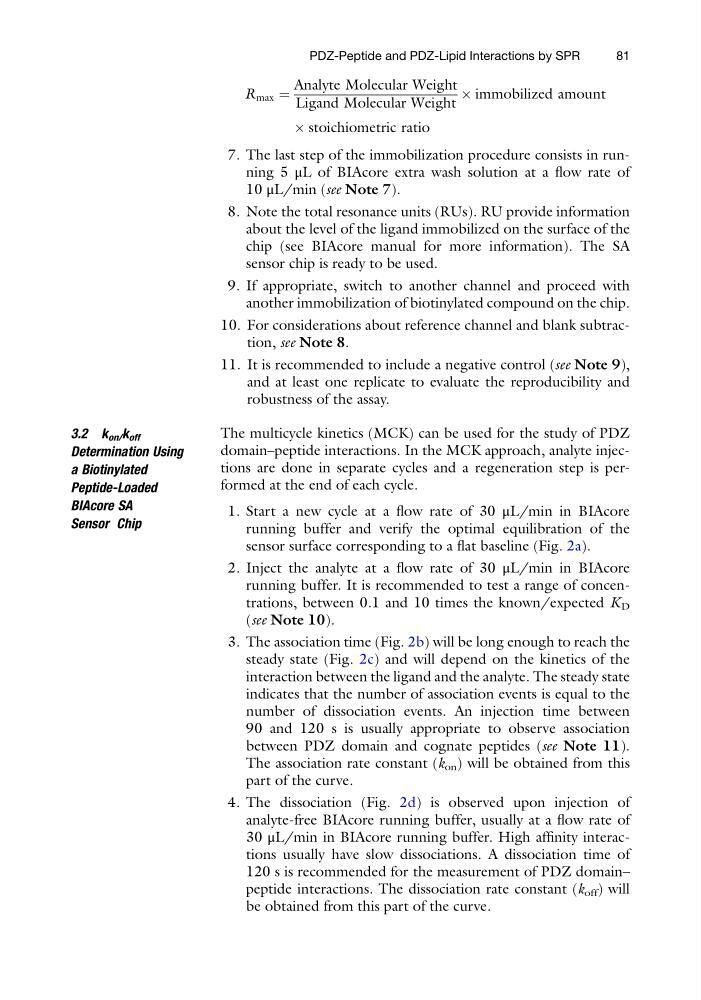
R max ¼
Analyte Molecular Weight
Ligand Molecular Weight
 immobilized amount
 stoichiometric ratio
7. The last step of the immobilization procedure consists in running 5 μL of BIAcore extra wash solution at a flow rate of
10 μL/min (see Note 7).
8. Note the total resonance units (RUs). RU provide information
about the level of the ligand immobilized on the surface of the
chip (see BIAcore manual for more information). The SA
sensor chip is ready to be used.
9. If appropriate, switch to another channel and proceed with
another immobilization of biotinylated compound on the chip.
10. For considerations about reference channel and blank subtraction, see Note 8.
11. It is recommended to include a negative control (see Note 9),
and at least one replicate to evaluate the reproducibility and
robustness of the assay.
3.2 k on/ k off
Determination Using
a Biotinylated
Peptide-Loaded
BIAcore SA
Sensor Chip
The multicycle kinetics (MCK) can be used for the study of PDZ
domain–peptide interactions. In the MCK approach, analyte injections are done in separate cycles and a regeneration step is performed at the end of each cycle.
1. Start a new cycle at a flow rate of 30 μL/min in BIAcore
running buffer and verify the optimal equilibration of the
sensor surface corresponding to a flat baseline (Fig. 2a).
2. Inject the analyte at a flow rate of 30 μL/min in BIAcore
running buffer. It is recommended to test a range of concentrations, between 0.1 and 10 times the known/expected K D
(see Note 10).
3. The association time (Fig. 2b) will be long enough to reach the
steady state (Fig. 2c) and will depend on the kinetics of the
interaction between the ligand and the analyte. The steady state
indicates that the number of association events is equal to the
number of dissociation events. An injection time between
90 and 120 s is usually appropriate to observe association
between PDZ domain and cognate peptides (see Note 11).
The association rate constant (k on ) will be obtained from this
part of the curve.
4. The dissociation (Fig. 2d) is observed upon injection of
analyte-free BIAcore running buffer, usually at a flow rate of
30 μL/min in BIAcore running buffer. High affinity interactions usually have slow dissociations. A dissociation time of
120 s is recommended for the measurement of PDZ domain–
peptide interactions. The dissociation rate constant (k off ) will
be obtained from this part of the curve.
PDZ-Peptide and PDZ-Lipid Interactions by SPR
81
Analyte Molecular Weight
Ligand Molecular Weight
 immobilized amount
 stoichiometric ratio
7. The last step of the immobilization procedure consists in running 5 μL of BIAcore extra wash solution at a flow rate of
10 μL/min (see Note 7).
8. Note the total resonance units (RUs). RU provide information
about the level of the ligand immobilized on the surface of the
chip (see BIAcore manual for more information). The SA
sensor chip is ready to be used.
9. If appropriate, switch to another channel and proceed with
another immobilization of biotinylated compound on the chip.
10. For considerations about reference channel and blank subtraction, see Note 8.
11. It is recommended to include a negative control (see Note 9),
and at least one replicate to evaluate the reproducibility and
robustness of the assay.
3.2 k on/ k off
Determination Using
a Biotinylated
Peptide-Loaded
BIAcore SA
Sensor Chip
The multicycle kinetics (MCK) can be used for the study of PDZ
domain–peptide interactions. In the MCK approach, analyte injections are done in separate cycles and a regeneration step is performed at the end of each cycle.
1. Start a new cycle at a flow rate of 30 μL/min in BIAcore
running buffer and verify the optimal equilibration of the
sensor surface corresponding to a flat baseline (Fig. 2a).
2. Inject the analyte at a flow rate of 30 μL/min in BIAcore
running buffer. It is recommended to test a range of concentrations, between 0.1 and 10 times the known/expected K D
(see Note 10).
3. The association time (Fig. 2b) will be long enough to reach the
steady state (Fig. 2c) and will depend on the kinetics of the
interaction between the ligand and the analyte. The steady state
indicates that the number of association events is equal to the
number of dissociation events. An injection time between
90 and 120 s is usually appropriate to observe association
between PDZ domain and cognate peptides (see Note 11).
The association rate constant (k on ) will be obtained from this
part of the curve.
4. The dissociation (Fig. 2d) is observed upon injection of
analyte-free BIAcore running buffer, usually at a flow rate of
30 μL/min in BIAcore running buffer. High affinity interactions usually have slow dissociations. A dissociation time of
120 s is recommended for the measurement of PDZ domain–
peptide interactions. The dissociation rate constant (k off ) will
be obtained from this part of the curve.
PDZ-Peptide and PDZ-Lipid Interactions by SPR
81