

interacting hotspots. Despite the fact that PDZ domains are poorly
suited for the development of small organic probes, different studies were reported in which inhibitor compounds were discovered.
The ultimate goals are to develop probes to decipher PDZ-related
biology and potential therapeutic drugs that target PDZ domains.
However, most compounds exhibited inhibition in the 10 micromolar range, despite intensive structure–activity relationship (SAR)
studies where close analogs are synthesized and tested. These compounds were discovered using either a screening-based strategy,
molecular modeling experiment or a combination of both
approaches. Currently reported PDZ inhibitors are quickly
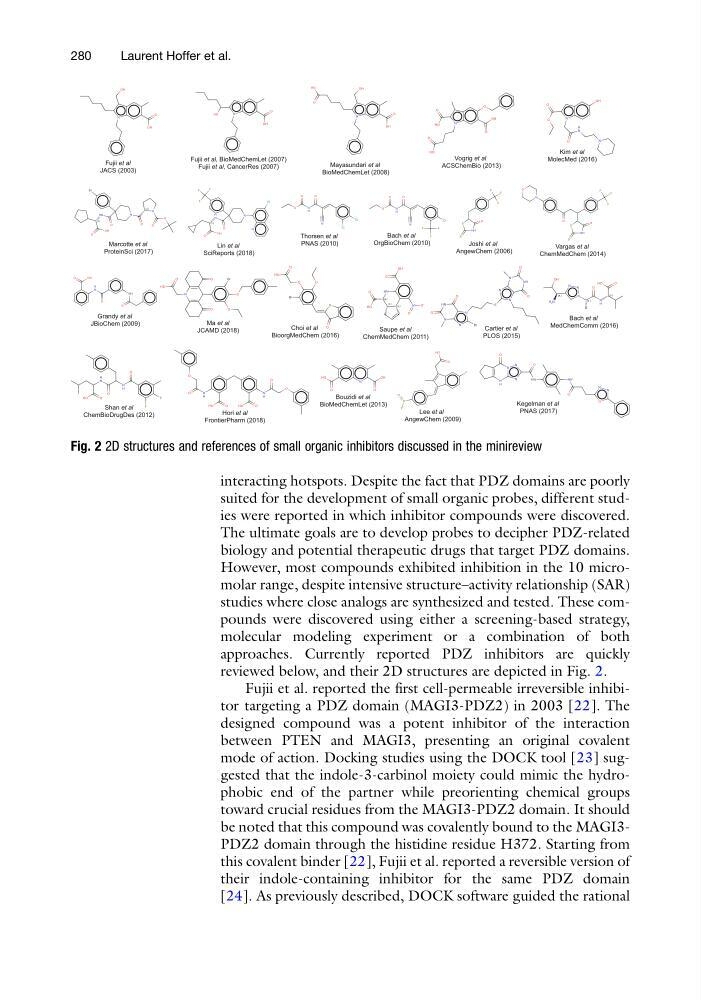
reviewed below, and their 2D structures are depicted in Fig. 2.
Fujii et al. reported the first cell-permeable irreversible inhibitor targeting a PDZ domain (MAGI3-PDZ2) in 2003 [22]. The
designed compound was a potent inhibitor of the interaction
between PTEN and MAGI3, presenting an original covalent
mode of action. Docking studies using the DOCK tool [23] suggested that the indole-3-carbinol moiety could mimic the hydrophobic end of the partner while preorienting chemical groups
toward crucial residues from the MAGI3-PDZ2 domain. It should
be noted that this compound was covalently bound to the MAGI3PDZ2 domain through the histidine residue H372. Starting from
this covalent binder [22], Fujii et al. reported a reversible version of
their indole-containing inhibitor for the same PDZ domain
[24]. As previously described, DOCK software guided the rational
Lin et al
SciReports (2018)
Thorsen et al
PNAS (2010)
Bach et al
OrgBioChem (2010)
Vargas et al
ChemMedChem (2014)
Joshi et al
AngewChem (2006)
Vogrig et al
ACSChemBio (2013)
Fujii et al
JACS (2003)
Fujii et al, BioMedChemLet (2007)
Fujii et al, CancerRes (2007)
Kim et al
MolecMed (2016)
Shan et al
ChemBioDrugDes (2012)
Hori et al
FrontierPharm (2018)
Bouzidi et al
BioMedChemLet (2013)
Kegelman et al
PNAS (2017)
Grandy et al
JBioChem (2009)
Ma et al
JCAMD (2018)
Choi et al
BioorgMedChem (2016)
Saupe et al
ChemMedChem (2011)
Cartier et al
PLOS (2015)
Bach et al
MedChemComm (2016)
Mayasundari et al
BioMedChemLet (2008)
Marcotte et al
ProteinSci (2017)
Lee et al
AngewChem (2009)
Fig. 2 2D structures and references of small organic inhibitors discussed in the minireview
280
Laurent Hoffer et al.
suited for the development of small organic probes, different studies were reported in which inhibitor compounds were discovered.
The ultimate goals are to develop probes to decipher PDZ-related
biology and potential therapeutic drugs that target PDZ domains.
However, most compounds exhibited inhibition in the 10 micromolar range, despite intensive structure–activity relationship (SAR)
studies where close analogs are synthesized and tested. These compounds were discovered using either a screening-based strategy,
molecular modeling experiment or a combination of both
approaches. Currently reported PDZ inhibitors are quickly
reviewed below, and their 2D structures are depicted in Fig. 2.
Fujii et al. reported the first cell-permeable irreversible inhibitor targeting a PDZ domain (MAGI3-PDZ2) in 2003 [22]. The
designed compound was a potent inhibitor of the interaction
between PTEN and MAGI3, presenting an original covalent
mode of action. Docking studies using the DOCK tool [23] suggested that the indole-3-carbinol moiety could mimic the hydrophobic end of the partner while preorienting chemical groups
toward crucial residues from the MAGI3-PDZ2 domain. It should
be noted that this compound was covalently bound to the MAGI3PDZ2 domain through the histidine residue H372. Starting from
this covalent binder [22], Fujii et al. reported a reversible version of
their indole-containing inhibitor for the same PDZ domain
[24]. As previously described, DOCK software guided the rational
Lin et al
SciReports (2018)
Thorsen et al
PNAS (2010)
Bach et al
OrgBioChem (2010)
Vargas et al
ChemMedChem (2014)
Joshi et al
AngewChem (2006)
Vogrig et al
ACSChemBio (2013)
Fujii et al
JACS (2003)
Fujii et al, BioMedChemLet (2007)
Fujii et al, CancerRes (2007)
Kim et al
MolecMed (2016)
Shan et al
ChemBioDrugDes (2012)
Hori et al
FrontierPharm (2018)
Bouzidi et al
BioMedChemLet (2013)
Kegelman et al
PNAS (2017)
Grandy et al
JBioChem (2009)
Ma et al
JCAMD (2018)
Choi et al
BioorgMedChem (2016)
Saupe et al
ChemMedChem (2011)
Cartier et al
PLOS (2015)
Bach et al
MedChemComm (2016)
Mayasundari et al
BioMedChemLet (2008)
Marcotte et al
ProteinSci (2017)
Lee et al
AngewChem (2009)
Fig. 2 2D structures and references of small organic inhibitors discussed in the minireview
280
Laurent Hoffer et al.