

protein-95/Disks large/Zonula occludens-1 (PDZ) domain proteins bind to their interactors with a low affinity ranging from 1 to
100 μM [3]. In the human proteome, 152 proteins harbor one or
more PDZ domains which bind to a hydrophobic motif located at
the C-terminus of their cognate interactors [4]. Mutation or deletion of the last three amino acids of this motif leads generally to
complete loss of interaction. The role of PDZ domain proteins are
multiple, from the scaffolding of receptors and signaling proteins to
promote efficient signal transduction to the establishment and
maintenance of cellular architecture required for epithelial and
neuronal tissue functions.
In the present chapter, we present a general procedure to
identify PDZ domain proteins associated to TANC1, a protein of
interest bearing a carboxy-terminal PDZ binding motif (PDZBM).
TANC1 is a postsynaptic scaffold protein [5] which regulates spatial
memory and embryonic development [6]. It contains TPR and
ankyrin repeat domains and a PDZBM (SNV) located at its
C-terminus (Fig. 2a). Our approach is based on the comparative
purification of protein complexes associated to wild type TANC1 or
Beads
Beads
Relatiive
abundance
m/z
200
400
600
800
286.8
432.2
456.3
810.7
Immobilization
Washing
Elution
Mass spectrometry
analysis
Associated
proteins
Non specific
proteins
FLAG tag
Silver staining
Beads
Beads
Beads
Cross linking
Binding
Protein lysate
Washing
Elution
Quantification
Protein network
Peptide:
log2 (Bait vs Ctl)
-Log10 (p-value)
Protein:
PDZ binding
motif
PDZ binding
motif
Beads
Beads
+
Immunopurification:
Peptide-based purification:
ANTI-FLAG® M2
Affinity Gel
Gel stack
10%
90%
Quality control
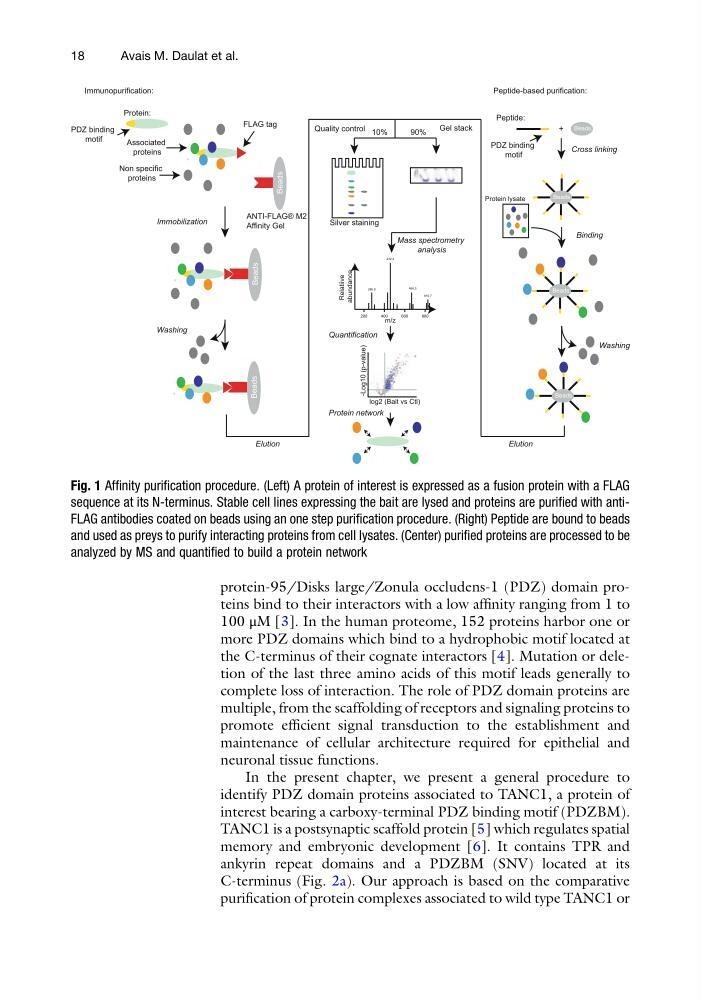
Fig. 1 Affinity purification procedure. (Left) A protein of interest is expressed as a fusion protein with a FLAG
sequence at its N-terminus. Stable cell lines expressing the bait are lysed and proteins are purified with antiFLAG antibodies coated on beads using an one step purification procedure. (Right) Peptide are bound to beads
and used as preys to purify interacting proteins from cell lysates. (Center) purified proteins are processed to be
analyzed by MS and quantified to build a protein network
18
Avais M. Daulat et al.
100 μM [3]. In the human proteome, 152 proteins harbor one or
more PDZ domains which bind to a hydrophobic motif located at
the C-terminus of their cognate interactors [4]. Mutation or deletion of the last three amino acids of this motif leads generally to
complete loss of interaction. The role of PDZ domain proteins are
multiple, from the scaffolding of receptors and signaling proteins to
promote efficient signal transduction to the establishment and
maintenance of cellular architecture required for epithelial and
neuronal tissue functions.
In the present chapter, we present a general procedure to
identify PDZ domain proteins associated to TANC1, a protein of
interest bearing a carboxy-terminal PDZ binding motif (PDZBM).
TANC1 is a postsynaptic scaffold protein [5] which regulates spatial
memory and embryonic development [6]. It contains TPR and
ankyrin repeat domains and a PDZBM (SNV) located at its
C-terminus (Fig. 2a). Our approach is based on the comparative
purification of protein complexes associated to wild type TANC1 or
Beads
Beads
Relatiive
abundance
m/z
200
400
600
800
286.8
432.2
456.3
810.7
Immobilization
Washing
Elution
Mass spectrometry
analysis
Associated
proteins
Non specific
proteins
FLAG tag
Silver staining
Beads
Beads
Beads
Cross linking
Binding
Protein lysate
Washing
Elution
Quantification
Protein network
Peptide:
log2 (Bait vs Ctl)
-Log10 (p-value)
Protein:
PDZ binding
motif
PDZ binding
motif
Beads
Beads
+
Immunopurification:
Peptide-based purification:
ANTI-FLAG® M2
Affinity Gel
Gel stack
10%
90%
Quality control
Fig. 1 Affinity purification procedure. (Left) A protein of interest is expressed as a fusion protein with a FLAG
sequence at its N-terminus. Stable cell lines expressing the bait are lysed and proteins are purified with antiFLAG antibodies coated on beads using an one step purification procedure. (Right) Peptide are bound to beads
and used as preys to purify interacting proteins from cell lysates. (Center) purified proteins are processed to be
analyzed by MS and quantified to build a protein network
18
Avais M. Daulat et al.