

2.2.2 Stage 1: Flattening
the Unbound State
MC will be run for the unbound state with the protMC program,
controlled by a configuration file adapt.conf. Since we plan to
mutate the peptide, the unbound simulation will correspond to
the peptide alone. If we wanted to mutate the protein, we would
simulate the protein alone. The file adapt.conf indicates which
mutations are allowed for positions that are active (four peptide
positions in our application [22]). During the adaptation, it is best
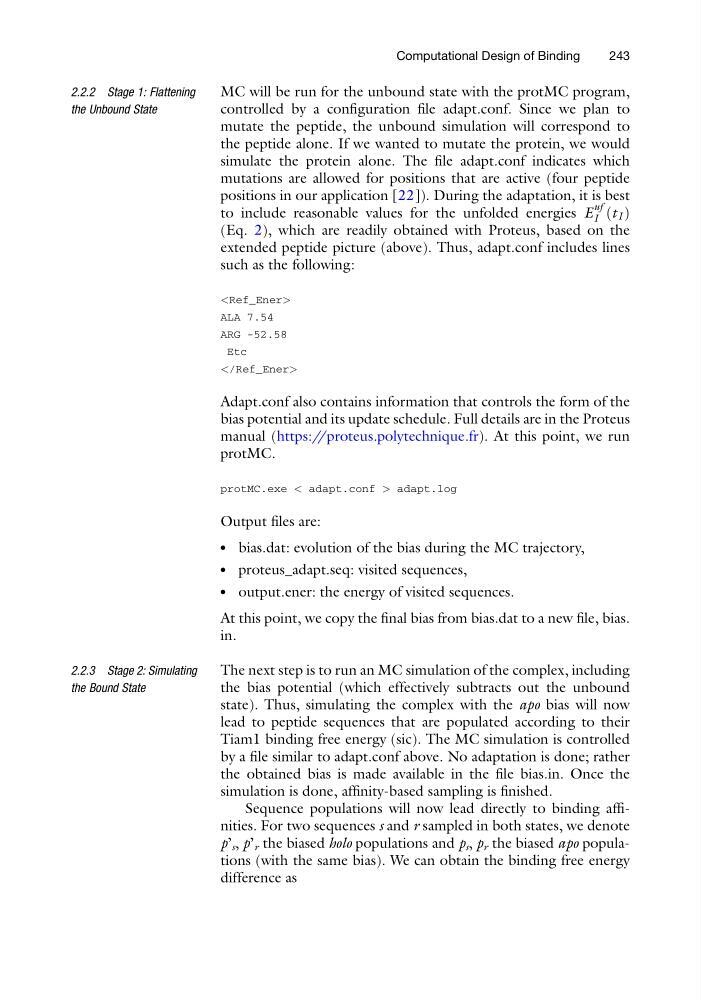
to include reasonable values for the unfolded energies E
uf
I t I
ð Þ
(Eq. 2), which are readily obtained with Proteus, based on the
extended peptide picture (above). Thus, adapt.conf includes lines
such as the following:
ALA 7.54
ARG -52.58
Etc
Adapt.conf also contains information that controls the form of the
bias potential and its update schedule. Full details are in the Proteus
manual (https://proteus.polytechnique.fr). At this point, we run
protMC.
protMC.exe < adapt.conf > adapt.log
Output files are:
l
bias.dat: evolution of the bias during the MC trajectory,
l
proteus_adapt.seq: visited sequences,
l
output.ener: the energy of visited sequences.
At this point, we copy the final bias from bias.dat to a new file, bias.
in.
2.2.3 Stage 2: Simulating
the Bound State
The next step is to run an MC simulation of the complex, including
the bias potential (which effectively subtracts out the unbound
state). Thus, simulating the complex with the apo bias will now
lead to peptide sequences that are populated according to their
Tiam1 binding free energy (sic). The MC simulation is controlled
by a file similar to adapt.conf above. No adaptation is done; rather
the obtained bias is made available in the file bias.in. Once the
simulation is done, affinity-based sampling is finished.
Sequence populations will now lead directly to binding affinities. For two sequences s and r sampled in both states, we denote
p’ s , p’ r the biased holo populations and p s , p r the biased apo populations (with the same bias). We can obtain the binding free energy
difference as
Computational Design of Binding
243
the Unbound State
MC will be run for the unbound state with the protMC program,
controlled by a configuration file adapt.conf. Since we plan to
mutate the peptide, the unbound simulation will correspond to
the peptide alone. If we wanted to mutate the protein, we would
simulate the protein alone. The file adapt.conf indicates which
mutations are allowed for positions that are active (four peptide
positions in our application [22]). During the adaptation, it is best
to include reasonable values for the unfolded energies E
uf
I t I
ð Þ
(Eq. 2), which are readily obtained with Proteus, based on the
extended peptide picture (above). Thus, adapt.conf includes lines
such as the following:
ALA 7.54
ARG -52.58
Etc
Adapt.conf also contains information that controls the form of the
bias potential and its update schedule. Full details are in the Proteus
manual (https://proteus.polytechnique.fr). At this point, we run
protMC.
protMC.exe < adapt.conf > adapt.log
Output files are:
l
bias.dat: evolution of the bias during the MC trajectory,
l
proteus_adapt.seq: visited sequences,
l
output.ener: the energy of visited sequences.
At this point, we copy the final bias from bias.dat to a new file, bias.
in.
2.2.3 Stage 2: Simulating
the Bound State
The next step is to run an MC simulation of the complex, including
the bias potential (which effectively subtracts out the unbound
state). Thus, simulating the complex with the apo bias will now
lead to peptide sequences that are populated according to their
Tiam1 binding free energy (sic). The MC simulation is controlled
by a file similar to adapt.conf above. No adaptation is done; rather
the obtained bias is made available in the file bias.in. Once the
simulation is done, affinity-based sampling is finished.
Sequence populations will now lead directly to binding affinities. For two sequences s and r sampled in both states, we denote
p’ s , p’ r the biased holo populations and p s , p r the biased apo populations (with the same bias). We can obtain the binding free energy
difference as
Computational Design of Binding
243