

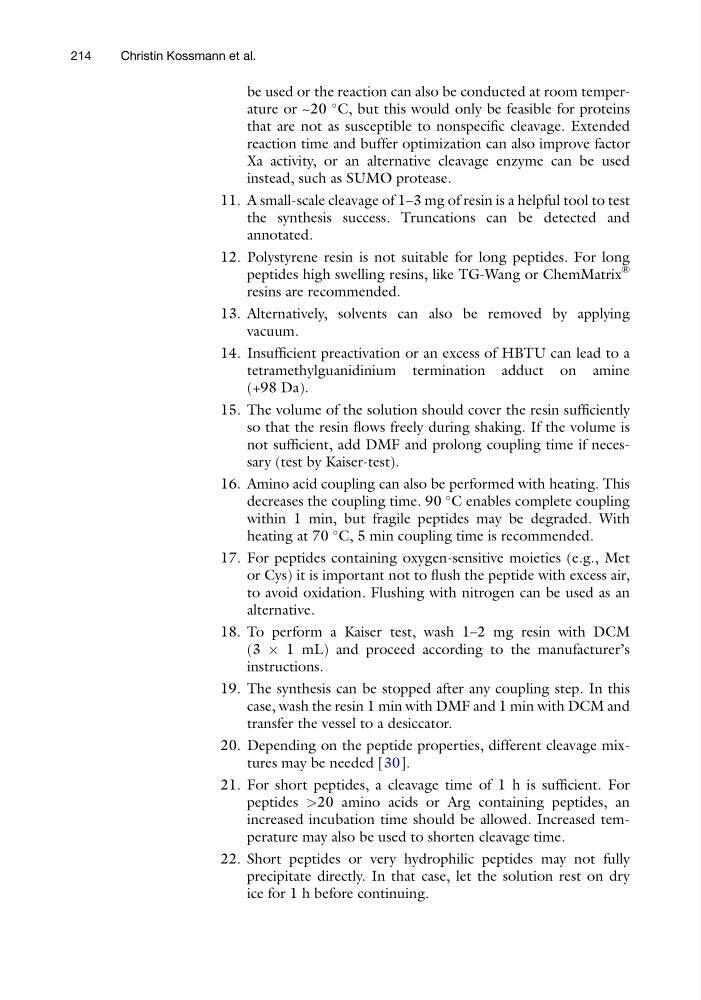
be used or the reaction can also be conducted at room temperature or ~20
C, but this would only be feasible for proteins
that are not as susceptible to nonspecific cleavage. Extended
reaction time and buffer optimization can also improve factor
Xa activity, or an alternative cleavage enzyme can be used
instead, such as SUMO protease.
11. A small-scale cleavage of 1–3 mg of resin is a helpful tool to test
the synthesis success. Truncations can be detected and
annotated.
12. Polystyrene resin is not suitable for long peptides. For long
peptides high swelling resins, like TG-Wang or ChemMatrix
®
resins are recommended.
13. Alternatively, solvents can also be removed by applying
vacuum.
14. Insufficient preactivation or an excess of HBTU can lead to a
tetramethylguanidinium termination adduct on amine
(+98 Da).
15. The volume of the solution should cover the resin sufficiently
so that the resin flows freely during shaking. If the volume is
not sufficient, add DMF and prolong coupling time if necessary (test by Kaiser-test).
16. Amino acid coupling can also be performed with heating. This
decreases the coupling time. 90
C enables complete coupling
within 1 min, but fragile peptides may be degraded. With
heating at 70
C, 5 min coupling time is recommended.
17. For peptides containing oxygen-sensitive moieties (e.g., Met
or Cys) it is important not to flush the peptide with excess air,
to avoid oxidation. Flushing with nitrogen can be used as an
alternative.
18. To perform a Kaiser test, wash 1–2 mg resin with DCM
(3 Â 1 mL) and proceed according to the manufacturer’s
instructions.
19. The synthesis can be stopped after any coupling step. In this
case, wash the resin 1 min with DMF and 1 min with DCM and
transfer the vessel to a desiccator.
20. Depending on the peptide properties, different cleavage mixtures may be needed [30].
21. For short peptides, a cleavage time of 1 h is sufficient. For
peptides >20 amino acids or Arg containing peptides, an
increased incubation time should be allowed. Increased temperature may also be used to shorten cleavage time.
22. Short peptides or very hydrophilic peptides may not fully
precipitate directly. In that case, let the solution rest on dry
ice for 1 h before continuing.
214
Christin Kossmann et al.
C, but this would only be feasible for proteins
that are not as susceptible to nonspecific cleavage. Extended
reaction time and buffer optimization can also improve factor
Xa activity, or an alternative cleavage enzyme can be used
instead, such as SUMO protease.
11. A small-scale cleavage of 1–3 mg of resin is a helpful tool to test
the synthesis success. Truncations can be detected and
annotated.
12. Polystyrene resin is not suitable for long peptides. For long
peptides high swelling resins, like TG-Wang or ChemMatrix
®
resins are recommended.
13. Alternatively, solvents can also be removed by applying
vacuum.
14. Insufficient preactivation or an excess of HBTU can lead to a
tetramethylguanidinium termination adduct on amine
(+98 Da).
15. The volume of the solution should cover the resin sufficiently
so that the resin flows freely during shaking. If the volume is
not sufficient, add DMF and prolong coupling time if necessary (test by Kaiser-test).
16. Amino acid coupling can also be performed with heating. This
decreases the coupling time. 90
C enables complete coupling
within 1 min, but fragile peptides may be degraded. With
heating at 70
C, 5 min coupling time is recommended.
17. For peptides containing oxygen-sensitive moieties (e.g., Met
or Cys) it is important not to flush the peptide with excess air,
to avoid oxidation. Flushing with nitrogen can be used as an
alternative.
18. To perform a Kaiser test, wash 1–2 mg resin with DCM
(3 Â 1 mL) and proceed according to the manufacturer’s
instructions.
19. The synthesis can be stopped after any coupling step. In this
case, wash the resin 1 min with DMF and 1 min with DCM and
transfer the vessel to a desiccator.
20. Depending on the peptide properties, different cleavage mixtures may be needed [30].
21. For short peptides, a cleavage time of 1 h is sufficient. For
peptides >20 amino acids or Arg containing peptides, an
increased incubation time should be allowed. Increased temperature may also be used to shorten cleavage time.
22. Short peptides or very hydrophilic peptides may not fully
precipitate directly. In that case, let the solution rest on dry
ice for 1 h before continuing.
214
Christin Kossmann et al.