

2. 100 mM ATP stock solution. Dissolve 10 mg ATP disodiumsalt hydrate in 180 μl Milli-Q water. Store at À20
C in 60 μl
aliquots.
3. RSK1-T573E 411–735 is a constitutively active T573E mutant
version of the C-terminal kinase domain (N411-L735) of
RSK1. Pure RSK1-T573E 411–735 can be obtained through a
tandem purification approach using GST- and Ni
2+
-affinity
chromatography sequential steps as described elsewhere
[14]. Upon mixing with 20% glycerol, 100 μM TCEP (reducing agent) and adjusting its final concentration to 50 μM, the
recombinant RSK1-T573E 411–735 protein is distributed in
500 μl aliquots that are subsequently frozen in liquid nitrogen
and stored at À80
C.
4. 1 mM RSK1 683–735 stock solution. The C-terminal peptide of
RSK1 (RSK1 683–735 ) can either be chemically synthesized or
produced as a recombinantly expressed fragment with an
N-terminal cleavable GST tag. To prepare a 1 mM stock solution of RSK1 683–735 , dissolve approximately 7.2 mg lyophilized
peptide in 1 ml phosphorylation buffer (buffer A). Adjust the
pH to 7.5. Store at À20
C in 500 μl aliquots [14].
5. Eluent A: 0.1% (v/v) trifluoroacetic acid (TFA) solution. Add
1 l Milli-Q water into a graduated cylinder then supplement it
with 1 ml TFA.
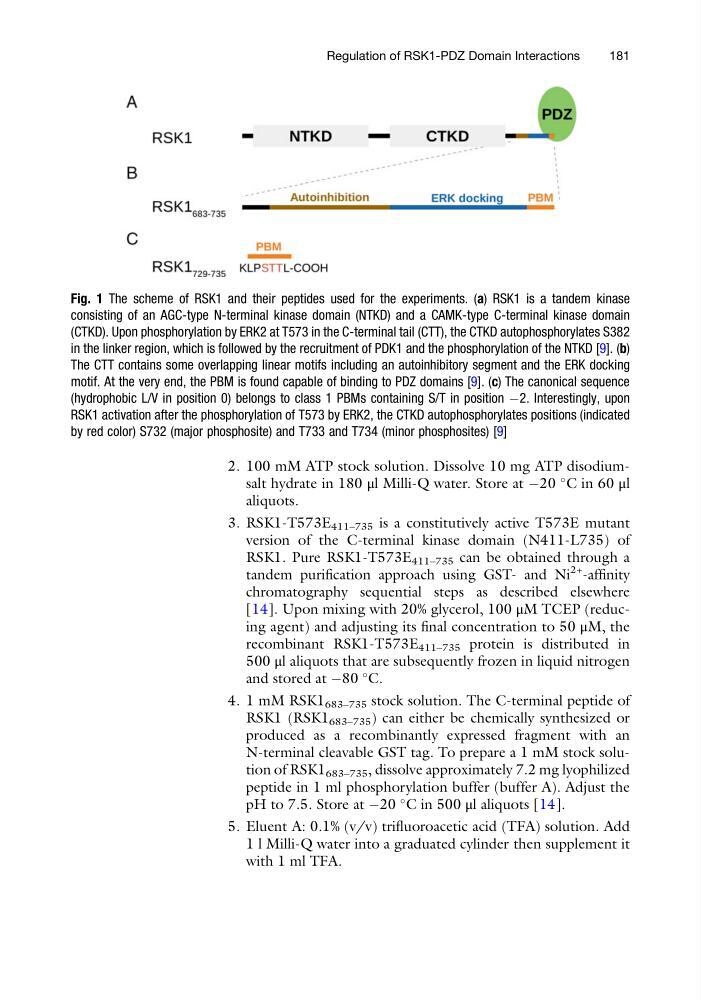
Fig. 1 The scheme of RSK1 and their peptides used for the experiments. (a) RSK1 is a tandem kinase
consisting of an AGC-type N-terminal kinase domain (NTKD) and a CAMK-type C-terminal kinase domain
(CTKD). Upon phosphorylation by ERK2 at T573 in the C-terminal tail (CTT), the CTKD autophosphorylates S382
in the linker region, which is followed by the recruitment of PDK1 and the phosphorylation of the NTKD [9]. (b)
The CTT contains some overlapping linear motifs including an autoinhibitory segment and the ERK docking
motif. At the very end, the PBM is found capable of binding to PDZ domains [9]. (c) The canonical sequence
(hydrophobic L/V in position 0) belongs to class 1 PBMs containing S/T in position À2. Interestingly, upon
RSK1 activation after the phosphorylation of T573 by ERK2, the CTKD autophosphorylates positions (indicated
by red color) S732 (major phosphosite) and T733 and T734 (minor phosphosites) [9]
Regulation of RSK1-PDZ Domain Interactions
181
C in 60 μl
aliquots.
3. RSK1-T573E 411–735 is a constitutively active T573E mutant
version of the C-terminal kinase domain (N411-L735) of
RSK1. Pure RSK1-T573E 411–735 can be obtained through a
tandem purification approach using GST- and Ni
2+
-affinity
chromatography sequential steps as described elsewhere
[14]. Upon mixing with 20% glycerol, 100 μM TCEP (reducing agent) and adjusting its final concentration to 50 μM, the
recombinant RSK1-T573E 411–735 protein is distributed in
500 μl aliquots that are subsequently frozen in liquid nitrogen
and stored at À80
C.
4. 1 mM RSK1 683–735 stock solution. The C-terminal peptide of
RSK1 (RSK1 683–735 ) can either be chemically synthesized or
produced as a recombinantly expressed fragment with an
N-terminal cleavable GST tag. To prepare a 1 mM stock solution of RSK1 683–735 , dissolve approximately 7.2 mg lyophilized
peptide in 1 ml phosphorylation buffer (buffer A). Adjust the
pH to 7.5. Store at À20
C in 500 μl aliquots [14].
5. Eluent A: 0.1% (v/v) trifluoroacetic acid (TFA) solution. Add
1 l Milli-Q water into a graduated cylinder then supplement it
with 1 ml TFA.
Fig. 1 The scheme of RSK1 and their peptides used for the experiments. (a) RSK1 is a tandem kinase
consisting of an AGC-type N-terminal kinase domain (NTKD) and a CAMK-type C-terminal kinase domain
(CTKD). Upon phosphorylation by ERK2 at T573 in the C-terminal tail (CTT), the CTKD autophosphorylates S382
in the linker region, which is followed by the recruitment of PDK1 and the phosphorylation of the NTKD [9]. (b)
The CTT contains some overlapping linear motifs including an autoinhibitory segment and the ERK docking
motif. At the very end, the PBM is found capable of binding to PDZ domains [9]. (c) The canonical sequence
(hydrophobic L/V in position 0) belongs to class 1 PBMs containing S/T in position À2. Interestingly, upon
RSK1 activation after the phosphorylation of T573 by ERK2, the CTKD autophosphorylates positions (indicated
by red color) S732 (major phosphosite) and T733 and T734 (minor phosphosites) [9]
Regulation of RSK1-PDZ Domain Interactions
181