

Shake for 4 h, drain and flow-wash consecutively with THF,
MeOH, DCM, and THF (see Fig. 3, step 2.2).
4. Treat the resin (2 mmol) with triphenylphosphine (PPh 3 ,
10 mmol) in THF (5 mL) and HO-PEG 2 -CH 2 CH 2 COOtBu
(10 mmol) in THF (5 mL) under N 2 atmosphere. Add dropwise diisopropyl azodicarboxylate (DIAD, 10 mmol) and shake
for 1 h (see Fig. 3, step 2.3).
5. Wash the resin with THF and DCM, dry under vacuum and
treat with cleavage cocktail for 2.5 h. Collect the TFA-mixture
and wash the resin with TFA and DCM. Evaporate the combined TFA/DCM fractions and coevaporate with diethyl ether
(2 Â 30 mL) (see Fig. 3, step 3).
6. Dissolve the final product in water–MeCN (75/25, 100 mL)
and lyophilize to provide Ns-NPEG4 linker.
3.2.3 Synthesis
of TAT-N-Dimeric Peptide
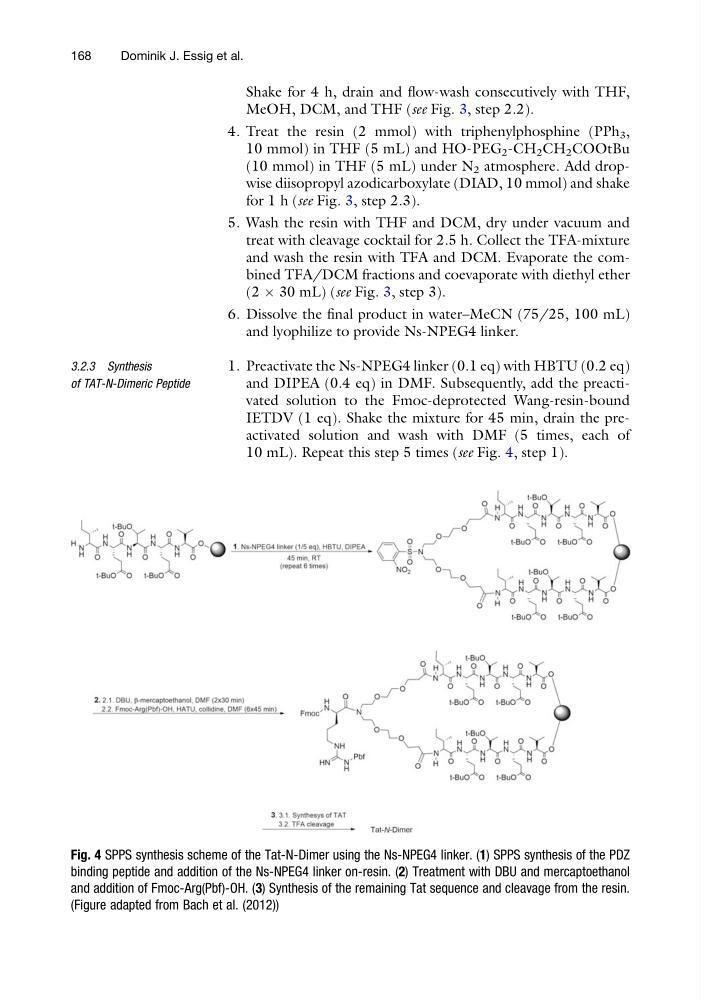
1. Preactivate the Ns-NPEG4 linker (0.1 eq) with HBTU (0.2 eq)
and DIPEA (0.4 eq) in DMF. Subsequently, add the preactivated solution to the Fmoc-deprotected Wang-resin-bound
IETDV (1 eq). Shake the mixture for 45 min, drain the preactivated solution and wash with DMF (5 times, each of
10 mL). Repeat this step 5 times (see Fig. 4, step 1).
Fig. 4 SPPS synthesis scheme of the Tat-N-Dimer using the Ns-NPEG4 linker. (1) SPPS synthesis of the PDZ
binding peptide and addition of the Ns-NPEG4 linker on-resin. (2) Treatment with DBU and mercaptoethanol
and addition of Fmoc-Arg(Pbf)-OH. (3) Synthesis of the remaining Tat sequence and cleavage from the resin.
(Figure adapted from Bach et al. (2012))
168
Dominik J. Essig et al.
MeOH, DCM, and THF (see Fig. 3, step 2.2).
4. Treat the resin (2 mmol) with triphenylphosphine (PPh 3 ,
10 mmol) in THF (5 mL) and HO-PEG 2 -CH 2 CH 2 COOtBu
(10 mmol) in THF (5 mL) under N 2 atmosphere. Add dropwise diisopropyl azodicarboxylate (DIAD, 10 mmol) and shake
for 1 h (see Fig. 3, step 2.3).
5. Wash the resin with THF and DCM, dry under vacuum and
treat with cleavage cocktail for 2.5 h. Collect the TFA-mixture
and wash the resin with TFA and DCM. Evaporate the combined TFA/DCM fractions and coevaporate with diethyl ether
(2 Â 30 mL) (see Fig. 3, step 3).
6. Dissolve the final product in water–MeCN (75/25, 100 mL)
and lyophilize to provide Ns-NPEG4 linker.
3.2.3 Synthesis
of TAT-N-Dimeric Peptide
1. Preactivate the Ns-NPEG4 linker (0.1 eq) with HBTU (0.2 eq)
and DIPEA (0.4 eq) in DMF. Subsequently, add the preactivated solution to the Fmoc-deprotected Wang-resin-bound
IETDV (1 eq). Shake the mixture for 45 min, drain the preactivated solution and wash with DMF (5 times, each of
10 mL). Repeat this step 5 times (see Fig. 4, step 1).
Fig. 4 SPPS synthesis scheme of the Tat-N-Dimer using the Ns-NPEG4 linker. (1) SPPS synthesis of the PDZ
binding peptide and addition of the Ns-NPEG4 linker on-resin. (2) Treatment with DBU and mercaptoethanol
and addition of Fmoc-Arg(Pbf)-OH. (3) Synthesis of the remaining Tat sequence and cleavage from the resin.
(Figure adapted from Bach et al. (2012))
168
Dominik J. Essig et al.